
Decorate a quiet study room by organizing floor-to-ceiling bookcases with 11-14 inch shelf spacing, setting up a 30-inch desk with anti-glare 4000K task lighting, hanging linen cork pinboards for research notes, and maintaining acoustic dampening with area rugs.
At a Glance: Key Takeaways
- Study room decoration prioritizes acoustic absorption and visual calm.
- Bookshelves should categorize books by topic and spine color for order.
- Linen-wrapped cork pinboards consolidate active research notes and schedules.
- Layered wool rugs and heavy drapes reduce echo for quiet reading.
In-Depth Guides in this Directory
Explore specialized subtopic blueprints, technical dimensions, and execution checklists:
Small Study Room Decor: Compact Bookcase & Desk Planning
Maximize small study rooms and reading nooks with vertical bookcases, wall-mounted drop-leaf desks, compact task lamps, and spatial tricks.
Study Room Lighting: Anti-Glare Reading & Task Illumination
Plan study room lighting: anti-glare desk lamps, Kelvin color selection (4000K), asymmetric reading beams, and bookshelf accent lights.
Study Room Storage: Document Organization & Cabinets
Organize study rooms with lateral file cabinets, modular bookshelf bins, magazine holders, paper trays, and locked document storage.
1. The Academic Sanctuary: Design Philosophy & Spatial Ergonomics
A dedicated study room represents a distinct architectural challenge fundamentally different from a commercial open-plan office or an informal laptop nook. While modern home offices are often designed around teleconferencing backdrops and multi-monitor computer rigs, an authentic study room functions as a cognitive sanctuary engineered for deep reading, academic research, reflective writing, and intellectual rigor. The physical environment directly influences neurocognitive performance, mental stamina, and stress levels. Every spatial dimension, acoustic surface, and light fixture must serve the central objective of uninterrupted mental immersion.
Architectural spatial zoning in a study room must address four core functional zones: the primary intellectual workstation (writing and computing desk), the reference repository (library bookcases and archive cabinets), the secondary contemplative reading zone (an ergonomic armchair paired with dedicated task lighting), and the tactile ideation wall (large-format pinboards, slate chalkboards, or dry-erase planning planes). In rooms measuring 120 square feet or greater, separating the active computer desk from an analog reading chair encourages distinct psychological states, preventing cognitive fatigue caused by continuous screen proximity.
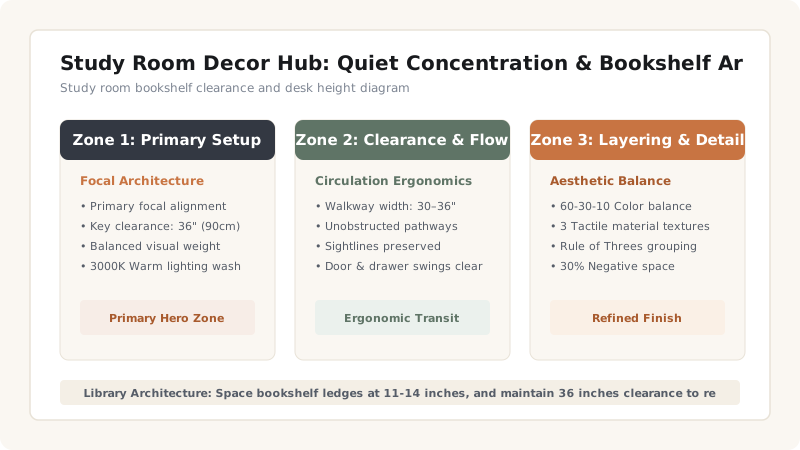
Spatial flow requires strict clearance standards to preserve visual serenity. Maintain a minimum perimeter clearance of 36 to 42 inches between the primary study desk and perimeter bookcases to allow effortless browsing and ladder access. Desks positioned facing into the room—utilizing the architectural 'command position' where the occupant commands a clear sightline of the primary entrance without sitting directly in line with high-traffic doorway drafts—engender psychological security and reduce subconscious startle reflexes during intense study intervals.
2. Library Bookshelf Architecture & Structural Specifications
Bookcases in an academic study room are not merely decorative shelving units; they are heavy structural elements that define the vertical volume and acoustic character of the room. A full linear foot of hardcover academic textbooks, legal volumes, or art monographs weighs between 25 and 45 pounds. Standard commercial flat-pack bookcases manufactured with 1/2-inch particleboard inevitably suffer catastrophic deflection (permanent shelf sagging) when loaded with comprehensive libraries.
To engineer permanent, heirloom-grade study library shelving, adhere strictly to structural span equations. For solid hardwoods such as North American white oak, walnut, or rock maple, an unsupported shelf span should never exceed 36 inches for a 3/4-inch thickness, or 48 inches when utilizing 1-inch thick stock. When specifying high-density cabinet-grade Baltic birch plywood or veneered MDF, unsupported spans must be restricted to 30 to 32 inches, or reinforced with a 1.5-inch solid hardwood front face frame that acts as a structural stiffening flange. Shelf depth must be categorized deliberately:
- Standard Octavo & Paperbacks: 8 to 9 inches shelf depth, with 10 to 11 inches clear vertical height spacing.
- Quarto & Standard Hardcovers: 10 to 11 inches shelf depth, with 12 to 13 inches clear vertical height spacing.
- Folio, Art Volumes & Law Binders: 12 to 14 inches shelf depth, with 14 to 16 inches clear vertical height spacing.
Always anchor full-height shelving assemblies directly into wall studs using heavy-gauge L-brackets or through-cabinet screws rated for minimum 150 lbs tensile withdrawal resistance to ensure absolute structural safety during seismic shifts or incidental climbing contact.
3. Material Selection, Acoustic Engineering & Tactile Finishes
The material palette of a study room plays a vital dual role: establishing tactile dignity while providing essential acoustic dampening. High-frequency reverberation (echo) in a room lined with reflective plaster walls, bare hardwood floors, and hard glass desktop surfaces increases auditory strain and significantly reduces comprehension speed during technical reading. An acoustically optimized study achieves a target Noise Reduction Coefficient (NRC) between 0.50 and 0.70 across the room envelope.
Incorporate generous porous materials strategically across the room. Acoustic floor conditioning begins with an 8x10 or 9x12 foot natural wool area rug placed over a dense 1/2-inch felt rug pad. Wool fibers offer natural flame retardancy, exceptional durability against caster wheels, and an NRC rating of approximately 0.35. For window fenestration, avoid thin plastic blinds; select floor-to-ceiling lined linen drapes, heavy cotton velvet, or wool-flannel blackout curtains that absorb external traffic rumble while sealing window perimeter thermal leaks.
For primary desktop surfaces, natural wood with a low-sheen, matte penetrating hardwax oil finish (such as Rubio Monocoat or Osmo Polyx) is vastly superior to high-gloss polyurethane lacquers. High-gloss desk tops reflect overhead lamp glare directly into the reader's retinas, inducing ocular headaches and premature eye fatigue. Matte linoleum desktop surfacing (such as Forbo Furniture Linoleum) provides an extraordinary, warm, self-healing writing surface that softens writing pen pressure and insulates against forearm thermal shock during prolonged winter writing sessions.
4. Circadian Task Lighting & Glare-Mitigation Protocols
Illumination engineering for reading and writing requires balancing ambient background lux with targeted task illumination. Relying solely on high-mounted recessed ceiling cans creates harsh, sharp downward shadows over writing hands and forces pupils to constantly dilate and constrict when shifting eyes between bright white paper sheets and dark floor zones.
Implement a balanced three-tier circadian lighting strategy:
- Ambient Diffused Base (150-200 Lux): Provided by indirect ceiling wash fixtures, dimmable cove LED coving, or a fabric-shaded central pendant equipped with 2700K to 3000K warm-white LED lamps boasting a Color Rendering Index (CRI) of 95 or greater.
- Adjustable Articulated Task Light (400-500 Lux at Paper Surface): A counterbalance architect arm or brass swing-arm reading lamp positioned strictly opposite the writer's dominant hand (to the left for right-handed writers; to the right for left-handed writers) to completely eliminate cast hand shadows across the active manuscript. Use 4000K neutral white task lighting for daytime technical focus, dimmable to 3000K for evening reading.
- Perimeter Bookshelf Accent Illumination (50-100 Lux): Concealed vertical or continuous horizontal 24V LED aluminum channel extrusions (fitted with frosted opal diffusers) integrated beneath shelf valances to illuminate book spines evenly from top to bottom shelf tiers.
5. Active Ideation Planes, Storage Discipline & Cable Management
Clutter in a study room is primarily psychological friction made physical. When notes, research clippings, and stationery stack haphazardly across a desk surface, cognitive bandwidth is drained by visual disarray. Combat this with dedicated active ideation vertical surfaces and concealed auxiliary storage joinery.
Mount a generous 48x36 inch linen-wrapped natural cork pinboard or magnetic porcelain-enamel steel panel directly adjacent to the writing desk. Unlike raw industrial brown cork, wrapping high-density self-healing 1/4-inch cork over 1/2-inch soundboard with unbleached natural Belgian linen elevates the board into an architectural design installation that softens room echoes while providing a clean tactile canvas for project timelines, citations, and structural outlines.
For technical peripherals (printers, scanners, uninterruptible power supplies, and external backup drives), incorporate a dedicated secondary credenza or lateral file cabinet with integrated internal power strips, cable pass-through grommets, and vented lower cavities. Keep the main desk completely wire-free by channeling laptop chargers and lamp cables through concealed under-desk steel wire troughs or spine raceways.
Study Room Typology & Specification Matrix
Use this reference table to calculate exact physical dimensions, ratios, and specifications before purchasing:
| Study Typology | Square Footage | Desk Proportion | Shelving Assembly | Target Lux Level | Acoustic Treatment |
|---|---|---|---|---|---|
| Compact Reading Nook | 60-90 sq ft | 30x48" Writing desk | Vertical twin tower (24" wide) | 350-400 Lux task | Heavy felt rug pad + wool runner |
| Scholar's Library | 120-180 sq ft | 34x72" Executive center desk | Full-perimeter built-ins (12" deep) | 450-500 Lux task + 200 Lux ambient | Lined velvet drapery + 8x10 wool rug |
| Dual Academic Research Room | 180-250 sq ft | Twin 30x60" parallel desks | Central double-sided room divider | Dual independent 4000K task lamps | Acoustic ceiling baffles + wall pinboards |
| Executive Archives & Study | 250+ sq ft | 36x84" Solid hardwood desk | Architectural library with ladder track | Layered dimmable LED channels + sconces | Full-room wool carpeting + coffered ceiling |
Real-World Study Room Architecture Constraints
Every successful decoration project must account for physical and environmental constraints:
Structural Floor Load Capacity
Concentrating 1,500+ lbs of books along a single non-load-bearing partition wall can cause joist deflection in timber-framed residences; position massive library built-ins perpendicular to primary floor joists or directly over supporting basement foundation beams.
Window Glare & Direct Solar Degradation
Unfiltered direct ultraviolet sunlight causes rapid yellowing of paper, leather decay, and wood bleaching, alongside debilitating screen glare; specify solar screen shades with 3-5% openness factor paired with UV-filtering window films.
Thermal Heat Generation from Tech Peripherals
Printers, monitors, and power backup units trapped inside unventilated cabinet joinery will overheat and degrade; install whisper-quiet 120mm USB-powered exhaust fan grilles in enclosed storage credenzas.
How to Arrange a Study Room
Execute this professional sequence to achieve flawless results without backtracking:
Anchor Bookcases
Install floor-to-ceiling bookshelves against the main focal wall.
Position Reading Desk
Set desk facing into the room or near a natural daylight window.
Hang Linen Corkboard
Mount a 36x24 inch linen pinboard beside desk for study schedules.
Lay Sound-Dampening Rug
Place an 8x10 wool rug under desk and reading chair.
Common Mistakes & Countermeasures
Avoid these costly errors that compromise aesthetics, ergonomics, and budget:
Neglecting Bookshelf Deflection (Shelf Sag)
Single-Source Ceiling Lighting Over Desks
Improper Desk Orientation Against High-Traffic Doors
Project Execution Checklist
Track your physical progress. Checkboxes persist automatically on this device:
Frequently Asked Questions
How high should bookshelf shelves be spaced for academic textbooks?
For mixed academic libraries, space lower base shelves 14 to 16 inches apart vertically to support heavy folios and law binders, and middle-to-upper shelves 11 to 12 inches apart for standard octavo hardcovers. Providing adjustable brass shelf pin pilasters at 1-inch vertical increments offers optimal long-term organizational flexibility.
What is the ideal lighting color temperature for deep reading and study focus?
For focused daytime technical reading and academic research, a neutral-white color temperature of 4000K with a high Color Rendering Index (CRI > 95) promotes alertness and minimizes visual fatigue. For evening study, dimmable 2700K to 3000K warm-white illumination prevents suppression of the body's natural melatonin production.
What are the best sound-dampening materials for a quiet home study room?
Combine multiple porous sound-absorbing layers: a dense 100% wool area rug over a 1/2-inch felt underlayment, floor-to-ceiling lined drapery panels (wool flannel or heavyweight velvet), linen-wrapped 1/2-inch acoustic homasote or cork pinboards, and fully loaded open bookshelves, which act as natural acoustic diffusers.
How much desk depth is required for a dual computer and writing workstation?
A study desk accommodating both a computer monitor and physical manuscript writing requires a minimum depth of 30 to 34 inches (75 to 85 cm). This allows a 27-inch monitor to sit at an ergonomic 20-to-28 inch viewing distance while reserving a clear 14-inch foreground for notebooks and open textbooks.
How can you prevent paper documents and leather-bound books from deteriorating in a study?
Maintain relative humidity strictly between 40% and 55%, and ambient room temperature between 65°F and 72°F (18°C to 22°C). Ensure bookshelves are positioned away from direct, unfiltered sunlight, and install window films with 99% UV-blocking capability to prevent premature yellowing and brittle bindings.


