
Choose Flat Roman Shades if you have bold patterned fabrics or want a clean, modern tailored look that raises and lowers effortlessly. Choose Relaxed Roman Shades for solid linen fabrics in romantic, casual, or cottage spaces where a soft curved 'smile' adds warmth.
At a Glance: Key Takeaways
- Flat Fold: Continuous flat face when lowered; displays geometric and floral patterns with zero distortion.
- Relaxed Fold: Lower hem curves into a 2 to 3-inch center dip; requires light 'dressing' with hands when raised.
- Pattern Display: Flat shades never distort stripe or floral prints; relaxed shades pull prints into curves.
- Operation Frequency: Flat shades handle daily raising/lowering; relaxed shades work best in static positions.
1. Internal Engineering & Cord Routing Differences
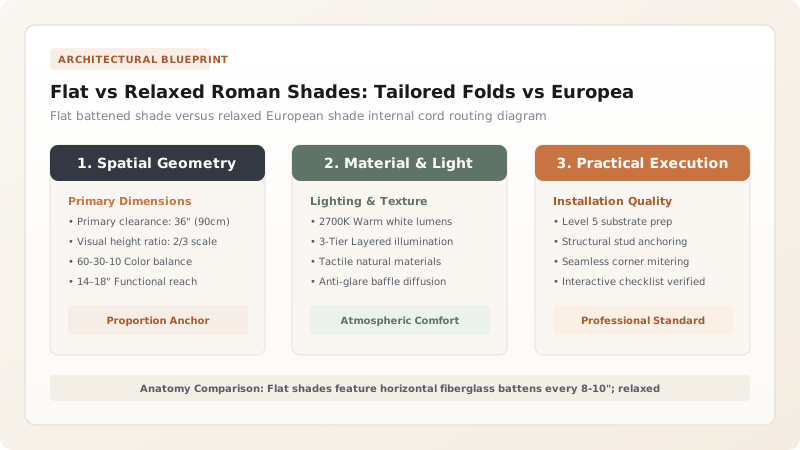
The fundamental distinction between Flat and Relaxed Roman shades lies in the presence or absence of horizontal stays (battens). A flat shade has rigid fiberglass or metal rods sewn into rear horizontal pockets every 8 to 10 inches, forcing the fabric to fold in rigid, razor-sharp rectangular pleats.
A relaxed (or European) shade has zero internal horizontal rods. Cords run only along the left and right outer vertical edges. As the sides are pulled upward, gravity pulls the un-supported center downward into a graceful crescent curve (the 'smile').

Flat vs Relaxed Roman Shade Comparison Matrix
Use this reference table to calculate exact physical dimensions, ratios, and specifications before purchasing:
| Feature / Attribute | Flat Roman Shade | Relaxed / European Shade | Winner / Recommendation |
|---|---|---|---|
| Pattern Display | Flawless, flat & un-distorted | Curved & folded in center | Flat Shade (For patterns/stripes) |
| Daily Operation Ease | Raises automatically into pleats | Requires manual smoothing 'dressing' | Flat Shade (High-traffic windows) |
| Aesthetic Character | Clean, tailored, architectural | Soft, romantic, informal, cottage | Relaxed Shade (Cozy spaces) |
| Fabric Suitability | Medium to heavy cotton, linen, wool | Lightweight, soft, fluid linen | Relaxed requires supple fabrics |
Wide Window Relaxed Shade Sag Constraints
Every successful decoration project must account for physical and environmental constraints:
Relaxed Shades Wider Than 54 Inches Sagging Dangerously
On windows wider than 54 inches, un-supported relaxed shade centers sag too deep (6+ inches), dragging on sills; on wide windows, install Flat Roman shades or divide into twin side-by-side shades.
How to 'Dress' a Relaxed Roman Shade
Execute this professional sequence to achieve flawless results without backtracking:
Raise Shade to Target Height
Lift shade using cordless bottom rail to desired window height.
Smooth Outer Edges Outward
Gently pull left and right pleats outward toward window jambs.
Cup Center Curve Downward
Use your hands to gently push the center fold downward into a uniform 2-inch curve.
Let Gravity Form Memory
Linen fibers will develop a natural 'drape memory' after 2 weeks of resting.
Common Mistakes & Countermeasures
Avoid these costly errors that compromise aesthetics, ergonomics, and budget:
Using Horizontal Stripe Fabric on Relaxed Roman Shades
Project Execution Checklist
Track your physical progress. Checkboxes persist automatically on this device:
Frequently Asked Questions
Can you put relaxed Roman shades on motorized wands?
Motorized motors can lift relaxed shades, but because relaxed folds require occasional manual hand-dressing to set the center curve, motorized operation is far better suited to Flat Roman shades.


