
Size a picture light by multiplying the total outer width of the frame by 0.50 to 0.65 (50% to 65%). For landscape artwork (wide), aim for 60% to 65% of the width; for tall portrait artwork (narrow), choose 50% of the width with an extended 8-inch stand-off arm.
At a Glance: Key Takeaways
- Landscape (Wide Art): Picture light width = 60% to 65% of total outer frame width.
- Portrait (Tall Art): Picture light width = 50% of frame width + 8" deep stand-off arm to reach the bottom.
- Avoid 1:1 Matching: A light matching 100% of frame width creates an awkward 'bar' roof over the art.
- Avoid Tiny Lights: A 6-inch light on a 40-inch canvas creates an ugly cone beam with dark corners.
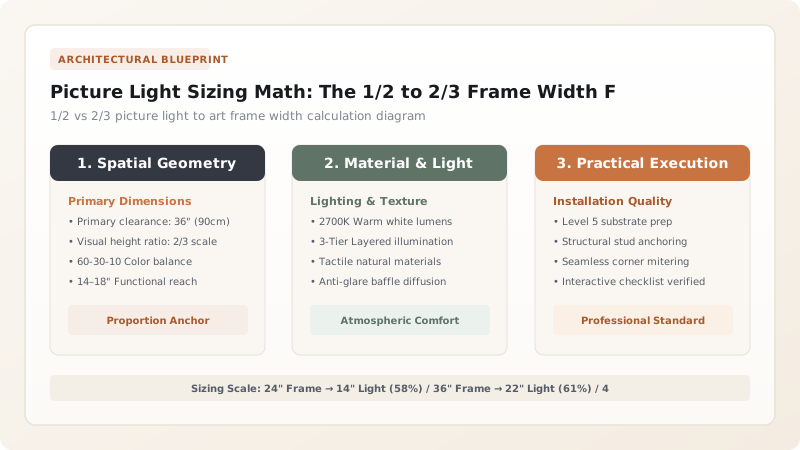
1. The Mathematics of Aspect Ratios: Landscape vs Portrait Art
A common mistake in art lighting is applying a single formula regardless of canvas orientation. A horizontal landscape canvas requires a wide light distribution, whereas a vertical portrait canvas requires downward beam penetration.
Professional art consultants adjust sizing based on aspect ratio physics:
- Horizontal Landscape (Width > Height): Use a longer 2/3 width picture light with a standard 5-inch stand-off arm to cover horizontal perimeter edges.
- Vertical Portrait (Height > Width): Use a 1/2 width picture light with an extended 7 to 9-inch stand-off arm, throwing light deeper down the vertical canvas plane.

Artwork Dimensions to Picture Light Sizing Reference
Use this reference table to calculate exact physical dimensions, ratios, and specifications before purchasing:
| Artwork Dimensions (W × H) | Orientation | Ideal Picture Light Width | Arm Projection Depth |
|---|---|---|---|
| 18" W × 24" H | Vertical Portrait | 9" - 10" Light (50%) | 7" Extended arm |
| 24" W × 18" H | Horizontal Landscape | 14" - 16" Light (65%) | 5" Standard arm |
| 36" W × 24" H | Horizontal Landscape | 22" - 24" Light (65%) | 6" Standard arm |
| 30" W × 48" H (Tall) | Vertical Portrait | 15" - 18" Light (50%) | 8" - 9" Deep reach arm |
| 60" W × 40" H (Large) | Oversized Canvas | 36" - 42" Light (65%) | 8" - 10" Heavy duty arm |
Ornate Deep Picture Frame Shadow Constraints
Every successful decoration project must account for physical and environmental constraints:
Deep 4-Inch Ornate Carved Frame Blocking the Light Beam
Deep gilded baroque frames cast a heavy top shadow on the canvas; specify an extra-long curved mounting arm that projects the light head 8 to 10 inches forward past the frame moulding.
How to Calculate Picture Light Sizing in 4 Steps
Execute this professional sequence to achieve flawless results without backtracking:
Measure Outer Frame Width
Measure the widest point of the outer frame moulding in inches.
Multiply by 0.60 Ratio
Calculate standard target width (e.g. 30" frame × 0.60 = 18" light).
Check Frame Depth / Thickness
If frame is deeper than 2.5 inches, order the extended 8-inch stand-off bracket.
Confirm Dimmable Driver
Verify the fixture connects to a trailing-edge ELV dimmer to adjust intensity to ambient room levels.
Common Mistakes & Countermeasures
Avoid these costly errors that compromise aesthetics, ergonomics, and budget:
Measuring Only the Canvas Glass and Ignoring the Outer Frame
Project Execution Checklist
Track your physical progress. Checkboxes persist automatically on this device:
Frequently Asked Questions
Can you use two picture lights over a single very wide artwork?
Yes! For ultra-wide gallery artworks over 6 feet (72 inches) wide, designers often install two matching 24-inch picture lights spaced symmetrically across the frame.


