
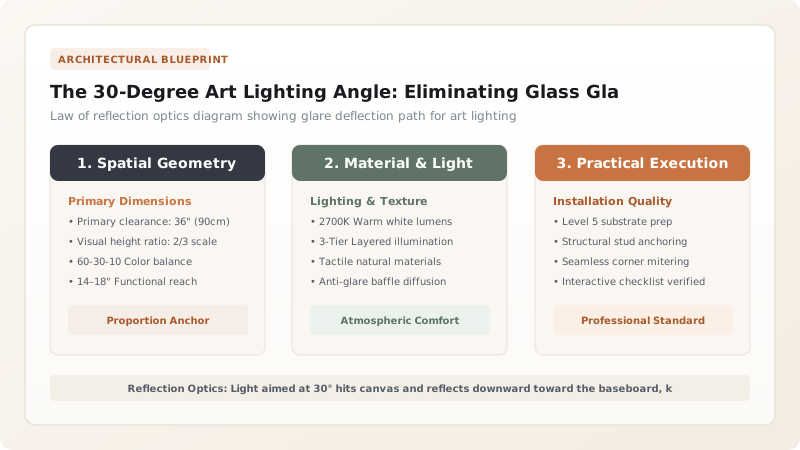
Eliminate art glare by aiming picture lights or ceiling art spotlights at a 30-degree angle of incidence toward the canvas center. Based on the optical Law of Reflection, this causes surface glare and glass reflections to bounce downward toward the floor rather than into the viewer's eyes.
At a Glance: Key Takeaways
- The 30° Sweet Spot: 30 degrees provides perfect balance between zero glare and minimal frame shadow.
- The 45° Problem: Greater than 45 degrees causes heavy downward shadows under frame lips and texture grooves.
- The 15° Problem: Less than 20 degrees bounces bright light reflections directly into the viewer's eyes.
- Museum Glass: Upgrade framed art to 99% anti-reflective UV-blocking Museum Glass (Tru Vue) for invisible clarity.
1. Optical Physics: The Law of Reflection & Glare Mechanics
The fundamental law of geometric optics states: Angle of Incidence = Angle of Reflection (\(\theta_i = \theta_r\)). When light strikes a smooth surface (like protective framing glass, acrylic, or varnished oil paint), the light rays do not scatter randomly; they reflect as a focused beam along the opposite reciprocal angle.
If you stand 6 feet away looking at a painting at average 58-inch eye level, light arriving at a 30-degree downward angle reflects downward toward the floor (at 30 degrees), completely bypassing your retinas and delivering pure, glare-free color saturation.

Art Lighting Angles & Optical Consequences
Use this reference table to calculate exact physical dimensions, ratios, and specifications before purchasing:
| Lighting Angle (Off Vertical) | Specular Glare Risk | Frame Shadow Casting | Curator Rating |
|---|---|---|---|
| 30° Angle (The Museum Standard) | 0% (Bounces to floor) | Minimal / Soft top shadow | 100% Optimal (Industry Gold Standard) |
| 15° Angle (Too Steep / Shallow) | High (Bounces into viewer eyes) | Zero shadow | Poor (Severe blinding glare) |
| 45° Angle (Too Far Out) | 0% (Bounces straight down) | Severe (Dark shadow across top 1/3 of art) | Poor (Obscures upper canvas) |
| Ceiling Framing Projector (30°) | 0% (Precision optical shuttering) | Zero (Clipped exactly to canvas edge) | Supreme Luxury (Museums & estates) |
Oil Paint Impasto Texture Shadow Constraints
Every successful decoration project must account for physical and environmental constraints:
Heavy Palette Knife Oil Paint Casting Deep Dark Grooves
Heavily textured impasto oil paintings cast dark downward shadows when lit from a single top picture light; pair with a low-output wide-wash ambient room light to soften shadows across texture ridges.
How to Calibrate a Picture Light to 30 Degrees
Execute this professional sequence to achieve flawless results without backtracking:
Hang Art at 58" Centerline
Confirm art is hung at standard museum centerline (58 inches to center of canvas).
Mount Light with 6" Arm Reach
Install picture light bracket extending the hood 6 inches out from the wall.
Loosen Swivel Collar Screw
Loosen the swivel joint screw on the light cylinder head.
Tilt to 30° & Stand Back
Tilt hood 30 degrees downward, stand 6 feet away, and tighten when all glare disappears.
Common Mistakes & Countermeasures
Avoid these costly errors that compromise aesthetics, ergonomics, and budget:
Aiming the Picture Light Straight Down at 0 Degrees
Project Execution Checklist
Track your physical progress. Checkboxes persist automatically on this device:
Frequently Asked Questions
What is an optical framing projector?
An optical framing projector is a specialized ceiling-recessed light fixture with internal adjustable steel shutters and focus lenses that crops light to the exact rectangular millimeter dimensions of the painting, making the canvas glow from within.


