
Prevent outdoor countertop winter cracking by specifying natural stone with a water absorption rate under 0.2% (such as Black Pearl or Steel Gray granite). For concrete countertops, cast Glass Fiber Reinforced Concrete (GFRC) containing silica fume pozzolans and seal with a deep-penetrating silane-siloxane hydrophobic impregnator.
At a Glance: Key Takeaways
- 9% Volumetric Water Expansion: Ice expansion exerts up to 30,000 PSI of internal hydraulic bursting pressure.
- <0.2% Stone Absorption Standard: Dense crystalline igneous rock prevents moisture from pooling inside the stone matrix.
- GFRC with Silica Fume Pozzolans: Densifies micro-capillaries in concrete, eliminating freeze-thaw surface spalling.
- Silane-Siloxane Hydrophobic Sealer: Nanotechnology molecules bond inside pores to repel liquid water while remaining vapor-permeable.
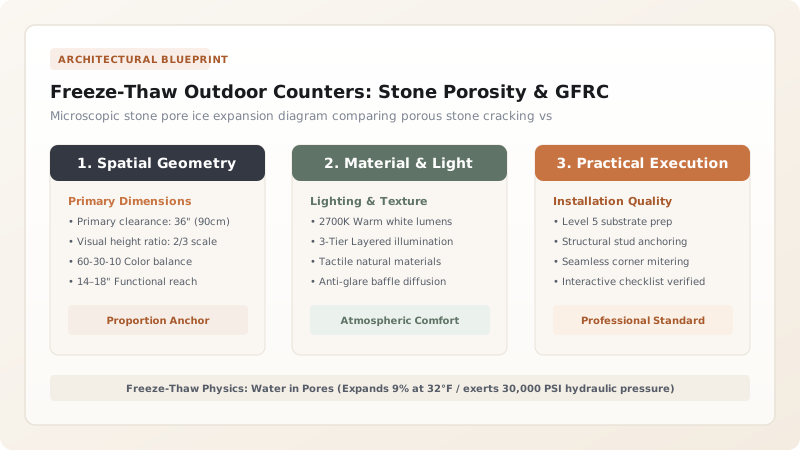
1. Cryogenic Physics: Hydraulic Bursting Pressure in Stone Pores
When liquid water transitions into solid ice at \(32^{\circ}\text{F} (0^{\circ}\text{C})\), its molecular structure rearranges into an open hexagonal crystal lattice, increasing in volume by 9.05%. In confined stone pores, this phase change generates over 30,000 PSI of internal hydraulic pressure—far exceeding the 2,500 PSI tensile strength of standard stone.
Porous stones (such as limestone, travertine, or low-density concrete) absorb winter rain, freezing and spalling (flaking into powder) within two seasons. Installing dense igneous plutonic granite (<0.2% absorption) prevents water entry, rendering the countertop 100% frost-proof.

Stone & Concrete Absorption Rates vs Frost Resistance
Use this reference table to calculate exact physical dimensions, ratios, and specifications before purchasing:
| Material Formulation | Water Absorption Rate (%) | Compressive Strength (PSI) | Freeze-Thaw Rating |
|---|---|---|---|
| Black Galaxy / Absolute Black Granite | 0.08% - 0.12% | 28,000 PSI | Maximum (100% Frost Proof) |
| Steel Gray / Blue Pearl Granite | 0.15% - 0.20% | 24,000 PSI | High Frost Resilience |
| GFRC Concrete (with Pozzolans & Sealer) | 1.0% - 2.0% | 10,000 PSI | High (When sealed properly) |
| Porous Travertine / Sandstone (FORBIDDEN) | 4.0% - 8.0% | 5,000 PSI | FAILS: Spalls and cracks in winter |
Winter Tarp Condensation Trapping Constraints
Every successful decoration project must account for physical and environmental constraints:
Covering Outdoor Kitchens with Non-Breathable Tarps Trapping Winter Moisture
Wrapping countertops tightly in plastic tarps traps rising ground humidity; when temperature drops below freezing, trapped condensation freezes and etches stone; use breathable marine-grade canvas covers with integrated mesh air vents.
How to Prepare Outdoor Concrete for Freeze-Thaw Climates
Execute this professional sequence to achieve flawless results without backtracking:
Design GFRC Mix with Silica Fume
Incorporate 10% silica fume (pozzolan) into Portland cement mix to eliminate capillary micro-voids.
Add AR Glass Fibers and Water Reducer
Mix 3% alkali-resistant (AR) glass fibers and polycarboxylate superplasticizer with low water-to-cement ratio (0.32).
Wet-Cure Under Plastic for 7 Days
Keep concrete covered in wet burlap and plastic for 7 days to reach full hydration strength.
Apply Deep-Penetrating Silane-Siloxane
Flood surface with breathable silane-siloxane impregnator (like Ghostshield Siloxa-Tek 8500).
Re-Seal Every 24 Months
Perform water drop test annually; re-apply penetrating sealer when water stops beading.
Common Mistakes & Countermeasures
Avoid these costly errors that compromise aesthetics, ergonomics, and budget:
Using Film-Forming Topical Epoxy Sealers on Outdoor Concrete
Project Execution Checklist
Track your physical progress. Checkboxes persist automatically on this device:
Frequently Asked Questions
Can you leave an outdoor kitchen uncovered in winter?
High-density granite can remain uncovered in snow without structural damage. However, covering the island with a breathable vented marine-grade fabric cover protects appliances, burners, and silicone joints from ice accumulation.


