
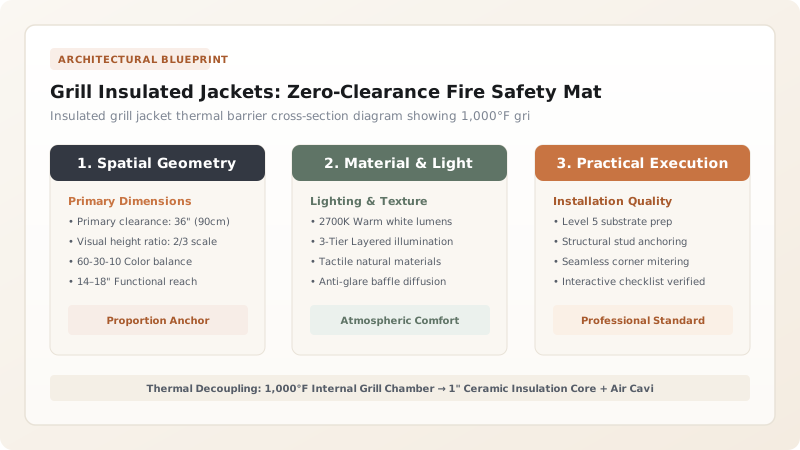
When framing an outdoor kitchen island with wood or placing a built-in gas grill into combustible structures, building codes (NFPA 54) mandate an Insulated Grill Jacket. This double-walled 304 stainless steel housing isolates the 1,000°F grill box, allowing zero-clearance installation into wood framing.
At a Glance: Key Takeaways
- Mandatory for Combustible Framing: Required whenever framing with 2x4 lumber, wood studs, or composite decking.
- Double-Walled 304 Stainless Construction: Heavy-gauge stainless steel with a dense ceramic fiber thermal core.
- Drop-In Flange Support: Heavy perimeter flange supports the weight of the grill while shielding cutout edges.
- Prevents Pyrolysis Wood Ignition: Long-term exposure to 200°F+ heat lowers wood's ignition temperature until it catches fire spontaneously.
- Matches Grill Manufacturer: Always purchase the specific insulated jacket engineered for your exact grill model.
1. Fire Physics: The Hidden Danger of Pyrolysis
Many DIY builders believe that placing a gas grill 2 inches away from wood framing is safe because wood ignites at \(451^{\circ}\text{F}\). However, under continuous exposure to \(180^{\circ}\text{F} - 250^{\circ}\text{F}\) radiant heat from a searing grill, wood undergoes a chemical decomposition process called Pyrolysis.
Pyrolysis slowly converts structural lumber into highly pyrophoric charcoal. Over 2 to 3 years, the wood's auto-ignition temperature drops from \(451^{\circ}\text{F}\) down to as low as \(200^{\circ}\text{F}\), causing the outdoor kitchen island to spontaneously burst into flames inside the walls. An insulated jacket maintains framing temperatures below \(120^{\circ}\text{F}\), eliminating pyrolysis risks entirely.

Island Framing Material vs Insulated Jacket Requirement
Use this reference table to calculate exact physical dimensions, ratios, and specifications before purchasing:
| Island Framing Construction | Insulated Jacket Mandatory? | Clearance to Rear Wall | Fire Risk Level |
|---|---|---|---|
| Wood Framing (2x4s / Plywood / Timber) | YES (100% MANDATORY) | Zero-clearance with jacket | EXTREME FIRE RISK without jacket |
| Composite Decking (Trex / Azek) | YES (100% MANDATORY) | Zero-clearance with jacket | High (Plastic melts & burns) |
| Non-Combustible Steel Studs + Cement Board | Recommended (Protects granite) | 12" to rear combustible wall | Low fire risk |
| Concrete Cinder Block (CMU) + Stone | No (Non-combustible) | 6" Rear airflow clearance | Zero fire risk |
Rough Cutout Dimension Expansion Constraints
Every successful decoration project must account for physical and environmental constraints:
Framers Cutting Island Opening for Grill Instead of the Insulated Jacket
An insulated jacket adds 4 to 6 inches of width and 3 inches of depth to the rough opening; framers MUST consult the jacket's cut-sheet dimensions rather than the grill dimensions when building rough framing.
How to Frame and Install an Insulated Grill Jacket
Execute this professional sequence to achieve flawless results without backtracking:
Check Jacket Cut-Sheet Dimensions
Obtain exact rough opening width, depth, and height specifications for the manufacturer's jacket.
Frame Rough Opening with Extra 1/4" Clearance
Frame the opening 1/4" larger than the jacket body to allow smooth drop-in fit.
Sheathe Cavity with Cement Board
Line framing members with 1/2" cement backer board around the opening perimeter.
Slide Insulated Jacket into Place
Lower the stainless steel jacket into the cavity until the top lip rests flat on the countertop.
Drop in Gas Grill and Connect Gas Flex Line
Slide gas grill into the insulated jacket cavity and connect certified stainless flex gas line.
Common Mistakes & Countermeasures
Avoid these costly errors that compromise aesthetics, ergonomics, and budget:
Modifying or Cutting the Insulated Jacket to Fit Tight Framing
Project Execution Checklist
Track your physical progress. Checkboxes persist automatically on this device:
Frequently Asked Questions
Do you need an insulated jacket if framing with steel studs?
If your island is framed with 100% steel studs and cement board, an insulated jacket is not legally required by NFPA codes. However, installing one is still strongly recommended because it protects expensive granite countertops from thermal shock cracking.


