
The quartz-rich frit-clay bisque formula is the ceramic engineering foundation of Ottoman Iznik tile making. Unlike conventional terracotta tiles made of plastic earthenware clay that shrinks by 8% to 12% during drying and firing, Iznik fritware is formulated from 80% crushed crystalline quartz (silica), 10% pre-melted glass frit, and only 10% white bentonite clay. This recipe reduces total drying and firing shrinkage to less than 1.5%, enabling the production of massive, dead-flat tile revetments with razor-sharp alignment.
At a Glance: Key Takeaways
- 80% Pure Silica Quartz (SiO2): Sourced from river pebbles crushed in watermills, providing an inert, non-shrinking structural skeleton.
- 10% Pre-Frit Glass Flux: Ground soda-lead glass that melts at 850°C, forming liquid glass bridges between quartz particles without melting the tile.
- 10% Plastic Bentonite / Montmorillonite Clay: Minimal clay content just sufficient to provide workability and green strength for hand-molding.
- Sub-1.5% Total Dimensional Shrinkage: Prevents warping, twisting, and edge curling, ensuring tiles remain perfectly square and coplanar.
- Paper-White Reflectance: Eliminates muddy brown tones of iron-rich clay, creating a luminous optical ground that intensifies blue and red pigments.
- Matched Thermal Expansion: Quartz core expansion calibrated to the lead glaze to prevent post-firing micro-crazing and moisture penetration.
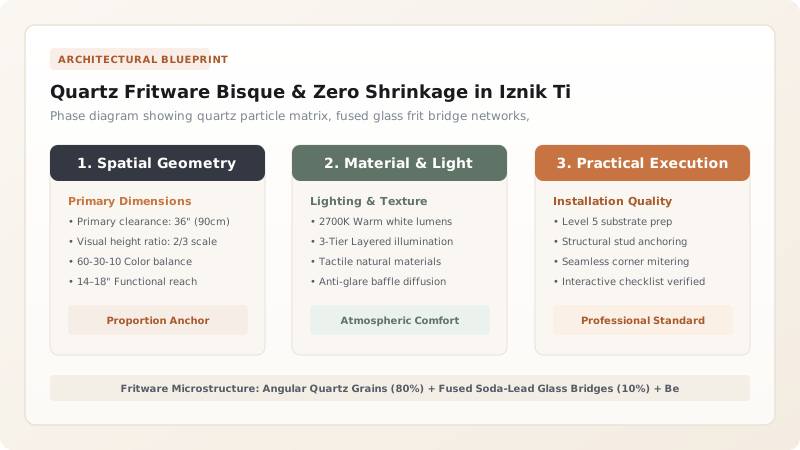
1. Material Science: The 80/10/10 Fritware Stoichiometry
In standard ceramic technology, clay is the primary ingredient, acting as both binder and structural body. However, natural clay minerals (kaolinite, illite) contain chemically bound hydroxyl ions (\(\text{OH}^-\)) that release during heating, causing massive volumetric contraction and inevitable warping.
The potters of Iznik bypassed clay's physical limitations by inventing fritware (stonepaste):
- Crushed Quartz (\(\approx 80\%\)): Highly refractory crystalline silica sand that does not melt at kiln temperatures (\(950^\circ\text{C}\)) and exhibits zero dehydroxylation shrinkage.
- Alkaline-Lead Glass Frit (\(\approx 10\%\)): A pre-melted glass compound made from quartz sand, lead oxide, and soda ash. During firing, this frit melts into a liquid flux that wets the quartz grains.
- Bentonite Clay (\(\approx 10\%\)): A high-plasticity clay used in minute quantities solely to lubricate the quartz grains and provide cohesion during slab pressing.
2. Shrinkage Dynamics: The Sub-1.5% Advantage
When cladding a monumental mosque wall spanning \(12\text{ meters}\) with hundreds of interlocking square tiles, dimensional consistency is essential. If tiles shrink by \(10\%\) with \(\pm 1\%\) variance (typical for red earthenware), joint lines drift by dozens of millimeters, destroying floral arabesque patterns.
The total linear shrinkage (\(S_L\)) of Iznik fritware is modeled as:
Because the rigid quartz grains touch each other directly in point-to-point contact, the body cannot contract volumetrically. The glass frit simply flows into microscopic interstitial voids between quartz grains via capillary action, fusing the mass into a stone-like composite without macroscopic shrinkage. Read about underglaze brushwork in underglaze Armenian bole coral-red and cobalt arabesque brushwork.
3. The Quartz Phase Inversion: Managing the 573°C Alpha-Beta Jump
While quartz eliminates shrinkage, it introduces a severe thermal hazard: the alpha-beta quartz phase inversion at \(573^\circ\text{C}\) (\(1,063^\circ\text{F}\)):
- As the kiln heats through \(573^\circ\text{C}\), alpha-quartz snaps into beta-quartz, undergoing a sudden \(0.8\%\) volume expansion.
- During cooling through \(573^\circ\text{C}\), the reverse phase transition occurs: beta-quartz snaps back to alpha-quartz, undergoing instantaneous thermal contraction.
If the kiln is cooled too rapidly through this critical \(600^\circ\text{C} \to 550^\circ\text{C}\) window, internal tensile stress shatters every tile in the kiln (a catastrophic failure called 'dunting'). Iznik potters maintained strict kiln soaking protocols, cooling the kilns over four days. Explore mosque wall installation in mosque mihrab niche revetment and lime-sand setting beds.
Ceramic Bisque Material Performance Comparison
Use this reference table to calculate exact physical dimensions, ratios, and specifications before purchasing:
| Bisque Type | Quartz Content (SiO2) | Drying Shrinkage | Firing Shrinkage | Total Contraction | Bisque Base Color |
|---|---|---|---|---|---|
| Iznik Quartz Fritware | 80% to 85% | 0.4% to 0.6% | 0.6% to 0.9% | < 1.5% (Dead Flat) | Paper White / Chalk |
| Standard Earthenware (Terracotta) | 20% to 30% | 4.0% to 6.0% | 5.0% to 7.0% | 9.0% to 13.0% | Red / Orange / Ochre |
| Stoneware Body | 35% to 45% | 3.5% to 5.0% | 6.0% to 8.0% | 10.0% to 12.5% | Gray / Buff |
| Vitrified Hard Porcelain | 20% to 25% | 5.0% to 7.0% | 9.0% to 12.0% | 14.0% to 18.0% | Translucent White |
Practical Constraints
Every successful decoration project must account for physical and environmental constraints:
Extremely Low Plasticity and Fragile Green Strength
Because 80% quartz fritware contains only 10% clay, the wet paste behaves like wet sand rather than moldable clay. It has minimal plasticity and will crumble if thrown on a potter's wheel. Slabs must be pressed into rigid wooden molds with high mechanical pressure and handled with supporting boards until completely dry.
Crushing Quartz Pebbles Without Iron Contamination
Crushing crystalline river quartz using steel jaw crushers deposits microscopic iron particles into the white powder. During firing, these iron specks melt into unsightly black spots and brown blemishes across the pristine white ground. Historic kilns utilized water-powered stone millstones (granite or chert) to grind quartz without metallic contamination.
Execution Blueprint & Craftsmanship Sequence
Execute this professional sequence to achieve flawless results without backtracking:
Quartz Calcining & Stone Grinding
Heat quartz river pebbles to 800°C and quench in cold water to induce thermal shattering. Grind the fractured stones in a stone mill and sift to pass through a 150-mesh sieve.
Glass Frit Flux Preparation
Melt a batch of 60% quartz sand, 25% red lead (minium), and 15% soda ash at 1,100°C in a crucible. Pour molten glass into cold water to form fritted granules; grind into fine powder.
Compounding & High-Shear Kneading
Combine 80 parts quartz flour, 10 parts glass frit, and 10 parts purified white bentonite clay. Add 18% clean water by weight. Knead thoroughly in a pugmill to eliminate trapped air pockets.
Precision Mold Pressing & Straightedge Strike
Dust hardwood slab molds with dry quartz dust. Pack fritware dough firmly into the mold, tamping with wooden blocks. Strike excess material flush with an aluminum straightedge.
Slow Shade Drying & Firing Kinetics
Dry green tiles slowly between absorbent plaster boards for 7 days. Fire in an updraft kiln to 930°C, holding for 3 hours, and slow-cool through the critical 573°C quartz inversion zone over 48 hours.
Common Mistakes & Countermeasures
Avoid these costly errors that compromise aesthetics, ergonomics, and budget:
Cooling the Kiln Too Fast Between 600°C and 550°C
Using Excess Bentonite Clay (Over 15%) for Better Workability
Project Execution Checklist
Track your physical progress. Checkboxes persist automatically on this device:
Frequently Asked Questions
What is the primary advantage of fritware over porcelain for wall tiles?
Porcelain shrinks by up to 18% during high-temperature vitrification (1,300°C), making it nearly impossible to produce large, dead-flat 250mm tiles without severe warping. Iznik fritware shrinks under 1.5% at lower temperatures (950°C), producing perfectly planar, dimensionally identical tiles.
Can broken green fritware slabs be recycled before firing?
Yes. Before firing, unfired green fritware can be broken up, re-hydrated with water, and re-kneaded without any loss of chemical or physical properties.


