
Long-term corrosion protection for exterior cast iron verandas requires abrasive blasting to SSPC-SP 10 Near-White Metal (achieving a 2.5-mil anchor profile), followed by a high-solids organic zinc-rich primer containing over 85% metallic zinc dust by dry weight. A high-build polyamide epoxy intermediate and a UV-resistant micaceous iron oxide (MIO) polyurethane topcoat provide a 25+ year maintenance-free barrier in harsh coastal environments.
At a Glance: Key Takeaways
- Near-White Blast Cleaning: SSPC-SP 10 abrasive blasting removes 100% of mill scale, old lead paint, and embedded iron rust from porous casting surfaces.
- Galvanic Sacrificial Zinc: Zinc dust acts as an electrochemical sacrificial anode, protecting exposed iron from rusting even if the paint film is scratched.
- High-Build Epoxy Tie-Coat: Polyamide epoxy provides an impenetrable moisture barrier that bridges microscopic casting pores and pinholes.
- Micaceous Iron Oxide (MIO): Lamellar specular hematite platelets align like overlapping roof shingles, blocking moisture migration and UV degradation.
- Lead Paint Encapsulation Rules: Strict adherence to EPA RRP and OSHA lead regulations during blasting prevents hazardous environmental contamination.
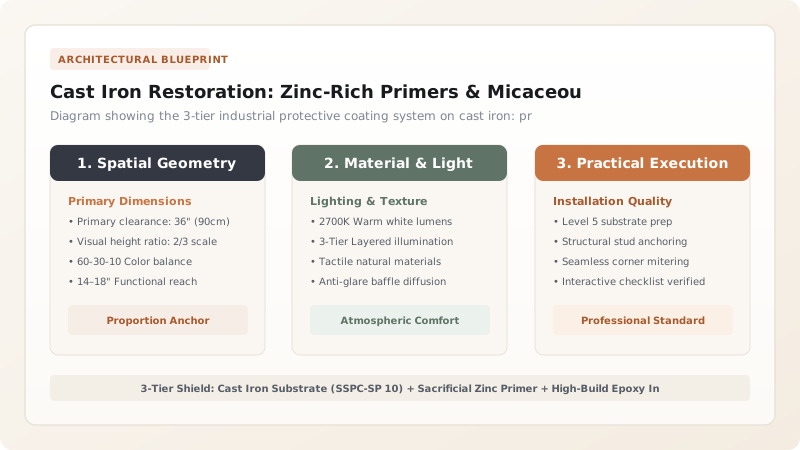
1. Surface Preparation: SSPC-SP 10 Near-White Blast Cleaning
No paint coating can overcome compromised surface preparation. The primary cause of premature coating failure on historic cast iron is painting over old oil-based lead paints, loose rust, and invisible chloride salts trapped in microscopic metal crevices.
Architectural specifications mandate SSPC-SP 10 / NACE No. 2 Near-White Metal Blast Cleaning. All surfaces must be blasted with hard, angular abrasive media (such as crushed glass, garnet, or coal slag #20/40 mesh) propelled by dry compressed air at 100 psi nozzle pressure.
This process removes 100% of existing coatings, rust, and carbonaceous scale, leaving an aggressive mechanical Anchor Profile of \(2.0 \text{ to } 3.0 \text{ mils}\) (\(50 \text{ to } 75 \mu\text{m}\)). The sharp microscopic peaks and valleys provide the essential mechanical interlocking grip required for high-solids zinc primers. Learn about casting methods in our guide to lace filigree sand molding.
2. Cathodic Protection: Why Zinc-Rich Primers Outperform Oil Enamels
Standard consumer exterior enamels are purely Barrier Coatings. If a flying pebble or windblown patio chair scratches through the paint film to bare metal, oxygen and rainwater immediately trigger galvanic rust, which creeps beneath the adjacent paint, bubbling and lifting the entire coating.
In contrast, an Organic Zinc-Rich Epoxy Primer (such as Carboline Carbozinc 859 or Sherwin-Williams Zinc Clad III) provides Active Cathodic Protection. The dry cured film contains greater than \(85\% \text{ Pure Metallic Zinc Dust}\) by weight.
Because zinc is more electrochemically active than iron on the galvanic galvanic scale (\(E^\circ_{\text{Zn}} = -0.76 \text{ V} \text{ vs } E^\circ_{\text{Fe}} = -0.44 \text{ V}\)), the zinc particles voluntarily corrode, generating a continuous protective electron flow to the cast iron substrate:
Even when a deep gouge exposes bare cast iron, the surrounding zinc sacrifices itself, passivating the scratch and producing insoluble zinc hydroxycarbonate salts that heal the defect. Contrast this with living finishes in our guide on microcrystalline bronze maintenance.
3. The Overlapping Shingle Armor: Micaceous Iron Oxide (MIO)
For the ultimate exterior armor over the zinc primer and epoxy intermediate coat, industrial coating engineers specify Micaceous Iron Oxide (MIO) Aliphatic Polyurethane (e.g., Carbothane 134 MIO).
Micaceous iron oxide consists of natural crystalline hematite (\(\text{Fe}_2\text{O}_3\)) processed into ultra-thin, microscopic hexagonal lamellar platelets. When the liquid polyurethane cures, these microscopic mica-like platelets align parallel to the substrate, forming a dense, shingled armor shield:
- Moisture Tortuosity: Water molecules cannot travel in a straight line to the metal; they must navigate a convoluted labyrinth around millions of overlapping platelets, cutting moisture permeability by 85%.
- UV Degradation Resistance: The opaque MIO platelets completely shield the underlying polymer resin from damaging ultraviolet sunlight, preventing chalking and fading for decades.
- Textured Antique Luster: MIO imparts a deep, sparkling metallic charcoal-graphite luster that perfectly complements the historic Victorian aesthetic of ornamental ironwork.
See overall veranda design in our ornamental cast iron veranda hub.
4. Lead Abatement Protocols: Environmental Safety & Waste Disposal
Because virtually all historic cast iron verandas erected before 1978 are coated with multiple layers of toxic lead carbonate and lead chromate paints, surface stripping must comply with EPA RRP (Renovation, Repair and Painting) and OSHA 29 CFR 1926.62 Lead in Construction Standards.
On-site open abrasive blasting is strictly prohibited in residential neighborhoods. Contractors must either dismantle the ironwork and transport panels to a certified off-site blast facility equipped with negative-pressure HEPA blast booths, or construct full on-site containment envelopes utilizing negative-pressure air filtration units (\(>0.02 \text{ in H}_2\text{O}\) water column differential).
All spent blast media and lead paint sludge must undergo Toxicity Characteristic Leaching Procedure (TCLP) Testing and be disposed of at certified hazardous waste handling facilities.
Cast Iron Restoration: Zinc-Rich Primers & Micaceous Iron Oxide Architectural Decision Matrix
Use this reference table to calculate exact physical dimensions, ratios, and specifications before purchasing:
| Architectural Factor | Professional Recommendation | Significance |
|---|---|---|
| Surface Cleanliness | SSPC-SP 10 / NACE No. 2 Near-White Metal Blast | Removes 100% of mill scale, old paint, and rust; zero residue in cast pores |
| Primer Metallic Zinc Content | ≥ 85% metallic zinc by weight in dry cured film | Ensures electrical percolation pathway for active galvanic cathodic protection |
| Intermediate Barrier Coat | High-build polyamide epoxy (4.0 to 6.0 mils DFT) | Seals porosity and provides chemical resistance against acid rain and salt air |
| Topcoat Formulation | Aliphatic acrylic polyurethane with micaceous iron oxide (MIO) | UV resistance > 3,000 hrs QUV-A testing; lamellar moisture-shedding barrier |
Execution Blueprint & Craftsmanship Sequence
Execute this professional sequence to achieve flawless results without backtracking:
Phase 1: Lead Containment & Decontamination
Erect negative-pressure HEPA containment enclosure and wash iron with TSP cleaner to strip dirt (Benchmark: Continuous negative pressure confirmed on digital manometer; water contained)
Phase 2: Abrasive Blasting to SSPC-SP 10
Blast all surfaces with 20/40 mesh angular garnet at 100 psi to achieve 2.5-mil anchor profile (Benchmark: Surface meets SSPC-VIS 1 Near-White visual standard; profile checked with surface comparator)
Phase 3: Soluble Salt Decontamination Test
Test blasted iron for residual chloride salts using Bresle patch conductivity method (Benchmark: Chloride level verified below 3 µg/cm²; rinse with chlorophyll wash if needed)
Phase 4: Zinc-Rich Primer Application
Apply organic zinc epoxy primer via airless spray within 4 hours of blasting (3.0 mils DFT) (Benchmark: Magnetic mil gauge verifies uniform DFT; zero dry spray or runs on filigree tracery)
Phase 5: Intermediate Epoxy & MIO Polyurethane
Apply 5.0 mils high-build epoxy, allow 12h cure, followed by 3.0 mils MIO aliphatic polyurethane (Benchmark: Total DFT reaches 11.0 mils; satin metallic luster with zero pinholing)
Common Mistakes & Countermeasures
Avoid these costly errors that compromise aesthetics, ergonomics, and budget:
Applying Primer Over Flash Rust After Blasting
Using Standard Oil-Based Alkyd Paints Over Zinc Primers
Dry Scraping Lead Paint with Wire Brushes
Neglecting Recessed Pockets and Joint Gaps
Project Execution Checklist
Track your physical progress. Checkboxes persist automatically on this device:
Frequently Asked Questions
Why is abrasive blasting necessary instead of just sanding cast iron?
Cast iron has a porous, open-grained surface texture. Hand or power sanding only polishes the outer peaks, leaving old degraded paint, active rust, and corrosive chloride salts trapped deep in the pores. Abrasive blasting scours out every microscopic pore and creates the angular anchor profile required for industrial coatings.
Can I use cold galvanizing spray cans for exterior cast iron railings?
Aerosol cold-galvanizing sprays contain low-grade binders, high solvent ratios, and insufficient resin solids to form a durable exterior protective film. Professional restoration requires two-component high-solids zinc-rich epoxy primers applied with professional spray equipment.
How long will a 3-coat zinc-epoxy-MIO paint system last on an oceanfront veranda?
When properly applied over an SSPC-SP 10 blasted substrate, a certified 3-coat system (zinc-rich primer + polyamide epoxy + MIO polyurethane) meets ISO 12944 Category C5-M high durability, routinely delivering 20 to 25+ years of service life before requiring a maintenance topcoat.


