
Interlocking thermal barrier gaskets and water-rated weep channels transform traditional solid brass thresholds into high-performance building envelope barriers. By severing the thermal conduction path with a high-rigidity polyamide 6.6 glass-fiber strut and evacuating infiltrated water via baffled gravity weep slots under pressures exceeding 300 Pa (ASTM E331), these systems eliminate winter condensation and water ingress while preserving monumental bronze aesthetics.
At a Glance: Key Takeaways
- Polyamide 6.6 Thermal Break: Glass-fiber reinforced structural polymer strut (25% GF) isolating interior and exterior brass extrusions with thermal conductivity of 0.30 W/(m·K).
- Condensation Resistance Factor (CRF): Elevates portal threshold CRF from an unacceptable 28 up to 64, preventing frost and condensation down to -20°C outdoor temperatures.
- Hydrostatic Pressure Performance: Tested under ASTM E331 up to 300 Pa (equivalent to 80 km/h wind-driven rain) with zero interior water leakage.
- Silicone & Santoprene Dual Gaskets: Co-extruded closed-cell elastomeric door-bottom gaskets maintaining flexible compression from -40°C to +120°C.
- Baffled Weep Ports: Internal stainless steel flap valves preventing wind-driven back-siphonage and insect entry into building interiors.
- Sub-Sill Pan Flashing: 20-gauge copper or 304 stainless steel welded sub-pan collecting secondary moisture and directing it onto exterior terrace drains.
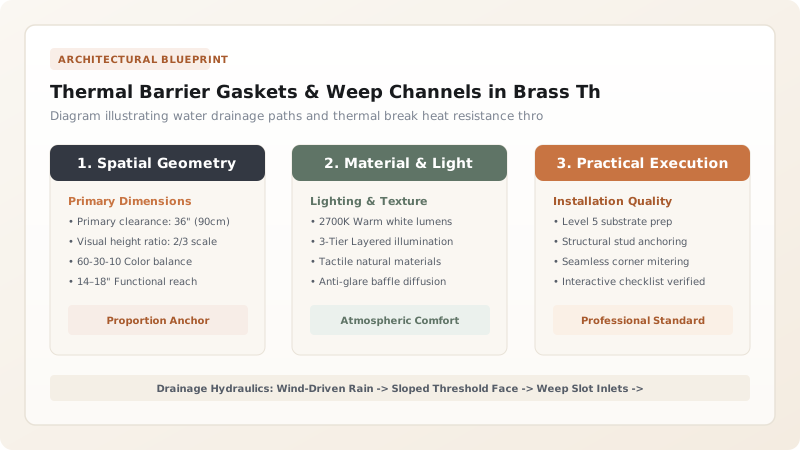
1. Thermal Severance: Structural Polyamide Strut Dynamics
Solid brass is an exceptional thermal conductor, transferring heat over \(115\text{ W/(m}\cdot\text{K)}\). In cold climates, an undivided solid brass threshold functions as a thermal siphon, chilling interior flooring and causing indoor humidity to condense into standing water pools that destroy adjoining parquetry or limestone.
To arrest this heat loss, the threshold is manufactured as two independent architectural bronze extrusions mechanically joined by a glass-fiber reinforced polyamide 6.6 strut (PA66 GF25). The strut features knurled dovetail tongues crimped hydraulically into receiving pockets in the brass profiles:
- Mechanical Shear Strength: The crimped joint withstands longitudinal shear forces exceeding \(30\text{ N/mm}\), maintaining full structural integrity under heavy pedestrian traffic.
- Thermal Expansion Matching: Polyamide 6.6 with 25% glass fiber exhibits a thermal expansion coefficient of \(23 \times 10^{-6}\text{ K}^{-1}\), closely matching brass (\(19.8 \times 10^{-6}\text{ K}^{-1}\)), eliminating thermal fatigue delamination.
2. Weep Channel Hydraulics: Drainage Under Wind-Driven Head Pressure
Wind-driven rain striking a monumental portal generates positive exterior pressure, forcing water through microscopic gaps between door sweeps and sills. High-performance brass thresholds integrate a pressure-equalized weep cavity designed to ASTM E331 test standards:
Where \(A_{\text{weep}}\) is the combined aperture area, \(C_d\) is the discharge coefficient (\(\approx 0.62\)), and \(\Delta P\) is the differential wind pressure. Water enters through hooded top slots, settles into an internal catch trough, and flows outward through one-way gravity-flapped weep valves. Back-siphonage under reverse pressure pulses is blocked by fine 316 stainless steel wire mesh screens.
3. Elastomeric Seal Interfaces: Santoprene, Neoprene, and Silicone
The seal between the moving door leaf and the stationary brass saddle relies on engineered elastomeric gasket geometries:
- Heavy-Duty Neoprene Bulb Seals: Hollow-bulb extruded gaskets seated into dovetail brass grooves, providing resilient mechanical resistance against high-velocity drafts.
- Co-Extruded Santoprene Fins: Multi-finger thermoplastic vulcanizate (TPV) sweep gaskets that wipe across the brass saddle crown without dragging excessively or marring the polished metal.
- Drop-Down Automatic Mortise Seals: Spring-loaded concealed mechanisms embedded in the door bottom that actuate only during the final 5 degrees of door swing, dropping a continuous silicone seal onto the flat brass plateau.
Explore ADA-compliant low profiles in wheelchair ADA compliant low-profile bevels and serrated traction.
Threshold Thermal & Drainage Performance Matrix
Use this reference table to calculate exact physical dimensions, ratios, and specifications before purchasing:
| Performance Parameter | Monolithic Solid Brass Sill | Thermally Broken Brass (PA66) | Standard Commercial Aluminum | Stainless Steel with Rubber Insert |
|---|---|---|---|---|
| Thermal Transmittance (U-Value) | 5.8 W/(m²·K) (Poor) | 1.7 W/(m²·K) (Excellent) | 4.2 W/(m²·K) (Moderate) | 2.9 W/(m²·K) (Good) |
| Condensation Resistance Factor | CRF 26 (High Condensation) | CRF 64 (Virtually Condensation-Free) | CRF 38 (Moderate) | CRF 52 (Low Risk) |
| ASTM E331 Water Penetration | Pass at 150 Pa | Pass at 300+ Pa | Pass at 200 Pa | Pass at 250 Pa |
| Gasket Material Longevity | 10 Years (Surface Glued) | 25+ Years (Keyway Inserted) | 7 to 10 Years | 15 to 20 Years |
| Acoustic Infiltration (STC) | STC 28 | STC 38 | STC 31 | STC 35 |
| Aesthetic Integrity | Monumental Classic | Flawless Architectural Bronze | Utilitarian Silver/Bronze | Industrial Modern |
Practical Constraints
Every successful decoration project must account for physical and environmental constraints:
Sub-Sill Pan Flashing Membrane Integration
Weep ports discharge water downward and outward. If installed over bare concrete without a continuous soldered copper or welded stainless steel pan flashing, moisture will penetrate the structural slab edge and rot subfloor framing. A soldered 16-ounce copper pan flashing with 50mm end dams is mandatory.
Debris and Grit Accumulation in Micro-Weep Ports
Exterior dirt, dust, and decomposed autumn leaves inevitably settle in sill drainage troughs. Weep openings must be sized no smaller than 8mm x 15mm with removable bronze inspection clean-out plates to allow annual flushing with compressed air or water.
Execution Blueprint & Craftsmanship Sequence
Execute this professional sequence to achieve flawless results without backtracking:
Sub-Sill Copper Pan Flashing Installation
Fabricate a 16-ounce copper pan flashing with 50mm upturned back and side dams. Solder all lap corners watertight. Bed the pan over a bituminous membrane onto the structural threshold rebate.
Thermal Strut Joint Inspection & Gasket Insertion
Inspect the polyamide 6.6 crimped joint of the brass threshold to ensure zero gap or separation. Slide closed-cell Santoprene bulb gaskets into the precision brass dovetail channels, anchoring each end with cyanoacrylate adhesive.
Weep Chamber Alignment & Stainless Mesh Positioning
Fit stainless steel anti-insect filter screens into the internal weep evacuation ports. Verify that weep baffles freely swing outward under gravity without binding against the profile wall.
Setting and Caulking the Threshold Assembly
Lower the assembled thermally broken threshold onto twin beds of non-curing polyisobutylene mastic within the copper pan. Secure anchors into concealed screw channels and verify horizontal level.
Pressurized Water Spray Infiltration Verification
Conduct a calibrated ASTM E1105 field water spray test at 300 Pa differential pressure for 15 minutes. Inspect interior joints and concrete slab for any signs of moisture migration.
Common Mistakes & Countermeasures
Avoid these costly errors that compromise aesthetics, ergonomics, and budget:
Caulking Over Exterior Weep Discharge Slots
Omitting End-Dams on Sub-Sill Pan Flashing
Project Execution Checklist
Track your physical progress. Checkboxes persist automatically on this device:
Frequently Asked Questions
Can a thermally broken brass threshold handle heavy vehicle or scissor-lift traffic?
Yes, provided the polyamide strut is structurally reinforced (PA66 GF25) and supported underneath by continuous high-density structural PVC shims or non-shrink epoxy grout. Modern thermally broken architectural bronze systems are rated for concentrated wheel loads up to 3,500 kg.
How often should weep channels and internal gaskets be cleaned?
In high-traffic commercial portals, weep ports should be inspected biannually. Flush the internal cavities with warm soapy water and verify that the stainless steel insect screens are free of packed dirt and debris.


