
Size and modulate linear gas fireplace burners by matching burner BTU ratings to room volume (approx. 30 to 40 BTU per square foot for secondary heating). Specify electronic modulating gas valves with a minimum 50% to 70% turndown ratio (e.g. 55,000 max down to 18,000 min BTU/hr) to maintain tall visual flames without overheating the room.
At a Glance: Key Takeaways
- BTU Sizing Formula (30 to 40 BTU/sq.ft): Prevents oversized fireplaces from driving occupants out of the room in 20 minutes.
- 70% Turndown Ratio Gas Valves: Step-motor modulating valves drop gas pressure smoothly to reduce heat while preserving flame beauty.
- Intermittent Pilot Ignition (IPI): Electronic spark ignition eliminates standing pilot flames, saving $80–$120 annually in wasted gas.
- Black Reflective Glass & Driftwood Media: Ceramic media radiates heat evenly across the 6-foot glass viewing area without soot buildup.
- Smart Home Thermostatic Modulation: Modulates flame height automatically to maintain exact programmed room temperature.
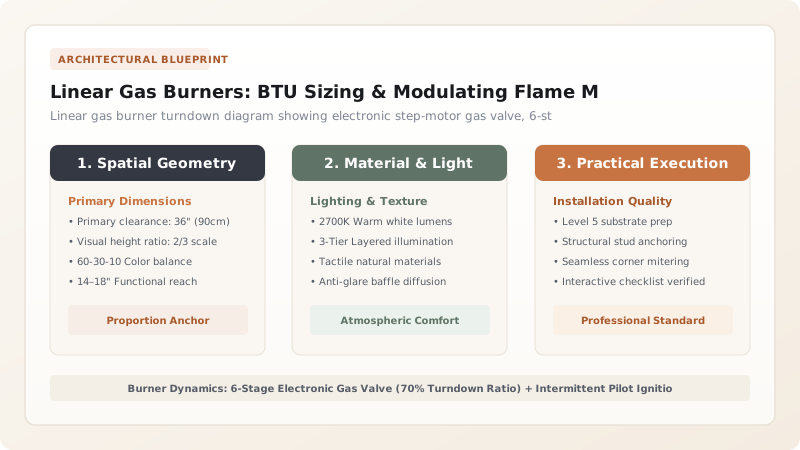
1. Thermal Engineering: Room Volume BTU Sizing Calculations
The most common homeowner complaint with linear gas fireplaces is Room Overheating: installing a non-modulating 60,000 BTU burner in a 400 sq.ft room makes the space unbearable within 15 minutes, forcing owners to turn off the fireplace.
HVAC engineers calculate fireplace thermal sizing using the 35 BTU per Square Foot Rule:
$$\text{Required BTU} = \text{Room Area (sq.ft)} \times 35\text{ BTU/sq.ft}$$
For a \(20\times30\text{-foot}\) living room (\(600\text{ sq.ft}\)), the ideal continuous thermal output is 21,000 BTU/hr. Sizing the burner requires a high-turndown modulating valve. Review wall chasing in cool-touch chase venting.

2. Step-Motor Gas Valves & Electronic Intermittent Pilot Ignition
To enjoy a magnificent 6-foot wide ribbon flame year-round without baking the living room, specify burners with a 70% Turndown Ratio Modulating Valve (such as SIT Proflame 2).
The valve throttles maximum firebox output from 55,000 BTUs down to 16,500 BTUs while maintaining tall, lively golden flame tips. Electronic Intermittent Pilot Ignition (IPI) lights the burner instantly on demand. Combine with concrete floating hearths.
Linear Gas Burner Specifications by Width
Use this reference table to calculate exact physical dimensions, ratios, and specifications before purchasing:
| Burner Width | Max BTU Output | Min Modulated BTU (70% Turndown) | Gas Pipe Diameter (50ft run) |
|---|---|---|---|
| 48 Inches (1.2m) | 35,000 BTU/hr | 12,000 BTU/hr | 1/2" Black Iron Pipe |
| 60 Inches (1.5m) | 45,000 BTU/hr | 15,000 BTU/hr | 3/4" Black Iron Pipe |
| 72 Inches (1.8m) Optimal | 55,000 BTU/hr | 17,500 BTU/hr | 3/4" Black Iron Pipe |
| 84 - 96 Inches (2.4m) | 70,000 BTU/hr | 22,000 BTU/hr | 1.0" Black Iron Pipe (High flow) |
Undersized Gas Pipe Starvation Constraints
Every successful decoration project must account for physical and environmental constraints:
Undersized 1/2" Gas Pipe Over 60 Feet Causing Fireplace Flame to Whistle and Flame Out
Long gas pipe runs suffer pressure drops; a 60,000 BTU linear burner fed by 1/2" pipe over 50ft starves for gas, causing yellow soot and burner popping; strictly size gas supply pipe to 3/4" or 1" black iron pipe per NFPA 54 National Fuel Gas Code sizing tables.
How to Size, Pipe, and Calibrate a Linear Gas Burner
Execute this professional sequence to achieve flawless results without backtracking:
Calculate Room Heating Load (BTU/hr)
Multiply room square footage × 35 BTU/sq.ft to determine target thermal comfort range.
Size Gas Supply Pipe per NFPA 54 Tables
Plumb 3/4" black iron gas line from meter to fireplace chase to deliver 7.0" w.c. natural gas pressure.
Install SIT Proflame 2 Modulating Gas Valve
Connect electronic step-motor gas valve and intermittent pilot ignition (IPI) control module.
Arrange Reflective Ceramic Glass Media
Spread 1/2" crushed black reflective glass media evenly over burner pan, leaving pilot hood clear.
Test Manifold Pressure with Digital Manometer
Measure 3.5" w.c. manifold pressure on High burn and 1.1" w.c. on Low burn; calibrate if needed.
Pair Wireless Thermostatic Remote Control
Program wireless remote for Smart Thermostat mode to auto-modulate flame height based on setpoint.
Common Mistakes & Countermeasures
Avoid these costly errors that compromise aesthetics, ergonomics, and budget:
Piling Ceramic Glass Media Over the Pilot Assembly Hood
Project Execution Checklist
Track your physical progress. Checkboxes persist automatically on this device:
Frequently Asked Questions
Can a linear gas fireplace run on Liquid Propane (LP) instead of Natural Gas (NG)?
Yes! Linear fireplaces can be ordered or converted for LP propane using a factory-certified conversion kit with smaller orifice jets and high-pressure LP regulator springs (10.0" w.c. manifold pressure).


