
Engineer cool-touch fireplace wall chases by framing a continuous double-wall cavity around the linear firebox. Incorporate a minimum 120 sq.in bottom air intake slot and a matching 120 sq.in top discharge register located 12 inches below the ceiling, ensuring drywall surface temperatures behind the TV stay below 100°F (38°C).
At a Glance: Key Takeaways
- Convective Airflow Physics: Utilizes natural stack effect (buoyancy) to pull cold air from the floor and evacuate heat near the ceiling.
- Drywall Temperature <100°F (38°C): Protects sensitive OLED television electronics, warranty validity, and delicate wall art.
- 12-Inch Minimum TV Clearance: Allows mounting television just 12 inches above the firebox opening without expensive heat deflectors.
- Shadow-Gap Louver Finishes: Top and bottom vents disguised as sleek 1/2" continuous architectural shadow reveal slots.
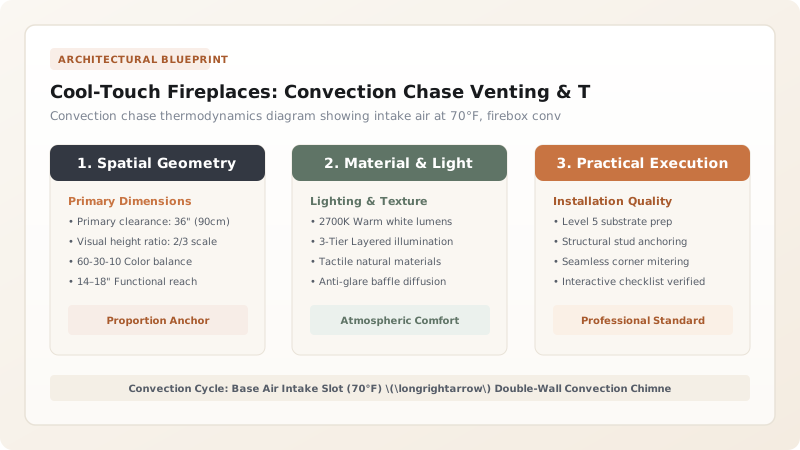
1. Thermodynamic Physics: The Stack Effect Convection Chimney
When a 50,000 BTU linear gas fireplace runs inside a sealed drywall box, temperatures inside the wall cavity reach over \(220^{\circ}\text{F} (104^{\circ}\text{C})\), causing drywall paper to char, paint to blister, and TVs to suffer catastrophic board failure.
The Cool-Wall Convection Chase converts the wall cavity into a natural Thermal Siphon (*Stack Effect*). Cool room air (\(70^{\circ}\text{F}\)) enters through a continuous floor intake slot, rises past the double-walled firebox jacket absorbing radiant heat, and exhausts harmlessly near the ceiling at under \(110^{\circ}\text{F}\). This keeps the wall face directly above the glass at a cool \(90^{\circ}\text{F} - 98^{\circ}\text{F}\). Compare with linear burner modulation.

2. Television Clearances & Non-Combustible Substrate Mandate
With cool-touch convection venting certified, manufacturers permit OLED and QLED televisions to be mounted 12 inches (305mm) above the top of the glass viewing area without voiding TV manufacturer warranties.
The entire front face of the chase must be clad in 1/2-inch Non-Combustible Cement Board (such as USG Durock or Promat Promafour) taped with high-temperature fiberglass mesh and refractory setting compound. Review floating hearth construction in concrete floating hearth framing.
Fireplace Enclosure Temperatures Comparison
Use this reference table to calculate exact physical dimensions, ratios, and specifications before purchasing:
| Wall Chase Enclosure Type | Wall Surface Temp Above Flame | Safe TV Mounting Distance | Risk of TV Failure |
|---|---|---|---|
| Cool-Touch Double-Wall Convection (Optimal) | 90°F - 98°F (32°C - 37°C) | 12 Inches (305mm) | Zero Risk (Safe for OLED TVs) |
| Traditional Sealed Drywall Chase | 175°F - 220°F (80°C - 104°C) | 36"+ (Requires deep mantel hood) | EXTREME: Melts TV screen & solder |
| Power-Vented Heat-Dump System | 85°F - 92°F (29°C - 33°C) | 8 Inches (200mm) | Zero Risk (Room stays cool) |
| Direct Vent with Deep Deflector Baffle | 125°F - 140°F (52°C - 60°C) | 24 Inches (610mm) | Moderate: Decreases TV lifespan |
Standard Joint Compound Heat Cracking Constraints
Every successful decoration project must account for physical and environmental constraints:
Standard Drywall Mud Cracking in Seams Directly Above Linear Fireplace Glass
Standard premixed drywall joint compound contains water-soluble starches that shrink and crack when heated to 120°F; strictly use non-combustible calcium-silicate setting compound (Promat Promafour-GLUE) or high-temp refractory cement taped with alkali-resistant mesh.
How to Frame a Cool-Touch Convection Wall Chase
Execute this professional sequence to achieve flawless results without backtracking:
Frame Steel Chase with 16-Gauge Studs
Erect non-combustible steel stud chase, ensuring 2" minimum clearance to firebox chassis.
Frame Bottom 120 Sq.In Air Intake Opening
Create a 3" × 40" (120 sq.in) opening at the base of the chase beneath the hearth level.
Frame Top 120 Sq.In Heat Release Register
Create a matching 3" × 40" opening at the top of the chase 12 inches below the ceiling.
Install Double-Wall Air Convection Ducting
Connect factory cool-wall convection air ducts from firebox to the top release plenum.
Hang Non-Combustible Calcium-Silicate Board
Fasten 1/2" Promat or Durock cement board over front chase face with self-tapping steel screws.
Thermal Gun Inspection at Full Burn
Fire burner on high for 2 hours; verify with infrared laser thermometer that TV zone remains <100°F.
Common Mistakes & Countermeasures
Avoid these costly errors that compromise aesthetics, ergonomics, and budget:
Blocking the Top Heat Release Plenum with Ceiling Crown Molding
Project Execution Checklist
Track your physical progress. Checkboxes persist automatically on this device:
Frequently Asked Questions
Do cool-touch convection chases require electric blower fans?
No! High-end systems (such as Flare or Ortal) operate via 100% silent natural gravity convection (the chimney stack effect). Electric blowers are optional for rapid room heating but unnecessary for thermal wall protection.


