
Decant pantry food by selecting modular square/rectangular borosilicate glass canisters with airtight silicone-sealed bamboo or stainless steel lids. Match container volume to standard bag sizes (e.g. a 4.4-quart canister fits a full 5-lb bag of flour with zero awkward leftover baggies).
At a Glance: Key Takeaways
- Volume Sizing Math: A standard 5-lb bag of all-purpose flour requires a 4.4-quart (4.2-liter) canister.
- Rectangular Space Efficiency: Square and rectangular canisters hold 25% more food per linear shelf foot than round jars.
- Silicone Gasket Seal: 100% airtight seals keep pantry moths, humidity, and ants out while locking in freshness.
- Minimalist Labeling: Waterproof vinyl labels with expiration date grease-pencil tabs on the underside.
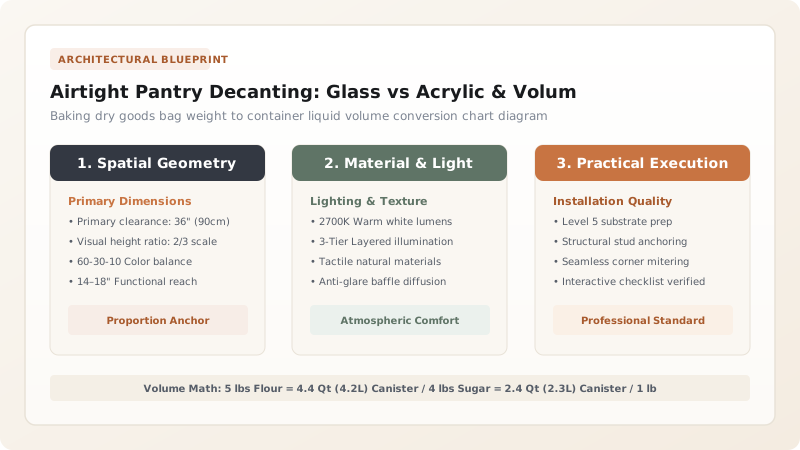
1. Volume Mathematics: Bag Weights vs Dry Volume Densities
The most frustrating experience in pantry decanting is pouring a bag of flour into a new canister, only to find the container fills to the top while 1 cup of flour remains in the bag, leaving an ugly, half-empty bag sitting on your shelf.
Weight (pounds) does NOT equal Volume (quarts) for dry pantry goods. Different dry goods have vastly different bulk densities:
- 5 lbs of All-Purpose Flour is fluffy and requires 4.4 Quarts (4.2 Liters) of container volume.
- 4 lbs of Granulated Sugar is dense and requires only 2.4 Quarts (2.3 Liters) of volume.
- 1 lb Box of Penne Pasta requires 2.0 Quarts of volume due to empty air pockets between noodles.

Pantry Food Weight to Canister Volume Sizing Guide
Use this reference table to calculate exact physical dimensions, ratios, and specifications before purchasing:
| Standard Grocery Packaging | Dry Food Item | Mandatory Canister Volume | Optimal Canister Shape |
|---|---|---|---|
| 5 lb Standard Bag | All-Purpose / Bread Flour | 4.4 Quarts (4.2 Liters / 140 oz) | Tall rectangular (Wide scoop mouth) |
| 4 lb Standard Bag | Granulated White Sugar | 2.4 Quarts (2.3 Liters / 80 oz) | Medium rectangular |
| 2 lb Bag | Brown Sugar / Confectioners | 1.6 Quarts (1.5 Liters / 50 oz) | Medium square with terra cotta disc |
| 1 lb Standard Box | Spaghetti / Long Pasta | 2.2 Quarts (Tall 12" Cylinder) | 12-Inch Tall Pasta Tube |
| 1 lb Standard Box | Short Pasta (Penne/Rigatoni) | 2.0 Quarts (1.9 Liters) | Medium square canister |
Expiration Date & Cooking Time Loss Constraints
Every successful decoration project must account for physical and environmental constraints:
Losing Pasta Cooking Times and Expiration Dates After Decanting
Throwing away pasta boxes loses the 9-minute boil instructions and expiration date; cut the cooking instructions off the cardboard box and tape inside the jar lid, or write the date on the bottom with a washable grease pencil.
How to Execute a Unified Pantry Decanting Plan
Execute this professional sequence to achieve flawless results without backtracking:
Select Single Modular Canister System
Choose a stackable modular brand (like OXO Good Grips or Glasslock) for uniform sizing.
Buy Correct Volume Sizes
Purchase 4.4-Qt for flour, 2.4-Qt for sugar, and 1.6-Qt for grains and oats.
Wash and 100% Dry Canisters
Ensure jars are bone dry; a single droplet of moisture will mold an entire batch of flour.
Apply Centered Waterproof Labels
Use a positioning jig to apply matte waterproof vinyl labels at identical heights on all jars.
Common Mistakes & Countermeasures
Avoid these costly errors that compromise aesthetics, ergonomics, and budget:
Buying Round Glass Mason Jars for Compact Pantry Shelves
Project Execution Checklist
Track your physical progress. Checkboxes persist automatically on this device:
Frequently Asked Questions
Is glass or BPA-free plastic better for pantry canisters?
Borosilicate glass is non-porous, dishwasher safe, scratch-proof, and will never absorb food odors or oil stains. High-grade BPA-free acrylic (like OXO Pop) is lighter and safer for households with young children.


