
Raking authentic Zen dry landscape gravel (Samon) requires 2–5mm sub-angular crushed Shirakawa granite (Shirakawa-Suna) and custom heavy wooden rakes (Mokuren). The angular quartz and feldspar granules interlock to form crisp 2-inch deep ridges that withstand heavy rain without slumping, creating concentric ripple rings (Sazanami) around boulders that blend into linear ocean waves.
At a Glance: Key Takeaways
- Kyoto Shirakawa Granite Mineralogy: 2–5mm angular decomposed granite containing quartz, feldspar, and biotite mica that sparkles in sunlight.
- Mechanical Interlocking Physics: Angular facet geometry locks particles together under rake compression, resisting wind and rain erosion.
- Custom Cedar Wooden Rakes (Mokuren): Heavy cypress or cedar rakes with 2-inch trapezoidal wooden teeth spaced 2 inches on-center.
- Concentric Ripples (Sazanami): Continuous circular wave rings radiating from boulder bases symbolize water expanding outward from islands.
- Linear Ocean Swells (Seikaiha): Broad parallel lines traversing the garden length simulate deep ocean currents and cosmic flow.
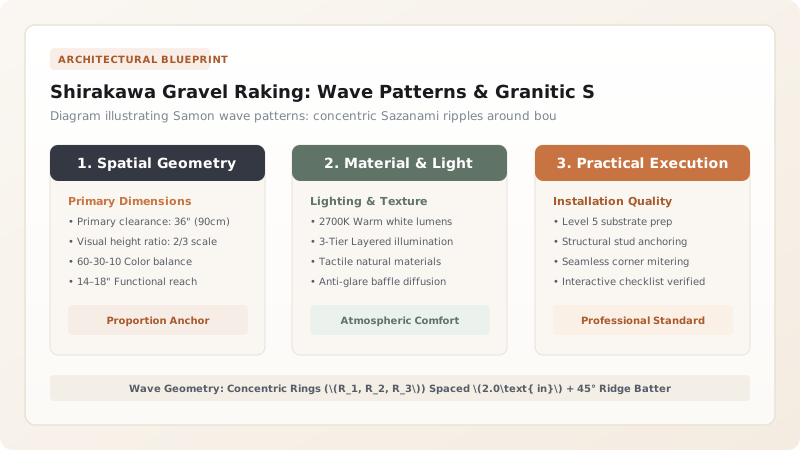
1. Granitic Particle Physics: Angularity & The Shear Interlocking Mechanism
Why do Japanese Zen dry gardens demand Shirakawa Decomposed Granite (Shirakawa-Suna) rather than ordinary gravel? The answer lies in soil mechanics and the Angle of Internal Friction (\(\phi\)).
Standard landscaping pea gravel consists of river-worn rounded pebbles. Under Mohr-Coulomb failure criteria, rounded pebbles have a very low angle of internal friction (\(\phi \approx 28^\circ\)) and zero cohesion. When raked into sharp ridges, gravity and vibration cause the round stones to roll downward into the valleys, flattening the pattern within hours.
In contrast, Authentic Shirakawa Gravel (2 to 5mm size) is naturally decomposed, crushed mountain granite featuring rough, sharp Sub-Angular Particle Morphology:
When the heavy wooden rake compresses the gravel bed, the microscopic jagged facets of quartz and feldspar mechanically interlock. The resulting raked ridges can stand at steep \(45^\circ\) Batter Angles, holding crisp 2-inch deep wave peaks through heavy windstorms and torrential summer downpours without washing out. Learn about boulder setting in our guide to Sanzon rock setting.
2. Tool Craftsmanship: Anatomy of the Traditional Cedar Rake (Mokuren)
Commercial metal garden rakes or flexible leaf rakes are completely unusable in a Karesansui garden—they leave ragged scratch marks and bounce over aggregate. Zen gardeners hand-craft heavy Wooden Garden Rakes (Mokuren) from Japanese Hinoki cypress, red cedar, or white oak.
The tool is engineered with specific architectural geometry:
- The Head Bar: Solid hardwood beam (24\" to 36\" wide × 3\" deep × 2\" tall) weighted with lead weights to achieve an overall tool weight of 8 to 12 pounds. The heavy mass compresses the gravel automatically without requiring downward muscle pressure.
- Trapezoidal Teeth: Hand-carved teeth spaced strictly \(1.75 \text{ to } 2.25 \text{ inches}\) on-center. Each tooth has a tapered trapezoidal cross-section (1-1/2\" wide at base, tapering to 3/4\" at tip, 2-1/2\" length). This shape packs the side slopes of the gravel ridge as it drags through the bed.
- Long Bamboo Handle: A 10- to 12-foot flexible bamboo pole allows the gardener to rake expansive 15-foot swathes while standing on stepping stones without leaving footprints in the gravel.
Check out our Japanese Zen gardens hub.
3. The Art of Samon: Water Ripples, Linear Oceans & Swirling Currents
The traditional gravel patterns (Samon — 沙紋) represent various manifestations of cosmic water:
- Sazanami (Concentric Water Ripples): Concentric rings raked around individual boulders or moss islands. The gardener begins at the stone perimeter and rakes three to five continuous, unbroken circles, simulating the ripple effect of raindrops striking a tranquil pond.
- Seikaiha (Blue Ocean Waves): Interlocking semicircular scales or overlapping cresting wave arcs representing the vast, rolling Pacific Ocean.
- Chosen (Straight Stream Lines): Long, perfectly straight parallel lines running the full length of the courtyard, representing a serene, flowing mountain river carrying consciousness toward eternity.
- Hamon (Swirling Eddies): Spiraling whirlpool patterns raked into corner bays to represent deep ocean vortexes and hidden spiritual depth.
Discover moss cultivation in our guide to moss mound transplanting and mist systems.
4. The Raking Kata: Kinesthetic Posture & Footprint Management
Raking a Karesansui garden is not maintenance chore; it is an active physical meditation requiring strict movement discipline (Kata):
- Backward Walking: The gardener always walks backward along the path of the rake, dragging the tool smoothly ahead of their body. The rake teeth immediately erase the gardener's footprints, leaving pristine undisturbed waves in their wake.
- Core Engagement: Movement originates from the lower abdomen (Hara / Dantian). The arms remain relaxed; the entire body moves with slow, rhythmic ocean-like strides.
- Intersection Blending: When straight river lines intersect circular ripples around stones, the straight lines stop precisely at the outer concentric ring with zero overlap, creating crisp visual borders.
Contrast with formal espalier cabling in our guide to formal espalier architecture.
Shirakawa Gravel Raking: Wave Patterns & Granitic Sand Physics Architectural Decision Matrix
Use this reference table to calculate exact physical dimensions, ratios, and specifications before purchasing:
| Architectural Factor | Professional Recommendation | Significance |
|---|---|---|
| Gravel Origin | Authentic Kyoto Shirakawa crushed granite (2–5mm) | Sub-angular grain morphology; high quartz/feldspar/mica ratio; non-slumping |
| Rake Fabrication | Hand-crafted Hinoki or Cedar heavy wooden rake | Weight 8–12 lbs; 2" trapezoidal teeth on 2" on-center spacing |
| Gravel Bed Moisture | Light water misting prior to raking | Capillary surface tension locks dust and sharpens raked ridge crests |
| Ridge Height Tolerance | 1.75 to 2.25 inches (45mm to 57mm) ridge-to-valley | Deep ridges cast dramatic morning shadows while shedding heavy rain |
Execution Blueprint & Craftsmanship Sequence
Execute this professional sequence to achieve flawless results without backtracking:
Phase 1: Surface Debris Clearing
Flick away fallen leaves and twigs using soft bamboo broom (Hoki) without disturbing underlying gravel (Benchmark: Surface 100% free of organic debris and leaf tannins)
Phase 2: Pre-Raking Water Misting
Mist gravel bed with fine garden hose sprayer until stones are uniformly damp (not soaked) (Benchmark: Capillary tension activated; zero airborne stone dust during raking)
Phase 3: Concentric Stone Ripples (Sazanami)
Rake 3 to 5 continuous concentric circular rings around all boulder clusters and moss islands (Benchmark: Rings perfectly concentric; uniform 2" depth; smooth connection at circle closure)
Phase 4: Linear Ocean Waves (Chosen)
Walk backward across garden dragging weighted wooden rake in long, uninterrupted parallel passes (Benchmark: Lines laser-straight; footprints 100% erased; lines terminate crisply at circular rings)
Phase 5: Perimeter Edge Tucking
Tuck gravel neatly against stone curbs and engawa veranda using small handheld hand-rake (Benchmark: Zero gravel spillage onto walkways; edge reveal uniform ±1/8")
Common Mistakes & Countermeasures
Avoid these costly errors that compromise aesthetics, ergonomics, and budget:
Raking Dry, Dusty Gravel
Using a Lightweight Metal Bow Rake
Stepping on Raked Gravel After Raking
Using Rounded River Pea Gravel
Project Execution Checklist
Track your physical progress. Checkboxes persist automatically on this device:
Frequently Asked Questions
How long does a freshly raked gravel garden pattern last?
When raked with authentic angular Shirakawa granite, patterns typically remain crisp for two to three weeks under mild weather. In Kyoto, gardens are raked every 7 to 10 days to maintain pristine meditative perfection. A heavy rainstorm will slightly soften ridge crests but will not wash out the deep 2-inch channels.
Can I rake a Zen gravel garden if I have pine trees overhead?
Yes, but pine needles must be cleared prior to raking. Japanese gardeners use a traditional soft bamboo broom (Hoki) swept with featherlight surface strokes to lift pine needles off the ridge peaks without disturbing the gravel ridges below.
Why are there small mounds of gravel at the entrance of some Zen gardens?
These cone-shaped mounds of sand (called *Kogetsudai* or *Morijuna*) have both practical and spiritual significance. Spiritually, they symbolize sacred mountains (like Mount Fuji) and purify visitors entering temple grounds; practically, they serve as reserve storage piles of clean gravel used by monks to touch up the raked patterns.


