
Cultivating authentic Japanese moss mounds in Karesansui gardens requires establishing acidic volcanic soil substrates (Kanuma clay/pumice, pH 5.0–5.5), transplanting mature Polytrichum commune (Haircap) or Hypnum cupressiforme moss sods, and providing dappled shade. Sustaining lush green moss requires high-pressure (800 psi) micro-mist irrigation systems delivering 50-micron droplets that hydrate leaves without washing away soil.
At a Glance: Key Takeaways
- Botanical Bryophyte Science: Mosses lack true roots, absorbing 100% of moisture and nutrients directly through their leaves via capillary action.
- Acidic Volcanic Substrate (pH 5.0–5.5): Kanuma and Akadama clay pumice blends prevent alkaline mineral lockup that causes moss yellowing.
- Polytrichum commune (Haircap Moss): The legendary moss of Kyoto temples, forming dense, upright, velvet green cushions up to 3 inches tall.
- High-Pressure Micro-Mist Emitters: 800 psi stainless fog nozzles deliver 50-micron water droplets, simulating mountain cloud forest humidity.
- Dappled Shade Canopy: Deciduous Japanese maples (Acer palmatum) provide 60%–70% dappled shade, protecting delicate fronds from scorching.
1. Bryophyte Physiology: Poikilohydry & Capillary Leaf Hydration
Unlike vascular plants that draw water from deep taproots through vascular xylem tubes, Mosses (Bryophytes) are non-vascular, Poikilohydric Organisms. They possess no true roots, only microscopic hair-like filaments called Rhizoids that serve solely to anchor the plant mechanically to soil or rock.
Moss absorbs 100% of its moisture and nutrients directly from the air and rain through its single-cell-thick leaves. Under dry conditions, moss cells suspend metabolic activity and enter dormancy without dying. However, to maintain the glowing emerald green velvet luster seen in Kyoto's Saiho-ji (\"Kokedera\" Moss Temple), relative humidity around the plant cushions must be maintained above \(70\% - 85\%\) for several hours each morning.
Drenching moss with heavy overhead lawn sprinklers is disastrous: heavy water droplets erode the soil beneath the rhizoids, churning mud onto the leaves and choking off photosynthesis. Moss requires ultra-fine atmospheric misting. Learn about rock placement in our guide to Sanzon rock setting.
2. Soil Chemistry: The Kanuma & Akadama Acidic Volcanic Soil Bed
Standard alkaline garden soils or potting soils containing lime will kill Japanese moss within weeks. Bryophytes require an Acidic, Nutrient-Poor Soil Substrate with a pH of 5.0 to 5.5.
Master Japanese gardeners build moss mounds using traditional volcanic soil blends imported from Japan:
| Substrate Component | Mineral Origin | Chemical Property / pH | Volume Ratio |
|---|---|---|---|
| Kanuma Soil (鹿沼土) | Zeolitic volcanic pumice from Tochigi | Acidic (pH 4.8 – 5.2), highly porous | 50% |
| Akadama Soil (赤玉土) | Hard-baked volcanic red clay granules | Neutral to slightly acidic (pH 6.0), high CEC | 30% |
| Sphagnum Peat Moss | Decomposed wetland peat moss | Acidic (pH 4.0), moisture retention | 20% |
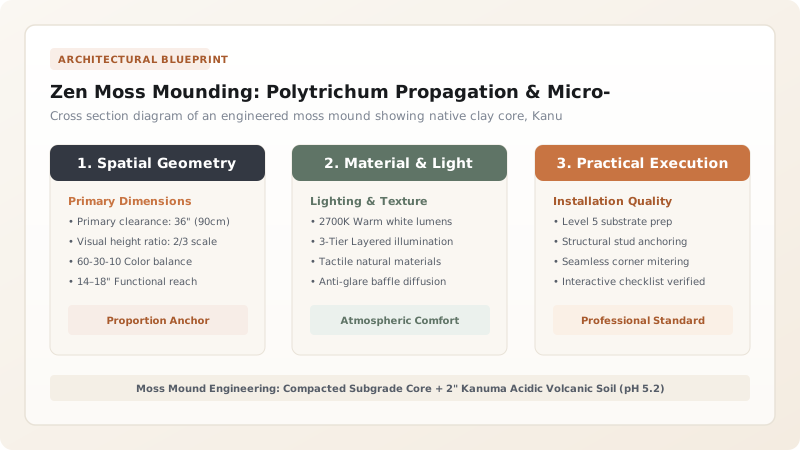
The mound is sculpted with gentle, organic undulating curves, rising 6 to 18 inches above the surrounding gravel bed. The acidic volcanic granules provide exceptional drainage while buffering moisture around the delicate rhizoids. Check out our Japanese Zen gardens hub.
3. Species Selection: Haircap, Sheet & Cushion Mosses
Selecting moss species must match microclimate exposure:
- Polytrichum commune (Sugi-goke / Haircap Moss): The undisputed king of temple gardens. Grows in dense, upright, miniature forest-like stalks reaching 2 to 4 inches tall. Requires consistent moisture and 60% dappled shade; tolerates gentle morning sun.
- Hypnum cupressiforme (Hai-goke / Sheet Moss): A creeping, prostrate moss that forms flat, dense green carpets over rocks, soil, and roots. Highly drought-tolerant; ideal for mound transitions bordering gravel.
- Leucobryum glaucum (Shiro-goke / Cushion Moss): Forms dense, silvery-green rounded pincushions. Thrives on shaded mounds beneath Japanese maples and black pines.
Explore gravel raking in our guide on Shirakawa gravel raking.
4. Microclimate Engineering: 800 PSI Stainless Fogging Systems
In hot, dry summer climates or urban courtyards, maintaining moss without an automated environmental control system is impossible. Landscape architects install High-Pressure Micro-Mist Systems (such as Koolfog or TrueFog).
A commercial high-pressure ceramic plunger pump pressurizes filtered water to \(800 \text{ to } 1,000 \text{ psi}\), feeding flexible 316 stainless steel lines concealed beneath stone edges and tree branches. Anti-drip ruby-orifice mist nozzles atomize water into a dense, billowing cloud of \(30 \text{ to } 50 \mu\text{m}\) Micro-Droplets.
The system operates on an automated cycle: running for 45 seconds every 15 minutes during early morning hours (6:00 AM to 9:30 AM). The fog settles gently over the moss mounds like authentic mountain clouds, saturating the leaves without displacing soil or wetting adjacent raked Shirakawa gravel. Contrast with orchard trellising in our guide to formal espalier architecture.
Zen Moss Mounding: Polytrichum Propagation & Micro-Mist Systems Architectural Decision Matrix
Use this reference table to calculate exact physical dimensions, ratios, and specifications before purchasing:
| Architectural Factor | Professional Recommendation | Significance |
|---|---|---|
| Soil Substrate pH | pH 5.0 to 5.5 (50% Kanuma + 30% Akadama + 20% Peat) | Prevents alkaline chlorosis; high capillary moisture retention |
| Irrigation Technology | High-pressure (800–1,000 psi) micro-mist fogging | Droplet size 30–50 microns; elevates local RH > 80% without soil wash |
| Canopy Shading Ratio | 60% to 75% Dappled shade from deciduous trees | Protects Polytrichum chloroplasts from photolytic sun scorch |
| Transplant Technique | Intact nursery-grown moss turf sods with 1/2" soil backing | Establishment success rate > 90% vs <30% for chopped moss slurry |
Execution Blueprint & Craftsmanship Sequence
Execute this professional sequence to achieve flawless results without backtracking:
Phase 1: Soil Mound Sculpting
Sculpt subgrade clay mound with gentle undulating contours rising 12" around boulder bases (Benchmark: Slopes graded to maximum 3:1 pitch to prevent water runoff erosion)
Phase 2: Acidic Volcanic Substrate Spreading
Spread 2" layer of Kanuma/Akadama volcanic soil blend; firm lightly with wooden paddle (Benchmark: Substrate pH tested between 5.0 and 5.4 with digital soil pH probe)
Phase 3: High-Pressure Mist Line Concealment
Trench 1/4" flexible stainless high-pressure mist lines around mound perimeter, disguise nozzles in rock crevices (Benchmark: Nozzles aimed upward at 45° angle; lines tested to 1,000 psi with zero leaks)
Phase 4: Live Moss Turf Setting
Lay mature Polytrichum moss sods tightly edge-to-edge, pressing firmly into damp Kanuma soil (Benchmark: Zero gaps between sods; seams pinned with biodegradable bamboo hairpins)
Phase 5: Automated Cycle Commissioning
Program high-pressure pump controller for morning dew cycles; observe fog coverage across mounds (Benchmark: Billowing fog blankets 100% of moss surface; zero overspray onto adjacent gravel)
Common Mistakes & Countermeasures
Avoid these costly errors that compromise aesthetics, ergonomics, and budget:
Using Hard Alkaline Tap Water for Irrigation
Watering with Standard Heavy Lawn Sprinklers
Planting in Full Hot Afternoon Sun
Applying Commercial Chemical Lawn Fertilizers
Project Execution Checklist
Track your physical progress. Checkboxes persist automatically on this device:
Frequently Asked Questions
Can I grow Japanese moss from the popular 'buttermilk and beer blender' recipe?
The internet myth of blending moss with buttermilk or beer is largely ineffective in outdoor gardens. The high fat and sugar content in milk breeds mold, attracts fruit flies, and rots before moss spores can germinate. The only reliable method for luxury gardens is laying mature, nursery-grown moss turf sods over acidic volcanic soil.
What happens to Polytrichum moss in the winter under heavy snow?
Polytrichum moss is extremely cold-hardy. Under winter snow, the moss remains fully alive in a state of suspended animation. When the snow melts in early spring, the moss emerges with an intensely vibrant, glowing emerald green color.
How do you control weed seedlings from sprouting in the moss mounds?
Weeding in a Japanese moss garden is performed entirely by hand. Gardeners inspect mounds weekly, using fine-tipped bonsai tweezers to pluck tiny weed sprouts by their roots before they can establish in the dense bryophyte carpet.


