
Treating terracotta tommettes requires a time-tested natural oil saturation process. Following a 30-day mortar curing window, successive coats of heated boiled linseed oil and pure gum spirits of turpentine (blended from 50/50 down to 90/10) penetrate deep into the clay pores. Once polymerized, the surface is buffed with carnauba and beeswax paste, delivering an impervious, satin-sheen patina that deepens with age.
At a Glance: Key Takeaways
- Linseed Oil Polymerization: Triglyceride linolenic acid reacting with atmospheric oxygen to form durable linoxin.
- Pine Turpentine Carrier: Natural terpene solvent reducing oil viscosity for deep capillary penetration.
- Graduated Dilution Ratios: Coat 1 (50% oil/50% turpentine), Coat 2 (70/30), Coat 3 (90/10).
- Excess Oil Removal: Wiping all surface puddles within 30 minutes to prevent sticky, gummy varnish films.
- Carnauba Hard Wax Topcoat: Brazilian palm wax providing high abrasion resistance and water-droplet beading.
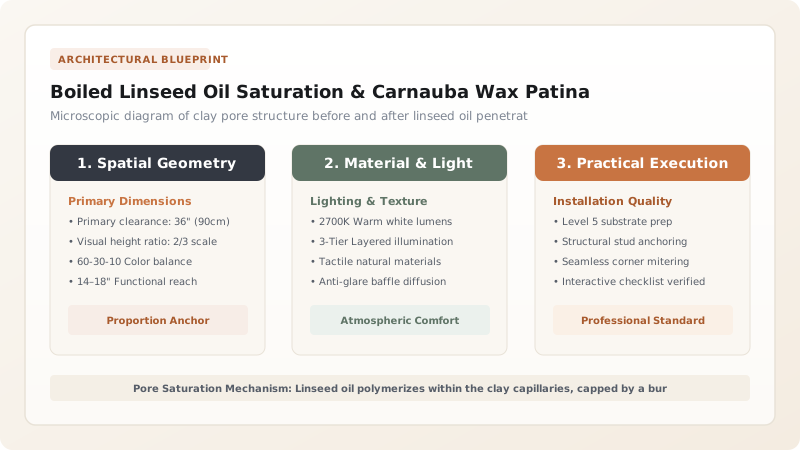
1. Polymerization Chemistry of Linseed Oil in Terracotta
Boiled linseed oil (huile de lin cuite) is an organic drying oil extracted from flax seeds (Linum usitatissimum) and pre-oxidized through heating with natural metallic driers. Unlike non-drying oils (like olive oil or mineral oil) that remain wet and turn rancid, linseed oil contains high concentrations of polyunsaturated fatty acids, particularly alpha-linolenic acid (50–55%) and linoleic acid (15–20%).
When exposed to atmospheric oxygen, these unsaturated double bonds undergo free-radical cross-linking polymerization:
This reaction transforms liquid oil into linoxin—a dense, flexible, rubbery solid embedded directly within the microscopic pores of the terracotta. Because the polymer resides inside the clay capillaries rather than sitting as a topical plastic film, it can never peel, chip, or flake away.
2. The Three-Stage Saturation Protocol
Before any oil touches the floor, the lime mortar and tiles must be completely dry (residual moisture < 3%). If oil is applied over damp tiles, trapped moisture will react with the oil, producing cloudy white emulsions and mold beneath the seal.
The traditional Provençal oil treatment follows a strict three-coat sequence applied over three consecutive days:
- First Coat (50% Oil / 50% Turpentine): The low-viscosity mix penetrates 3mm to 6mm deep into the dry clay. Apply generously with a wide natural bristle brush. After 20 to 30 minutes, thoroughly buff away any excess liquid oil pooling on the surface with clean cotton rags.
- Second Coat (70% Oil / 30% Turpentine): Applied 24 hours later. The increased oil concentration fills the intermediate capillary channels. Again, wipe away all unabsorbed surface oil after 30 minutes.
- Third Coat (90% Oil / 10% Turpentine): Applied on day three to saturate the uppermost pore layer. Thoroughly wipe the floor bone-dry to touch.
Warning: Rags soaked in linseed oil undergo exothermic oxidation and can spontaneously combust. Always submerge used rags in water before outdoor disposal.
3. The Carnauba & Beeswax Burnishing Finish
While polymerized linseed oil makes terracotta water-resistant, the exposed surface remains microscopically matte and slightly soft. To achieve the legendary silky, honeyed luster of Provençal manor floors, craftsmen apply a final topcoat of hard paste wax:
- Carnauba Wax (Copernicia prunifera): Derived from Brazilian palm fronds, carnauba is the hardest natural wax known (melting point 82°C–86°C), providing exceptional scratch and scuff resistance.
- Pure Beeswax (Cera alba): Adds elasticity, pleasant natural scent, and warm golden tones.
The wax paste is buffed onto the fully cured floor (7 to 10 days after oiling) using a mechanical rotary floor buffer fitted with a natural horsehair brush or lambswool bonnet. The friction heat melts the wax slightly into the tile surface, creating a mirror-smooth, liquid-repellent seal that beads water droplets instantly.
Linseed Oil & Wax Application Schedule
Use this reference table to calculate exact physical dimensions, ratios, and specifications before purchasing:
| Application Stage | Formula Mixture | Waiting / Cure Time | Crucial Execution Rule |
|---|---|---|---|
| Subfloor Dry Check | Moisture meter reading < 3% | 30-45 days post-grouting | Zero efflorescence haze; clean with black soap prior to oiling |
| Pass 1 (Deep Primer) | 50% Boiled Linseed Oil / 50% Pine Turpentine | Wait 24 hours before Pass 2 | Wipe all standing puddles bone-dry after 20 minutes |
| Pass 2 (Pore Filler) | 70% Boiled Linseed Oil / 30% Pine Turpentine | Wait 24 hours before Pass 3 | Ensure uniform color darkening across all tiles |
| Pass 3 (Surface Saturation) | 90% Boiled Linseed Oil / 10% Pine Turpentine | Cure 7 days before waxing | Zero sticky residue permitted on surface |
| Final Wax Burnish | 70% Carnauba wax / 30% Beeswax paste | Buff immediately when dry | Machine buff with horsehair pad to generate friction heat |
Safety & Operational Constraints
Every successful decoration project must account for physical and environmental constraints:
Spontaneous Combustion Hazard
Linseed oil rags generate internal heat as the oil cures; immerse all used rags in water-filled metal cans immediately.
Ventilation Requirements
Pure gum turpentine emits strong pine terpenes; ensure continuous cross-ventilation during application and wear organic vapor respirators.
Protocol for Oiling and Waxing Terracotta Tommettes
Execute this professional sequence to achieve flawless results without backtracking:
Substrate Moisture & Cleanliness Verification
Verify tiles have cured for 30+ days. Wash with dilute black soap, vacuum thoroughly, and allow 48 hours to dry completely.
First Pass Application (50/50)
Heat the 50/50 linseed oil and turpentine mixture in a double boiler to 40°C; apply evenly with wide floor brushes.
Thorough Rag Buffing
Exactly 25 minutes after application, buff the floor vigorously with dry cotton cloths to remove every trace of unabsorbed liquid oil.
Second Pass (70/30) & Third Pass (90/10)
Apply sequential coats at 24-hour intervals, strictly repeating the 25-minute rag-buffing wipe-down after each application.
Polymerization Curing Window
Allow the oiled floor to oxidize and polymerize undisturbed for 7 days under good ventilation.
Carnauba Paste Wax Burnishing
Apply a thin coat of carnauba-beeswax paste; allow 30 minutes to haze, then burnish to a high satin sheen with a rotary floor buffer.
Common Mistakes & Countermeasures
Avoid these costly errors that compromise aesthetics, ergonomics, and budget:
Leaving pools of linseed oil to dry naturally on the tile surface
Applying mineral spirits or odorless paint thinner instead of gum turpentine
Project Execution Checklist
Track your physical progress. Checkboxes persist automatically on this device:
Frequently Asked Questions
How often should a tommette floor be re-waxed or re-oiled?
A properly saturated floor rarely needs re-oiling (perhaps once every 15–20 years). Paste wax should be lightly reapplied every 1 to 2 years in high-traffic kitchen and dining areas, followed by machine buffing to restore the water-beading satin sheen.
What should you do if an oiled floor becomes sticky and gummy?
Sticky residue indicates excess oil was left to dry on the surface without being wiped off. To remove it, scrub the gummy areas with fine steel wool (000 grade) lubricated with pure turpentine, wipe clean immediately, and re-buff with paste wax once dry.


