
Pietraforte is the monumental fortress sandstone of Florence, showcased on the rusticated facades of Palazzo Vecchio, Palazzo Medici Riccardi, and Palazzo Strozzi. Dense, iron-calcareous, and weathering to a golden-brown patina, it resists colossal structural palace loads. Its rusticated bugnato blocks create deep chiaroscuro shadow textures while protecting palaces from urban warfare and river damp.
At a Glance: Key Takeaways
- High Compressive Strength: 130 to 165 MPa, rivaling granite in structural load capacity.
- Graduated Bugnato Rustication: Heavy pillow-faceted blocks on the ground floor transitioning to smooth ashlar above.
- Golden Ochre Weathering: Iron-carbonate minerals oxidizing over centuries into a warm Tuscan amber hue.
- Drafted Margin Detailing: Hand-chiseled flat perimeter borders (nastro) framing pillow-faced stone centers.
- Hydraulic Lime Jointing: Ultra-thin 2mm lime joints providing seismic ductility across massive palace elevations.
1. Petrography & Mechanical Superiority of Pietraforte
Unlike gray Pietra Serena which is prone to weather exfoliation, Pietraforte is an extraordinarily tough, dense sandstone. Petrographically, it is an iron-bearing calcareous sandstone containing 50–60% quartz, 25–35% calcite matrix, and 5% feldspar. The calcite acts as a crystalline chemical cement, giving Pietraforte a high compressive strength (130 to 165 MPa) and very low water absorption (< 2.2%).
When freshly quarried, the stone is a cool grayish-tan. Over decades of exposure to oxygen and rainwater, microscopic siderite (iron carbonate, \(\text{FeCO}_3\)) within the stone oxidizes into limonite and hematite, transforming the stone into the rich, golden-amber honey patina that characterizes the Florence cityscape.
2. The Architectural Hierarchy of Graduated Rustication (Bugnato)
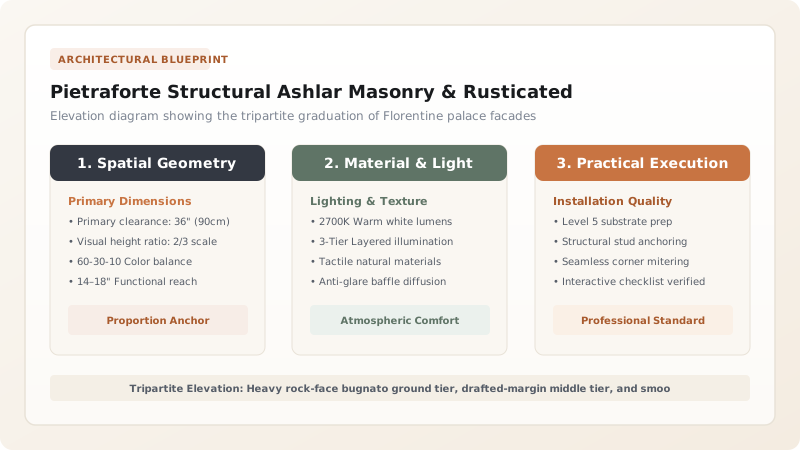
In palace design, Michelozzo (Palazzo Medici Riccardi) and Benedetto da Maiano (Palazzo Strozzi) developed the tripartite graduated rustication system, expressing physical stability and social hierarchy:
- Ground Floor (Bugnato rustico): Colossal, rough-faced pillow blocks projecting 80mm to 150mm beyond the wall plane, evoking impregnable military fortress strength.
- Piano Nobile (Bugnato a cuscino): Intermediate floor blocks featuring flat pillow faces with crisp 25mm hand-chiseled drafted margins (nastro) surrounding each block.
- Top Floor (Ashlar liscio): Perfectly flat, smooth-dressed ashlar blocks with flush hairline joints, dissolving visual weight beneath the colossal classical projecting cornice.
3. Jointing & Load Transfer Mechanics
A Florentine Renaissance palace wall is a colossal gravity structure measuring 1.5 to 2.2 meters in thickness at the base. The exterior Pietraforte blocks are not thin modern veneers glued to concrete; they are massive structural ashlars extending 400mm to 800mm deep into the wall core.
Courses were laid with tight 2mm to 4mm joints using a mortar of aged slaked lime, washed Arno river sand, and crushed terracotta brick grog. To ensure that vertical loads did not concentrate along the front rusticated stone faces, masons slightly relieved (undercut) the bedding plane toward the front edge, ensuring that bearing contact was concentrated strictly along the middle third of the stone bed.
Bugnato Rustication Styles on Florentine Palazzi
Use this reference table to calculate exact physical dimensions, ratios, and specifications before purchasing:
| Rustication Style | Projection Depth | Chisel Tooling Technique | Architectural Zone |
|---|---|---|---|
| Bugnato Rustico (Rock-Face) | 80mm to 150mm projecting | Split with stone wedge and pitching chisel; uncarved quarry face | Ground floor base, fortress plinth |
| Bugnato a Cuscino (Pillow-Faced) | 40mm to 60mm rounded projection | Drafted margin with claw-chiseled convex center | First floor (piano nobile) window arcade |
| Bugnato Liscio (Smooth Ashlar) | 0mm (flush wall plane) | Fine comb-chisel dressing followed by sand rubbing | Upper living quarters beneath palace cornice |
Structural & Material Constraints
Every successful decoration project must account for physical and environmental constraints:
Extreme Density & Tool Wear
Pietraforte's high calcite-silica density rapidly dulls standard carbide chisels; masons must use hardened tungsten-tipped tools.
Weight Logistics
A single ground-floor bugnato block weighs between 400kg and 1,200kg; installation requires heavy lifting gantries.
Protocol for Dressing and Setting Rusticated Pietraforte Ashlars
Execute this professional sequence to achieve flawless results without backtracking:
Quarry Sizing & Bedding Identification
Split Pietraforte blocks along natural rifts; ensure bedding planes are oriented horizontally on the natural bed.
Drafted Margin Chiseling (Nastro)
Chisel a 25mm wide, dead-flat perimeter margin around the face of each block using a flat chisel (scalpello piatto) and straightedge.
Rock-Face Dressing
Dress the center pillow area using a pitching chisel (martellina da spacco) to create uniform rugged chiaroscuro relief.
Relieved Bed Preparation
Chisel the top and bottom bedding surfaces flat, undercutting the front 15mm by 1mm to prevent face edge-spalling under load.
Lime Mortar Bedding
Spread a 3mm bed of NHL 3.5 hydraulic lime and pozzolana mortar; lower ashlar block into place using scissor clamps.
Alignment & Recessed Pointing
Check face alignment with plumb rules; strike joint mortar back 5mm from the drafted margin to create clean shadow reveals.
Common Mistakes & Countermeasures
Avoid these costly errors that compromise aesthetics, ergonomics, and budget:
Laying Pietraforte blocks with quarry bedding oriented vertically (face-bedded)
Using gray cement pointing mortar across historic Pietraforte facades
Project Execution Checklist
Track your physical progress. Checkboxes persist automatically on this device:
Frequently Asked Questions
Why did Renaissance merchants make the ground floor of their palaces look like fortresses?
During the 15th century, Florence was frequently convulsed by violent factional street riots and attempted coups. The rusticated bugnato Pietraforte ground floor functioned as a real defensive bastion with high, barred windows capable of withstanding battering rams and street mobs.
How does Pietraforte differ in longevity from Pietra Serena outdoors?
Pietraforte has a dense calcite binder and low clay content, allowing it to withstand centuries of exterior rain and pollution without flaking. Pietra Serena contains swelling clay minerals that rapidly exfoliate outdoors, which is why it was primarily reserved for sheltered interiors and loggias.


