
Renaissance architect Filippo Brunelleschi revived classical antiquity by carving monolithic columns, pilasters, and entablatures from single blocks of Fiesole Pietra Serena. Using modular proportions based on column base diameter, optical entasis curves, and lead-shim bearing joints, Brunelleschi established a mathematical harmony that defined Renaissance spatial architecture.
At a Glance: Key Takeaways
- Modular Vitruvian Ratios: Column height precisely 9.5 to 10 times the lower shaft diameter (Corinthian order).
- Optical Entasis Curvature: Subtle convex swelling along the upper two-thirds of the column shaft to counteract optical hollowing.
- Monolithic Lathe Turning: Shafts turned on heavy timber water-powered lathes or dressed with hand compass templates.
- Lead Sheet Bearing Shims: 3mm ductile lead sheets distributing compressive stress across column joints without edge crushing.
- Intricate Acanthus Capitals: Deeply undercut foliate capitals carved with fine tooth chisels and bow drills.
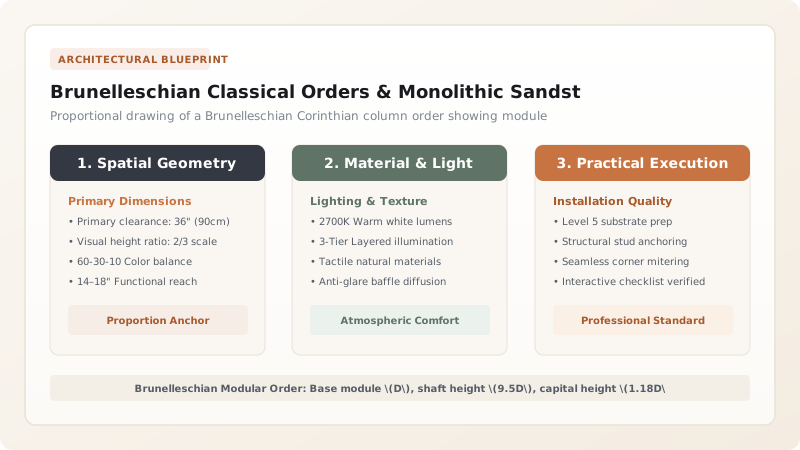
1. Modular Mathematics of the Brunelleschian Column
In the Basilica of San Lorenzo and the church of Santo Spirito, Brunelleschi applied the module \(D\) (the diameter of the column shaft at its base) as the fundamental governing unit for the entire building. For his signature Corinthian order:
- Total Column Height: \(9.5 \times D\) (including base and capital).
- Shaft Height: \(8.0 \times D\), tapering to \(0.85 \times D\) at the necking (hypotrachelion).
- Capital Height: \(1.18 \times D\), featuring two tiers of eight acanthus leaves surmounted by four corner volutes.
- Entablature Height: \(2.0 \times D\), divided in a 4:3:5 ratio among architrave, frieze, and projecting cornice.
By carving these elements from monolithic blocks of fine-grained Pietra Serena, Brunelleschi achieved millimeter-level dimensional accuracy across 30-meter basilica spans.
2. Entasis Calculation: Geometry of the Optical Curve
A tall cylindrical column with straight sides appears to the human eye to be narrower in the middle—an optical illusion known as hourglassing. To eliminate this, Renaissance stonemasons carved an entasis: a delicate convex swelling.
The lower one-third of the column shaft remains a true cylinder of diameter \(D\). From the one-third mark to the top, the shaft follows a smooth hyperbolic or circular arc calculated by transferring points from a quadrant circle template. The maximum deviation from a straight taper is merely 3mm to 6mm, yet this subtle curvature gives the sandstone column an appearance of muscular elasticity holding up the vault above.
3. Lead Shim Joint Engineering
When a monolithic sandstone column carrying over 150 kN of vertical axial load is seated directly onto a flat marble or sandstone pedestal, microscopic surface irregularities will cause point-to-point contact. The brittle sandstone edges will spall and fracture under concentrated bearing pressure.
Florentine masons inserted a 3mm sheet of pure rolled lead (piombo in lastra) between the column base and the pedestal, cut 15mm smaller than the column circumference. Under the immense compressive load, the ductile lead yields and cold-flows into every microscopic chisel mark, distributing bearing stress with 100% uniformity while keeping the lead concealed within a recessed perimeter shadowline reveal.
Corinthian Column Proportional Specifications
Use this reference table to calculate exact physical dimensions, ratios, and specifications before purchasing:
| Order Component | Classical Proportional Ratio | Dimension for D = 600mm | Tolerances & Jointing Standard |
|---|---|---|---|
| Attic Base (Torus + Scotia) | 0.50 D | 300mm | ±0.5mm concentric turning tolerance |
| Column Shaft (Monolith) | 8.00 D | 4,800mm | Entasis curve deviation max 4.5mm at 2/3 height |
| Corinthian Capital | 1.18 D | 708mm | Deep undercutting of acanthus caulicoli volutes |
| Lead Bearing Shim | Thickness 3mm, radius (R - 15mm) | 570mm disc | Pure ductile rolled sheet lead; zero mortar |
Quarrying & Transport Constraints
Every successful decoration project must account for physical and environmental constraints:
Flawless Block Length
Monolithic 5-meter sandstone blocks are rare; blocks must be ultrasonically tested at the quarry for hidden bedding micro-faults.
Rigging Weight
A 5-meter Pietra Serena column shaft weighs over 3.5 metric tons; lifting points must be cushioned with timber lagging.
Protocol for Carving and Erecting a Pietra Serena Column
Execute this professional sequence to achieve flawless results without backtracking:
Monolithic Block Extraction
Extract a 5-meter flaw-free block of Macigno sandstone from the quarry, verifying absence of clay vein flaws.
Octagonal Roughing
Hew the rectangular block into an octagon using tooth chisels (gradina), checking axial straightness with string lines.
Entasis Template Scribing
Apply curved wooden entasis templates along four quadrants, roughing the shaft to circular profile with hand planes and rasps.
Capital Sculpting
Sculpt two tiers of acanthus leaves using hollow gouges and stone drills, carving openwork spaces behind the corner volutes.
Lead Shim Placement
Position the 3mm rolled lead disc centered on the plinth pedestal; apply graphite powder as a friction buffer.
Column Hoisting & Plumb Alignment
Hoist column with hemp slings and shear-legs crane; lower onto lead shim and check vertical plumb across two orthogonal planes.
Common Mistakes & Countermeasures
Avoid these costly errors that compromise aesthetics, ergonomics, and budget:
Setting sandstone columns on hard Portland cement mortar beds
Omitting the entasis curve on tall monolithic shafts
Project Execution Checklist
Track your physical progress. Checkboxes persist automatically on this device:
Frequently Asked Questions
How did Renaissance builders hoist 4-ton monolithic stone columns into place?
They utilized wooden shear-legs cranes and compound treadwheel capstans engineered by Brunelleschi himself, using reduction gearboxes and braided hemp ropes counterweighted with lead sandbags.
Can modern CNC stone routers replicate a Brunelleschian Corinthian capital?
5-axis CNC stone routers can rough out 80% of the mass, but the delicate undercutting beneath acanthus leaf lips and the crisp tooth-chisel texture of the caulicoli volutes still require final hand carving by a master scarpellino.


