
The iconic silhouette of Santorini and the Cycladic islands—interlocking white cubes crowned by smooth, semicircular and parabolic vaults—is widely celebrated for its picturesque aesthetic. Yet in the lexicon of structural engineering and aerodynamics, these vaulted forms represent a masterclass in vernacular survival.
At a Glance: Key Takeaways
- Calculate vault profile using authentic inverted catenary curve formulas.
- Verify voussoir stone is certified lightweight volcanic tuff (< 80 lbs/ft³).
- Bond stone voussoirs with hydraulic lime and Santorinian pozzolan mortar.
- Orient building geometry aerodynamically against northern Meltemi wind vectors.
- Eliminate projecting roof eaves to prevent low-pressure wind suction uplift.
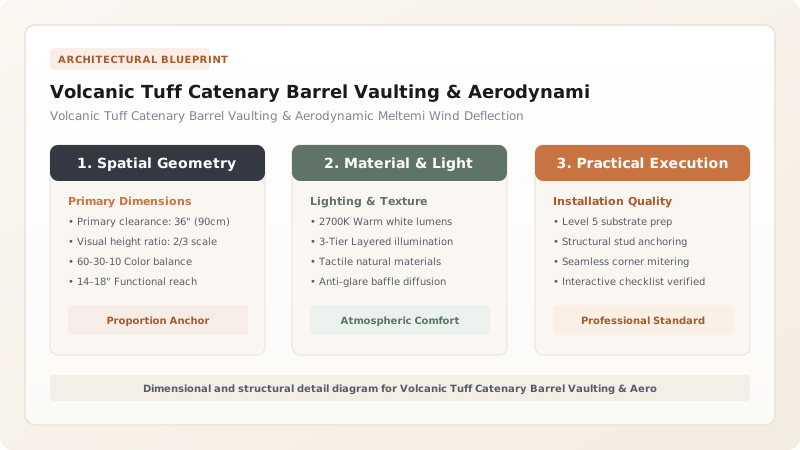
Architectural Principles & Structural Foundations
The iconic silhouette of Santorini and the Cycladic islands—interlocking white cubes crowned by smooth, semicircular and parabolic vaults—is widely celebrated for its picturesque aesthetic. Yet in the lexicon of structural engineering and aerodynamics, these vaulted forms represent a masterclass in vernacular survival.
Because the arid Aegean islands have virtually zero native forest cover, island builders possessed no structural timber to fabricate flat roof joists or floor trusses. To enclose domestic space, they turned to the earth: quarrying ultra-lightweight **Volcanic Tuff and Pumice Blocks (Asprochoma) and laying them into self-supporting Catenary Barrel Vaults.
Simultaneously, the Cyclades lie directly in the path of the Meltemi**: ferocious, high-velocity summer gale winds originating in the Russian steppes that blast across the Aegean from July through September at speeds exceeding 50 to 70 mph (Force 8 to 10 on the Beaufort scale). The interlocking cubical masses, curved parapets, and parabolic vaults work together as an aerodynamic landform—deflecting high-velocity wind vectors smoothly over the buildings without generating the catastrophic low-pressure roof uplift forces that tear conventional pitched roofs apart.
AERODYNAMIC MELTEMI WIND DEFLECTION DYNAMICS
   Prevailing Northern Meltemi Winds (50-70 mph)
   ============================================>
                               /  Laminar Flow Deflection Arc
                              /   (Zero Roof Uplift Drag)
                             /
                   /========+========\  <-- Catenary Parabolic Vault
                  /                   \     (Lightweight Volcanic Tuff)
                 /                     \
        +-------+                       +-------+
        |                                       |  Aerodynamic Stepped Cube
        |  Deep Double-Wythe Stone Wall         |  Channels Wind Up & Over
        |  with Curved Leading Windward Edge    |  Protected Leeward Courtyard
        |                                       |
   =====+=======================================+=============================
The Mathematics of the Catenary Vault
A standard semicircular arch experiences tensile bending moments at its haunches, requiring heavy external stone buttresses to prevent the sides from kicking outward. Conversely, a Catenary Curve describes the precise shape that an idealized flexible chain assumes under its own self-weight:
\[ y = a \cosh\left(\frac{x}{a}\right) = \frac{a}{2} \left(e^{x/a} + e^{-x/a}\right) \]
When inverted into a rigid masonry arch, the catenary curve represents the line of pure thrust. Every stone within a catenary vault operates in pure, 100% compression, with zero internal tensile stress. Because compressive forces travel cleanly down through the voussoirs directly into the foundation bedrock, catenary vaults can be constructed with astonishingly thin stone shells (often only 8.0 to 12.0 inches thick) without structural collapse.
Materiality: Volcanic Tuff & Theran Pozzolan
Constructing a durable vault using masonry requires materials with high compressive strength, low dead load, and impervious binder chemistry: - **Volcanic Tuff (Porolithos): Formed from compacted volcanic ash and pumice ejecta during ancient caldera eruptions. It has a bulk dry density of only 60 to 80 lbs/ft³ (less than half the weight of standard granite or limestone, which weighs 160 lbs/ft³). This low dead load minimizes outward lateral thrust on supporting walls while providing exceptional natural thermal insulation (R-value ~ 1.2 per inch). - Theran Earth (Santorinian Pozzolan)**: Sourced from the volcanic ash deposits of Santorini, this pinkish-gray pozzolan contains 65% amorphous reactive silica (\(\text{SiO}_2\)) and 15% alumina (\(\text{Al}_2\text{O}_3\)). When mixed with slaked lime putty, it forms an ancient hydraulic cement that hardens underwater, resists sea-salt attack, and gains strength continuously over centuries.
Aerodynamic Cube Formations: Taming the Meltemi
The arrangement of Cycladic homes within cliffside villages is an exercise in passive aerodynamic engineering: 1. The Stepped Amphitheater Layout: Houses are stacked vertically up the hillsides in terraced steps. When the ferocious Meltemi wind strikes the lowest house, the stepped geometry directs the wind upward in a smooth, continuous laminar sheet, bypassing upper terraces. 2. Deflection Parapets: Parapet walls on the windward (northern) side are rounded with generous bullnose radii and curved outward, deflecting gale winds up and over private interior courtyards. 3. **The Microclimatic Leeward Courtyard (Avli)**: By deflecting the wind overhead, the southern, leeward terrace remains calm, sheltered, and sun-drenched—allowing outdoor Mediterranean dining and citrus cultivation even during violent offshore gales.
Explore the overall architectural style in Cycladic Greek Island Architecture Hub, see wall shaping in Organic Curved Parapets & Bullnose Stairs, or discover whitewashing formulations in Hydrated Slaked Lime Whitewashing.
Volcanic Tuff Catenary Barrel Vaulting & Aerodynamic Meltemi Wind Deflection Engineering Specifications
Use this reference table to calculate exact physical dimensions, ratios, and specifications before purchasing:
| Technical Parameter | Specification Standard | Tolerance & Execution Notes |
|---|---|---|
| Volcanic Tuff Bulk Density | 60 to 80 lbs/ft³ (approx. 960 to 1,280 kg/m³) | Delivers superior thermal resistance and reduced structural dead weight. |
| Vault Shell Thickness | 8.0 to 12.0 inches (200 to 300 mm) | Lightweight voussoirs laid in radial compression courses. |
| Aerodynamic Wind Resistance | Designed for 80+ mph wind gust deflection | Smooth continuous parabolic profile eliminates turbulence drag. |
| Hydraulic Pozzolan Compressive Strength | 800 to 1,200 psi after 90-day cure | Provides exceptional long-term strength in marine salt-fog environments. |
Project Execution & Craftsmanship Sequence
Execute this professional sequence to achieve flawless results without backtracking:
Phase 1: Aerodynamic Siting & Wind Vector Analysis
Analyze site microclimate and prevailing Meltemi wind azimuths. Orient building volumes to step upward from north to south, sheltering leeward courtyards.
Phase 2: Catenary Falsework & Centering Assembly
Calculate catenary coordinates using chain modeling. Construct lightweight curved timber arch centering ribs supported on heavy timber posts.
Phase 3: Volcanic Tuff Voussoir Laying & Pozzolan Mortaring
Shape volcanic tuff blocks into tapered voussoirs. Lay simultaneous opposing courses from spring lines to crown in hydraulic Theran pozzolan mortar.
Phase 4: Waterproof Pozzolan Capping & Lime Whitewash
Strike centering after 21 days. Coat the exterior vault crown with multi-layer waterproof pozzolan render, finish with 5 coats of slaked lime whitewash.
Common Mistakes & Countermeasures
Avoid these costly errors that compromise aesthetics, ergonomics, and budget:
Using heavy limestone or granite for vault voussoirs
Constructing standard high-pitched or overhang gable roofs in Meltemi zones
Using modern cement mortar with high salt content
Project Execution Checklist
Track your physical progress. Checkboxes persist automatically on this device:
Frequently Asked Questions
How long do volcanic tuff catenary vaults last?
When bonded with authentic hydraulic lime-pozzolan mortar and kept whitewashed, Cycladic catenary vaults endure for centuries. Many vaults constructed on Santorini and Paros during the 17th and 18th centuries remain structurally flawless today.
Can you walk on top of a catenary barrel-vaulted roof?
Yes. The crown of a catenary vault operates in pure compression and easily supports human foot traffic. In Cycladic villages, upper terrace walkways and sunbathing decks routinely pass directly over the curved crowns of lower vaulted bedrooms.
How do catenary vaulted homes perform during earthquakes?
Remarkably well. The low mass of volcanic tuff combined with the structural flexibility of lime-pozzolan mortar allows the catenary vault to absorb seismic vibrations without brittle fracture, far outperforming rigid unreinforced concrete.


