
Prevent fountain water loss and slippery patio puddles by following the 1:2 Splash Containment Rule: the basin catchment radius must extend outward from the water impact point by a distance equal to at least twice the vertical drop height (e.g. an 18-inch water drop requires a 36-inch catchment radius).
At a Glance: Key Takeaways
- The 1:2 Splash Ratio: Catchment basin radius = 2 × Vertical Drop Height (essential to capture parabolic droplet bounce).
- Wind Drift Compensation: In breezy courtyards, add 6 to 12 inches of downwind basin buffer.
- Submerged Anti-Splash Mats: Open-cell PVC filter mats placed 1/2" below water surface absorb kinetic impact with zero bounce.
- Porous Basalt Pebble Inset: Surrounding the pool with a 6-inch river rock trench catches stray droplets and drains them back to the basin.
1. Kinetic Physics: Impact Velocity & The 45-Degree Splash Cone
When a sheer sheet of water drops from a weir, gravitational acceleration (\(g = 32.2\text{ ft/s}^2\)) accelerates the water. Impact velocity (\(v\)) is determined by:
$$v = \sqrt{2 \cdot g \cdot h}$$
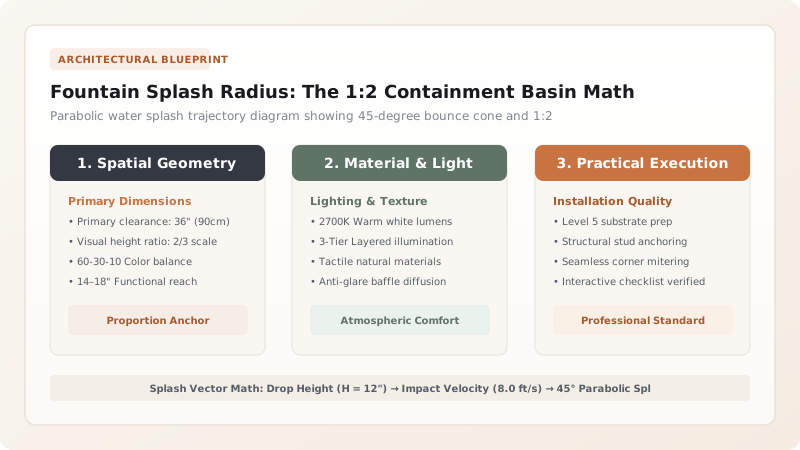
For an 18-inch (1.5 ft) drop, water strikes the pool at 9.8 ft/s (6.7 mph). Upon collision, kinetic energy shatters the water sheet into thousands of micro-droplets that rebound upward and outward along a 45-degree parabolic trajectory cone.
If the receiving basin is too narrow, droplets splash continuously onto surrounding patio pavers, emptying the fountain within 48 hours and creating hazardous algae-slick walking surfaces.

Water Drop Height vs Minimum Basin Catchment Radius
Use this reference table to calculate exact physical dimensions, ratios, and specifications before purchasing:
| Vertical Drop Height | Impact Velocity | Min Basin Radius (Indoor / Shielded) | Min Basin Radius (Outdoor Breezy) |
|---|---|---|---|
| 8 Inches (0.67 ft) | 6.5 ft/sec | 12 Inches Radius | 16 Inches Radius |
| 12 Inches (1.00 ft) | 8.0 ft/sec | 20 Inches Radius | 24 Inches Radius (1:2 Ratio) |
| 18 Inches (1.50 ft) | 9.8 ft/sec | 30 Inches Radius | 36 Inches Radius |
| 24 Inches (2.00 ft) | 11.3 ft/sec | 40 Inches Radius | 48 Inches Radius |
Algae Slip Hazard Paver Constraints
Every successful decoration project must account for physical and environmental constraints:
Water Splashing onto Smooth Travertine Pavers Creating Slippery Algae
Continuous water splash on stone pavers breeds slippery green biofilm, creating severe fall risks; install a 4-inch deep decorative river pebble catchment moat around the fountain perimeter to capture 100% of splash without wetting walkways.
How to Layout a Zero-Loss Splash Containment Basin
Execute this professional sequence to achieve flawless results without backtracking:
Calculate Water Impact Centerline
Water falling from a weir arcs forward 2 to 4 inches; mark the exact landing point on the water surface.
Apply 1:2 Radius Formula
Multiply drop height by 2 (e.g. 15" drop × 2 = 30" radius required in all directions from impact point).
Excavate Basin Footprint
Dig basin to calculated dimensions, sloping perimeter edges inward at 5 degrees toward the reservoir.
Install Anti-Splash Matting
Place black open-cell aquatic filter foam 1/2" below water line at the exact impact zone to deaden splash.
Test with Wind Fan or Natural Breeze
Run fountain for 4 hours on a breezy day, verifying surrounding patio pavers remain 100% bone-dry.
Common Mistakes & Countermeasures
Avoid these costly errors that compromise aesthetics, ergonomics, and budget:
Building a Tall 3-Foot Waterfall Dropping into a Narrow 2-Foot Basin
Project Execution Checklist
Track your physical progress. Checkboxes persist automatically on this device:
Frequently Asked Questions
How do anti-splash mats work in fountains?
Anti-splash mats (like Matala filter media) are submerged just 1/2 inch below the water surface directly where the waterfall lands. The open labyrinth matrix absorbs the kinetic energy of the falling water, completely eliminating upward droplet bounce.


