
Tune a courtyard fountain's acoustic output by adjusting water flow volume (target 100 GPH per inch of weir width) and vertical drop height (12 to 16 inches). Adjust the water depth in the receiving pool (4 inches creates a sharp splash, while 10 inches creates a deep, hollow resonating bass tone).
At a Glance: Key Takeaways
- 100 GPH per Inch of Weir Width: Creates a solid, unbroken 1/4" thick water sheet (e.g. 2,400 GPH for a 24" weir).
- Receiving Pool Depth Acoustics: Deep pools (>8") absorb impact energy into low resonance; shallow pools (<3") produce crisp treble splash.
- Variable-Speed Pump Flow Tuning: Dial in exact decibel levels (50 to 65 dBA) using electronic pump controllers.
- Auditory Masking Threshold: Water sound must be within 5 dBA of ambient background noise to achieve 100% masking.
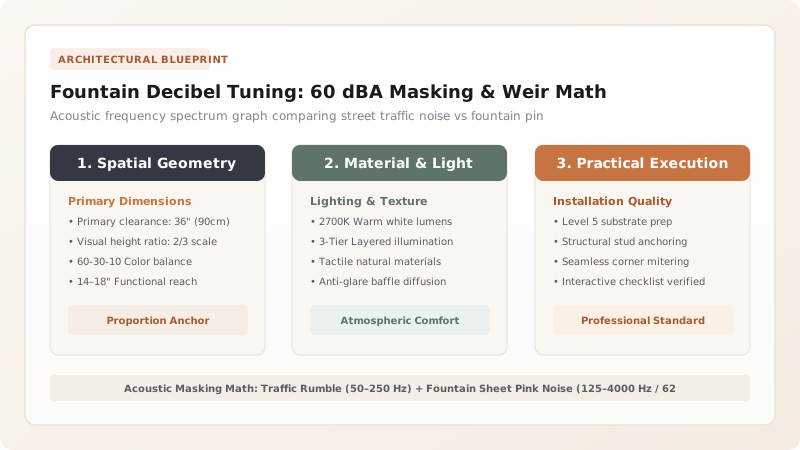
1. Fluid Acoustics: Water Impact Energy & Basin Resonators
The sound generated by a water fountain is produced when falling water droplets impact the pool surface, entraining air to create oscillating microscopic bubbles (Minnaert bubble resonators). The resonant frequency (\(f\)) of each bubble is inversely proportional to its radius (\(r\)):
$$f = \frac{1}{2\pi r} \sqrt{\frac{3\gamma P_0}{\rho}}$$
A thick sheer waterfall creates large air bubbles that produce deep, soothing low-frequency rumblings (100 Hz to 500 Hz), while a fine mist creates tiny bubbles producing bright high-frequency trickles (2,000 Hz to 4,000 Hz).

Receiving Pool Depth vs Acoustic Sound Tone
Use this reference table to calculate exact physical dimensions, ratios, and specifications before purchasing:
| Pool Depth at Impact Zone | Sound Frequency Character | Acoustic Quality | Best Architectural Fit |
|---|---|---|---|
| 10" - 14" Deep Pool (Optimal) | Low-Frequency (120 Hz - 400 Hz) | Deep, hollow, meditative bass resonance | Enclosed stone courtyards (Echoes softly) |
| 4" - 6" Medium Depth | Balanced Midrange (400 Hz - 1,500 Hz) | Crisp, energetic natural waterfall | Outdoor dining patios & lounge spaces |
| 1" - 2" Shallow Splash Basin | High-Frequency (2,000 Hz - 5,000 Hz) | Sharp, bright splashing (Higher splash risk) | Small entrance fountain urns |
| River Rock Splash Bed (No Pool) | Muffled Midrange (Zero hollow boom) | Soft whispering stream | Bedroom courtyard gardens |
Courtyard Echo Amplification Constraints
Every successful decoration project must account for physical and environmental constraints:
Hard Enclosed Courtyard Walls Amplifying Fountain Decibels into Loud Echo Chamber
In a 10x10 foot courtyard with solid stucco walls, hard surfaces amplify fountain sound by +10 dBA, making normal conversation difficult; install climbing ivy on walls or use a variable-speed pump to throttle flow down to 52 dBA.
How to Acoustically Tune a Courtyard Fountain
Execute this professional sequence to achieve flawless results without backtracking:
Measure Ambient Street Noise
Use a smartphone decibel meter app to record ambient traffic noise during peak rush hour (e.g. 58 dBA).
Set Water Drop Height to 14 Inches
Position weir spillway 14 inches above finished pool water line.
Fill Receiving Pool to 8" Depth
Adjust overflow standpipe so receiving pool water depth is at least 8 inches to deepen acoustic resonance.
Adjust Ball Valve to 100 GPH/Inch
Throttle water supply valve until the falling water forms a solid glass sheet with zero air gaps.
Verify Sound Level at Seating Area
Confirm sound meter reads 62 to 64 dBA at the primary patio seating location.
Common Mistakes & Countermeasures
Avoid these costly errors that compromise aesthetics, ergonomics, and budget:
Designing an Overly Loud 75+ dBA Waterfall in a Small Enclosed Patio
Project Execution Checklist
Track your physical progress. Checkboxes persist automatically on this device:
Frequently Asked Questions
How does water temperature affect fountain acoustics?
Warm summer water has lower viscosity than cold winter water, creating slightly smaller air bubbles upon impact and producing a brighter, crisper sound tone compared to the deeper resonance of winter water.


