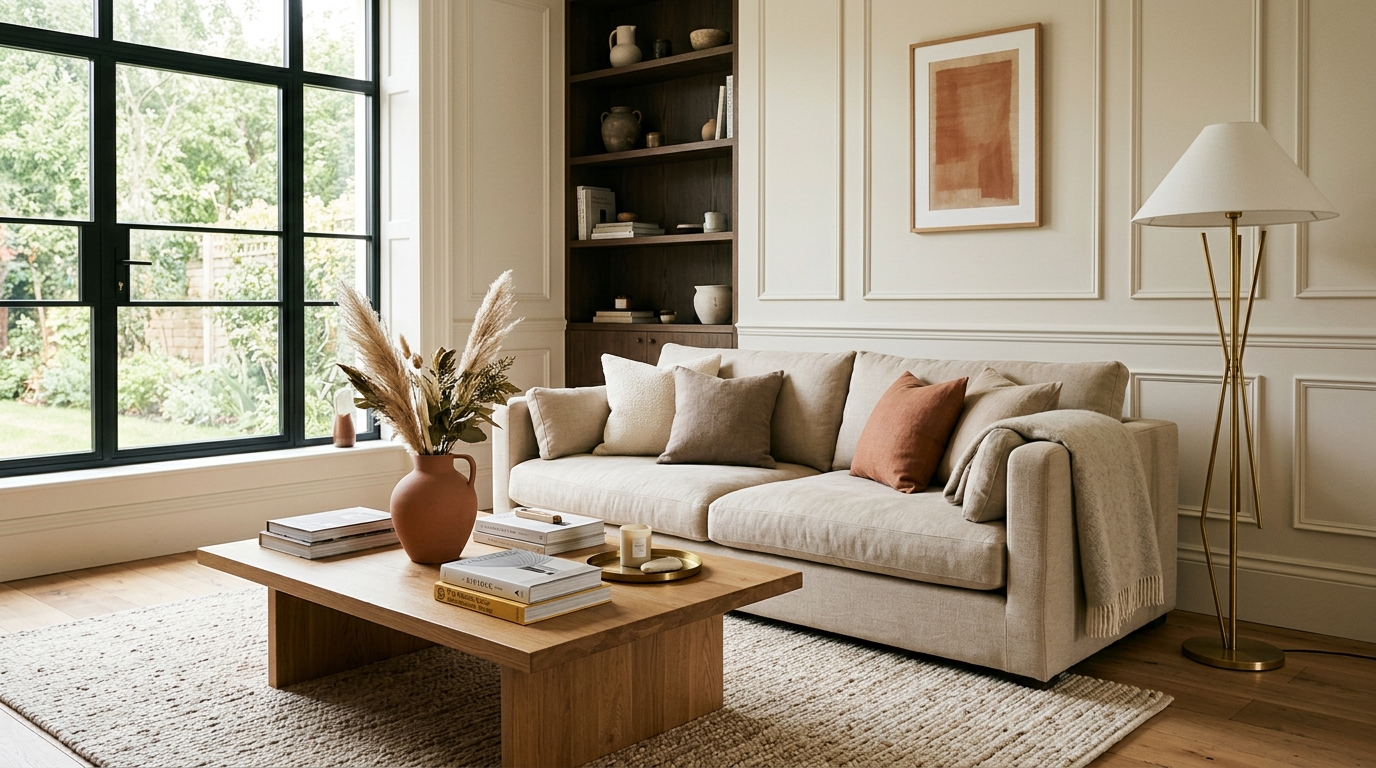
To combine colors, textures, and patterns, use the 3-Scale Pattern Rule within a 60-30-10 color palette: 1) One large-scale anchor pattern (e.g., botanical drapery), 2) One medium-scale geometric pattern (e.g., striped rug), and 3) One small-scale organic pattern (e.g., micro-check pillows). Balance visual patterns with contrasting tactile textures (bouclé, velvet, raw linen, smooth wood, and polished brass).
At a Glance: Key Takeaways
- Apply the 3-Scale Pattern Rule: Mix 1 large, 1 medium, and 1 small-scale pattern to avoid visual fighting.
- Unify diverse patterns by ensuring they all share at least 1 common color from your 60-30-10 master palette.
- Layer 4 tactile textures in every room: rough/matte (linen), plush (velvet), hard/warm (wood), and reflective (brass).
- Anchor heavy patterns with solid neutral planes (walls, sofa cushions) to give the eye resting room.
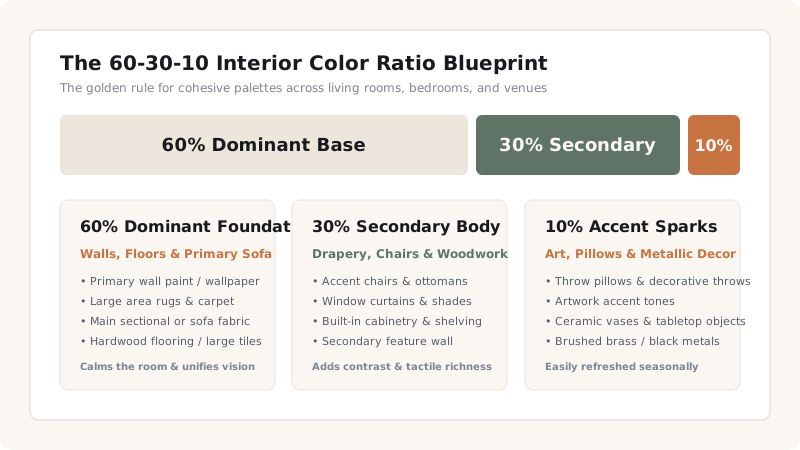
1. The 3-Scale Pattern Mixing Blueprint
Combining patterns fails when prints compete for the same visual frequency. When three medium-sized patterns sit next to each other, the human brain registers it as chaotic visual vibration. Professional textile designers follow the 3-Scale Formula:
- Pattern 1: Large-Scale Statement (The Anchor): Spans 10 to 18 inches per repeat. Typically an organic botanical, large damask, or oversized abstract watercolor applied to window drapery, a large area rug, or wallpaper.
- Pattern 2: Medium-Scale Geometric (The Structure): Spans 3 to 6 inches per repeat. A crisp architectural stripe, herringbone, buffalo check, or Moroccan lattice on accent chairs or large pillows.
- Pattern 3: Small-Scale Accent (The Texture): Spans 1/2 to 2 inches per repeat. A subtle pin-stripe, ditsy floral, micro-gingham, or woven basketweave on small lumbar pillows or ottoman piping.
- The Unifying Color Thread: All three patterns must share at least one identical color from your 60-30-10 master palette to tie the ensemble together.
2. The 5 Tactile Texture Layers (Sensory Depth)
A monochromatic room with zero patterns can feel rich, warm, and layered if it incorporates Tactile Friction. Every room should feature at least four of these five textural families:
- 1. Matte & Breathable (The Base): Raw washed Belgian linen, flatweave cotton, and matte eggshell-painted drywall.
- 2. Plush & High-Pile (The Softness): Dense velvet cushions, chunky boucle armchairs, and hand-tufted wool rugs.
- 3. Hard & Organic (The Warmth): Grained natural white oak, fluted walnut millwork, woven rattan baskets, and textured terracotta pottery.
- 4. Sleek & Reflective (The Spark): Polished unlacquered brass hardware, mirrored glass, and honed Carrara marble tabletops.
- 5. Structural Roughness (The Character): Exposed brick, rough lime-washed plaster, and hand-chiseled architectural stone.
3. The 60/40 Negative Space Balancing Principle
Pattern and texture need solid negative space to be appreciated. If every cushion, wall, rug, and chair is patterned, visual fatigue sets in:
- The Solid-to-Pattern Ratio (60/40): Ensure at least 60% of visible surfaces in the room are solid colors (solid sofa fabric, solid wall paint, solid hardwood flooring), allowing the 40% patterned elements to stand out as intentional artistic highlights.
Pattern & Texture Mixing Formulation Matrix
Use this reference table to calculate exact physical dimensions, ratios, and specifications before purchasing:
| Layer Category | Pattern Scale | Pattern Type | Texture Material | Ideal Application |
|---|---|---|---|---|
| Scale 1 (Dominant) | Large (10–18" repeat) | Flowing Botanical / Chintz | Heavy Woven Linen / Cotton | Floor-to-Ceiling Drapery |
| Scale 2 (Secondary) | Medium (3–6" repeat) | Geometric Cabana Stripe | Ribbed Corduroy / Wool | Accent Armchair & Rug |
| Scale 3 (Accent) | Small (1–2" repeat) | Micro-Gingham / Houndstooth | Textured Tweed / Bouclé | 14x36" Lumbar Throw Pillow |
| Solid Tactile Base | Zero Pattern (Solid) | Pure Color Plane | Matte Velvet / Washed Linen | Main 3-Seater Sectional |
| Hard Organic Anchor | Zero Pattern (Woodgrain) | Natural Timber Grain | Solid Grained White Oak | Central Coffee Table |
Pattern & Texture Constraints
Every successful decoration project must account for physical and environmental constraints:
Pattern Alignment & Repeat Matching
When ordering patterned fabric for custom drapes or wallpaper, always calculate 20% extra yardage to account for vertical pattern repeat matching along seams.
Bouclé and Pet Claw Snagging
Trendy high-loop bouclé and loose open-weave knits snag easily on cat and dog claws; choose tight-weave velvet or flat-woven chenille in pet-friendly homes.
Small Room Pattern Overload
In rooms under 120 sq.ft., keep large-scale bold patterns limited to 1 surface (drapes OR wallpaper), relying on subtle medium and small patterns to prevent claustrophobia.
10-Step Pattern and Texture Layering Protocol
Execute this professional sequence to achieve flawless results without backtracking:
Establish the 60-30-10 Master Color Palette
Select 1 base neutral, 1 secondary tone, and 1 metallic/accent color.
Select the Large-Scale Statement Pattern (Scale 1)
Choose a large botanical, floral, or abstract print for drapes or wallpaper.
Identify Unifying Color Thread
Pinpoint 1 exact color shared between your large pattern and master palette.
Select Medium-Scale Geometric Pattern (Scale 2)
Choose a stripe, check, or lattice sharing the unifying color for accent seating.
Select Small-Scale Organic Pattern (Scale 3)
Choose a subtle micro-print or pin-stripe for throw pillow accents.
Audit Solid-to-Pattern Ratio (60% Solid)
Ensure large foundational upholstery (sofa) remains solid to anchor the room.
Introduce 4 Contrasting Tactile Textures
Combine washed linen, plush velvet, solid oak wood, and brushed brass.
Lay a Textured Low-Pile or Flatweave Rug
Anchor seating on a wool loop, jute, or textured geometric area rug.
Style Pillow Arrangements with Mixed Scales
Layer 1 solid velvet pillow, 1 medium stripe, and 1 small textured lumbar.
Step Back and Assess Visual Vibration
If the space feels dizzying, replace 1 patterned pillow with a solid textured linen.
Common Mistakes & Countermeasures
Avoid these costly errors that compromise aesthetics, ergonomics, and budget:
Mixing Three Patterns of the Exact Same Scale
All-Smooth Flat Textures in Neutral Rooms
Forgetting the Unifying Color Thread
Project Execution Checklist
Track your physical progress. Checkboxes persist automatically on this device:
Frequently Asked Questions
Can I mix stripes with floral patterns?
Yes! Stripes and florals are the most classic pattern combination in design history. Pair a large-scale organic floral (e.g., on drapery) with a crisp medium-scale geometric stripe (on pillows or an accent chair).
How do I make a beige neutral room look interesting?
Rely heavily on tactile texture: combine raw washed linen curtains, a chunky wool boucle chair, a rustic wire-brushed oak coffee table, smooth honed marble coasters, and unlacquered brass lamps.
How many total patterns can I use in one living room?
Follow the Rule of Three: 3 patterns (1 large, 1 medium, 1 small) is the sweet spot for visual balance. In large formal rooms, you can expand to 5 patterns if 2 are subtle tone-on-tone textures.