
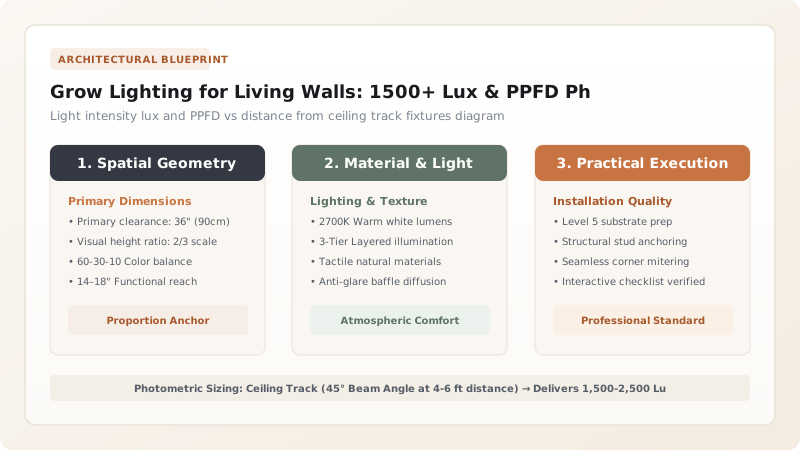
Illuminate indoor living green walls by mounting full-spectrum LED grow track spotlights 4 to 6 feet away on the ceiling at a 45-degree angle. Deliver 1,500 to 2,500 lux (30 to 50 µmol/m²/s PPFD) across the foliage canopy for 12 hours daily, using high-CRI (95+) 4000K natural white chips.
At a Glance: Key Takeaways
- 1,500 to 2,500 Lux Target: Provides sufficient photonic energy for tropical foliage photosynthesis indoors.
- PAR / PPFD Standard: 30 to 50 µmol/m²/s (Photosynthetic Photon Flux Density) sustains vigorous growth.
- 4000K Natural White CCT: High-CRI white diodes (like Soltech Solutions or Sansi) avoid ugly purple 'blurple' light.
- 12-Hour Photoperiod: Automated timer runs lights for 10 to 12 hours daily to maintain plant metabolic rhythm.
1. Photobiology Science: Lumens vs PPFD & The 4000K Spectrum
Human eyes are most sensitive to green and yellow light (measured in lumens/lux), whereas plant chlorophyll pigments (\(a\) and \(b\)) primarily absorb blue (450nm) and red (660nm) wavelengths for Photosynthetically Active Radiation (PAR).
Early LED grow lights used harsh pink/purple diodes that ruined interior home aesthetics. Modern Full-Spectrum Ceramic White LED COB chips provide a continuous solar spectrum with a clean, crisp 4000K natural white color temperature and 95+ CRI. Living rooms feel like sunlit art galleries while plants thrive.

Living Wall Plant Light Requirements (Lux & PPFD)
Use this reference table to calculate exact physical dimensions, ratios, and specifications before purchasing:
| Plant Light Category | Target Lux at Leaf Canopy | PPFD (µmol/m²/s) | Recommended Plant Species |
|---|---|---|---|
| Low-Light Tropicals | 800 - 1,500 Lux | 15 - 30 µmol/m²/s | Cast Iron Plant, Snake Plant, ZZ Plant, Pothos |
| Medium-Light Foliage (Standard) | 1,500 - 2,500 Lux | 30 - 50 µmol/m²/s | Philodendron Cordatum, Bird's Nest Fern, Aglaonema, Maranta |
| High-Light Flowering / Variegated | 2,500 - 4,500 Lux | 50 - 90 µmol/m²/s | Anthurium, Ficus Elastica, Calathea Ornata, Peperomia |
| Edible Herbs / Vertical Produce | 5,000 - 10,000+ Lux | 100 - 200+ µmol/m²/s | Basil, Mint, Microgreens, Strawberries |
Light Burn Leaf Bleaching Constraints
Every successful decoration project must account for physical and environmental constraints:
Mounting 50W Grow Spotlights Too Close Scorching Upper Leaves
Placing high-wattage narrow-beam LEDs within 2 feet of top plants causes photonic bleaching and crisp brown leaf scorch; maintain at least 4 to 5 feet of distance and use 45-degree wide-beam optical lenses.
How to Calculate and Install Living Wall Track Lighting
Execute this professional sequence to achieve flawless results without backtracking:
Mount Ceiling Track 4-5 Feet from Wall
Install architectural H-track or J-track on ceiling parallel to the green wall.
Install 30W-40W 4000K Grow Spotlights
Click full-spectrum horticultural LED fixtures (like Soltech Track Lights) into track.
Aim at 45° Downward Angle
Angle fixtures down to wash the top, middle, and lower tiers uniformly.
Verify Lux with Light Meter App
Hold light meter at lowest plant level to confirm at least 1,500 lux.
Program 12-Hour Daily Timer
Set smart dimmer or switch to turn lights on at 7:00 AM and off at 7:00 PM.
Common Mistakes & Countermeasures
Avoid these costly errors that compromise aesthetics, ergonomics, and budget:
Using Cheap Standard Household LED Bulbs (CRI 80, Low PAR)
Project Execution Checklist
Track your physical progress. Checkboxes persist automatically on this device:
Frequently Asked Questions
Can grow lights be left on 24 hours a day to make plants grow faster?
No! Plants require a dark period (respiration phase) to process carbohydrates produced during photosynthesis. Leaving lights on 24/7 stresses plants and causes leaf yellowing. Maintain a 12-hour on / 12-hour off cycle.


