
Decorate a bathroom effectively by pairing a moisture-resistant vanity with eye-level sconce lighting (3000K, CRI 90+), choosing non-porous materials like sealed teak and natural stone, and utilizing vertical recessed niches to maintain clean, spa-like surfaces.
At a Glance: Key Takeaways
- Mount twin vertical vanity sconces at eye level (60-64 inches from finished floor) to eliminate harsh facial shadows.
- Enforce the Wet/Dry zone division: use waterproof stone and teak in wet zones, soft textiles in dry zones.
- Select 3000K illumination with a Color Rendering Index (CRI) of 90+ for true-to-life skin tones.
- Corral daily vanity grooming essentials onto footed marble or teak trays to prevent visual clutter.
- Utilize between-stud recessed medicine cabinets to gain 4 inches of depth with zero walkway obstruction.
- Choose high-humidity biophilic plants (snake plants, ferns) and long-staple 700 GSM Turkish cotton towels.
In-Depth Guides in this Directory
Explore specialized subtopic blueprints, technical dimensions, and execution checklists:
Small Bathroom Decor: Space-Saving Vanities & Mirrors
Maximize small bathrooms and powder rooms with wall-mounted floating vanities, frameless mirrors, vertical shelving, and bright lighting.
Bathroom Lighting & Vanity Sconces: Mirror Illumination
Plan bathroom lighting: vanity sconces, backlit mirror LED strips, IP-rated wet zone fixtures, and dimmable nightlight layers.
Bathroom Storage & Organization: Vertical Shelving & Nook Styling
Organize bathroom clutter with recessed shower niches, over-toilet cabinets, rolled towel baskets, drawer dividers, and vanity trays.
1. The Spa Sanctuary Design Principles: Waterproofing & Visual Flow
Over the past decade, residential bathroom design has undergone a profound architectural shift. Once treated as purely utilitarian, clinical water closets concealed behind closed doors, modern bathrooms have evolved into personal wellness sanctuaries—restorative environments intended for sensory decompression, mindful grooming, and physical rejuvenation. However, decorating a bathroom requires a unique engineering mindset: every fixture, finish, and textile operates in an unforgiving microclimate characterized by high steam surges, fluctuating ambient humidity, standing water exposure, and stringent hygiene demands.
To achieve a seamless spa-like atmosphere that endures years of daily use without degrading, successful bathroom decoration adheres to the principle of Wet and Dry Zone Separation:
- The Wet Zone (Shower & Tub): Encompasses surfaces subject to direct water spray and pooling. Finishes must be strictly non-porous and slip-resistant (Dynamic Coefficient of Friction DCOF ≥ 0.42). Decorative accents in this zone are limited to built-in tile niches, solid teak shower benches, and decanted shampoo pump vessels.
- The Transition Zone (Vanity & Mirror): The high-frequency grooming area where water drops and cosmetics gather. Styling focuses on moisture-sealed vanity trays, high-CRI mirror sconces, and hygienic soap dispensers.
- The Dry Zone (Linen Storage & Entryway): The outer perimeter where humidity stabilizes. This zone introduces textural warmth through long-staple cotton bath mats, framed architectural sketches with sealed backings, biophilic greenery, and aromatherapy reed diffusers.
Crucially, effective ventilation is the invisible backbone of bathroom aesthetics. Without an exhaust fan calibrated to deliver at least 1 CFM (Cubic Foot per Minute) per square foot of room area, moisture accumulates on mirror glass and drywall, causing paint peeling, mildew on grout lines, and tarnishing on metal hardware. Ensure your ventilation runs for 20 minutes after showers to protect decorative elements.
2. Vanity Ergonomics, Mirror Architecture & Countertop Vignettes
The vanity is the undisputed visual focal point of any bathroom. It is the first architectural element guests observe upon entering, and the surface you engage with every morning and evening. When a vanity becomes congested with open makeup containers, electric toothbrushes, razors, and tangled charging cords, the room's restorative ambiance collapses into visual anxiety.
Architectural vanity styling relies on the Grounding Tray Strategy. By corralling items onto a solid boundary tray—such as a honed Carrara marble rectangular dish, a charcoal slate slab, or an oiled teak plank—disparate grooming bottles become visually unified. Maintain a strict discipline regarding what remains above-deck versus what belongs inside drawers:
- Above-Deck Essentials (Keep Visible): A heavy glass or ceramic soap dispenser with an amber or charcoal finish, a ceramic tumbler for grooming tools, a small hand lotion bottle, and an optional scented soy candle or single-stem vase.
- Below-Deck Utilities (Conceal Completely): Toothpaste tubes, dental floss, electronic toothbrushes on charging docks, hair dryers, and personal hygiene supplies. Use internal drawer dividers crafted from acrylic or bamboo to prevent internal drawer clutter.
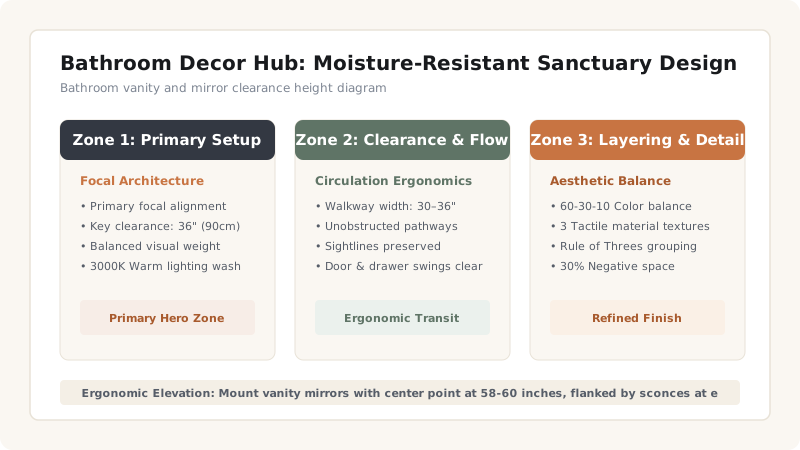
When selecting and positioning the vanity mirror, adhere to precise architectural clearance benchmarks. Hang the mirror so its vertical center point aligns at exactly 58 to 62 inches from the finished floor level, accommodating the average standing eye height of adults. Furthermore, mirror width should measure approximately 2 to 4 inches narrower than the vanity cabinet below. A mirror that extends wider than the vanity makes the room feel top-heavy and unbalanced, whereas a properly proportioned mirror grounds the cabinet below like a solid pedestal.
3. 3-Tier Bathroom Lighting: Shadow-Free Grooming & Ambient Dimmers
Grooming requires exceptional illumination, yet traditional residential bathrooms are notoriously poorly lit. The single most pervasive decorating flaw is installing a solitary recessed can light or horizontal globe bar directly above the vanity mirror. When light projects down from directly overhead, it casts deep, unflattering shadows beneath your brow, eye sockets, nose, and chin—making daily grooming, makeup application, and shaving difficult.
The professional solution is Cross-Illuminating Sconce Architecture. Mount twin vertical wall sconces on either side of the vanity mirror, positioned at human eye level:
- Mounting Height: The vertical center of each sconce should sit exactly 60 to 64 inches above the finished floor level.
- Spacing Dimensions: Sconces should be positioned 28 to 36 inches apart to envelope your face in even, shadowless cross-illumination.
- Diffused Optics: Select sconces with frosted opal glass or fabric-wrapped damp-rated cylinders that diffuse the light evenly, preventing harsh pin-point glare in your direct field of vision.
Color rendering is equally critical. Always specify LED bulbs with a Color Rendering Index (CRI) of 90 or higher and a color temperature of 3000K Neutral Warm White. Bulbs rated at 2700K cast an overly yellow undertone that conceals skin blemishes and distorts makeup shades, while 4000K commercial bulbs impart a pale, blue-green hospital cast. 3000K at 90+ CRI delivers pure, flattering, true-to-life reflections that mirror natural morning daylight.
4. Vertical Storage Optimization & Recessed Architectural Niches
Because bathroom floor footprints are inherently restricted—often measuring between 35 and 75 square feet in standard residential layouts—decorating must leverage vertical wall volume rather than expanding horizontally. Intrusive floor storage units or deep freestanding cabinets congest walkways, creating ergonomic hazards in wet, slippery conditions.
To maximize spatial efficiency without sacrificing high-end styling, incorporate recessed and floating vertical elements:
- Recessed Between-Stud Medicine Cabinets: Standard interior partition walls feature 2x4 framing studs spaced 16 inches on center, providing a 3.5-inch deep structural cavity. Installing a custom frameless mirrored medicine cabinet that recesses directly between the studs gains 4 inches of interior shelving with zero outward intrusion into the sink clearance zone.
- Architectural Shower Niches: Eliminate cumbersome hanging showerhead caddies by framing a recessed wall niche. Align the niche with tile grout lines, sizing it to at least 12 × 24 inches to accommodate tall shampoo pump bottles. Crucially, engineer the bottom sill of the niche with a subtle 1/4-inch per foot slope toward the shower floor to prevent standing water and soap scum buildup.
- Over-Commode Floating Shelves: The wall area above the toilet tank represents prime vertical display real estate. Mount two thick solid wood floating shelves (sealed white oak or walnut) with a maximum depth of 8 inches, positioned at least 24 inches above the tank lid. Style with folded linen washcloths, an amber glass diffuser, and a small potted snake plant.
5. Textile Layering, Olfactory Aromatherapy & Biophilic Wellness
The final layer of luxury bathroom design addresses tactile softness, biophilic vitality, and olfactory wellness. Bathrooms are dominated by hard, cold surfaces: ceramic tile, glazed porcelain, glass panels, and stone counters. Introducing organic textiles and botanical elements balances this coldness, creating a welcoming, multisensory sanctuary.
Elevate your bathroom's sensory palette with three refined design methods:
- High-GSM Long-Staple Towels: Upgrade standard thin bath sheets to 600 to 800 GSM (grams per square meter) 100% Turkish or Egyptian ring-spun cotton towels. Their extra-long fibers provide exceptional plush absorbency and dry quickly when hung from sleek brass wall hooks. Display fresh hand towels rolled neatly in a low wire or woven basket beside the basin for five-star hotel elegance.
- Biophilic Steam Greenery: Introduce living plants that naturally thrive in warm, humid microclimates with indirect light. Hang a fresh bundle of eucalyptus stems behind your showerhead; the hot shower steam activates the natural essential oils, releasing a restorative therapeutic aroma. On countertops and floating shelves, incorporate hardy varieties like snake plants (Sansevieria), ZZ plants, or trailing English ivy in moisture-sealed ceramic pots.
- Aromatherapy & Olfactory Layering: Scent plays a profound neurological role in personal relaxation. Avoid artificial aerosol air fresheners that leave a chemical residue. Instead, position an elegant natural rattan reed diffuser infused with white tea, cedarwood, or bergamot on a high shelf, complemented by a minimalist soy wax candle on the vanity deck.
Bathroom Material Hardiness Guide
Use this reference table to calculate exact physical dimensions, ratios, and specifications before purchasing:
| Material | Water Resistance | Best Application | Maintenance Requirement |
|---|---|---|---|
| Sealed Teak / Bamboo | High (Natural oils) | Bath caddies, shower benches | Oil annually |
| Carrara / Cultured Marble | High (Sealed stone) | Vanity countertops, tray displays | Wipe dry daily |
| Unlacquered Brass | Medium (Patinas gracefully) | Faucets, mirror frames, sconces | Polished or left rustic |
| 100% Ring-Spun Cotton | High (Washable) | Plush folded towels, bath mats | Wash weekly at 60°C |
Bathroom Decor Constraints
Every successful decoration project must account for physical and environmental constraints:
High Steam and Humidity
Unsealed wooden picture frames warp quickly in steam; use aluminium or brass frames with sealed backs.
How to Style a Bathroom Vanity
Execute this professional sequence to achieve flawless results without backtracking:
Clear Vanity Counter
Remove toothpaste tubes and clutter into medicine drawers.
Add Marble Tray Anchor
Place a rectangular marble or teak tray beside the sink basin.
Set Soap Dispenser & Candle
Place an amber glass soap pump and a soy candle on the tray.
Display Rolled Hand Towels
Tuck two neatly rolled white hand towels into a small brass basket.
Common Mistakes & Countermeasures
Avoid these costly errors that compromise aesthetics, ergonomics, and budget:
Installing a Single Overhead Downlight over the Vanity
Selecting Non-Moisture-Resistant Decorative Materials
Allowing Personal Hygiene Clutter to Dominate Countertops
Using Solid or Opaque Partitions in Compact Bathrooms
Project Execution Checklist
Track your physical progress. Checkboxes persist automatically on this device:
Frequently Asked Questions
What lighting Kelvin is best for bathroom vanities?
3000K with a High CRI (Color Rendering Index) above 90 is universally recommended by lighting architects for vanity mirrors. 3000K provides crisp, true-to-life skin tones without the sallow yellow cast of 2700K or the unflattering harsh blue glare of 4000K-5000K commercial bulbs.
How do you keep shower decor and accessories clean in wet zones?
To prevent water spots and soap residue, maintain a 1/4-inch per foot downward slope on the bottom sill of all shower niches. Avoid wire shower caddies hanging from showerheads; instead, decant shampoos into matching waterproof silicone or amber plastic pump bottles placed in a recessed niche.
Can you keep real indoor plants in a bathroom with steam?
Yes, provided you choose high-humidity, low-to-medium light botanical varieties. Snake plants (Sansevieria), Boston ferns, ZZ plants, and trailing pothos thrive in warm bathroom steam while absorbing residual moisture and purifying indoor air quality.
What is the correct height to hang a bathroom vanity mirror?
Hang wall mirrors so the horizontal centerline aligns at 58 to 62 inches from the finished floor level, which matches average standing human eye height. Ensure the mirror width is approximately 2 to 4 inches narrower than the vanity cabinet below to preserve grounded visual proportions.


