
Hang William Morris botanical wallpapers using the traditional Victorian tripartite wall system. Paper the middle 6-foot wall field with hand block-printed Morris patterns (such as Willow Bough, Acanthus, or Strawberry Thief) using reversible natural wheat starch paste, bounding top and bottom with wood dado rails and picture rails.
At a Glance: Key Takeaways
- Hand-Carved Pearwood Block Printing: Up to 30 individual woodblocks print layered opaque mineral gouache colors.
- Natural Mineral Distemper Pigments: Ultramarine, indigo, madder root, and chalk white deliver deep matte floral hues.
- Pitch-Pin Registration Accuracy: Microscopic brass pins in block corners ensure seamless pattern repeats across wall drops.
- Tripartite Spatial Harmony: Prevents heavy botanical motifs from overwhelming room scale.
- Natural Wheat Starch Paste: Reversible organic adhesive allows precise pattern positioning without stretching delicate paper.
1. Artisanal Printing: Hand-Carved Pearwood Blocks & Mineral Gouache
Designed by William Morris starting in 1864, iconic patterns like Willow Bough, Fruit, and Acanthus were printed by hand using Carved Pearwood Printing Blocks with Brass Inset Wire Details.
Each color layer is applied individually using heavy hand-lever presses and opaque natural mineral distemper pigments. The thick paint build creates a tactile, slightly raised paint texture that catches ambient light differently from flat modern digital rolls. Explore mantel styling in ebonized cherry Eastlake millwork.

2. Tripartite Wall Layering & Dado Rail Transitions
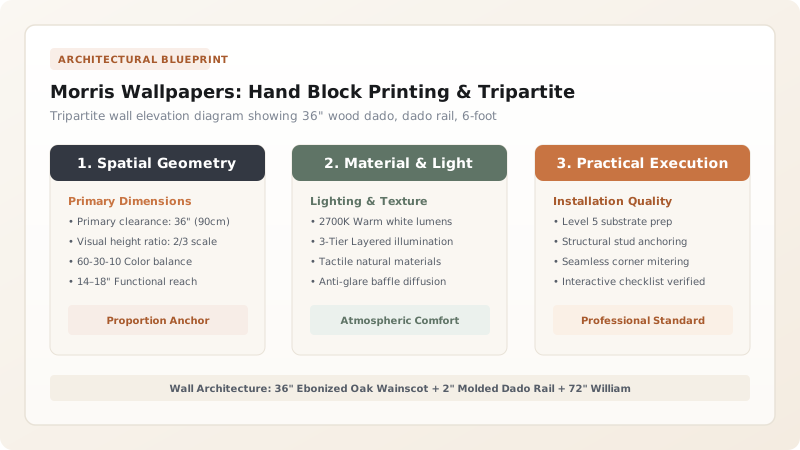
To prevent heavy botanical designs from making rooms feel dark, Victorians divided walls into Three Architectural Zones:
- Dado (Bottom 36"): Solid wood paneling or heavily textured Anaglypta/Lincrusta painted in deep matte green or black.
- Field (Middle 6ft): William Morris botanical wallpaper.
- Frieze (Top 18"): Lighter foliated frieze paper or painted parchment above the picture rail.
Coordinate with William De Morgan fireplace tiles.
Iconic William Morris Wallpaper Patterns
Use this reference table to calculate exact physical dimensions, ratios, and specifications before purchasing:
| Morris Pattern Name | Year Designed | Pattern Structure & Scale | Optimal Room Setting |
|---|---|---|---|
| Acanthus (Optimal Grand Field) | 1875 | Grand 3D swirling acanthus foliage (Large) | Great rooms / Grand dining rooms |
| Willow Bough | 1887 | Delicate overlapping diagonal willow leaves | Bedrooms / Sitting rooms / Hallways |
| Strawberry Thief | 1883 | Intricate thrushes stealing wild berries | Libraries / Powder rooms / Accent walls |
| Fruit / Pomegranate | 1864 | Branches bearing pomegranates and olives | Breakfast nooks / Kitchens / Pantries |
Delicate Surface Water Bleeding Constraints
Every successful decoration project must account for physical and environmental constraints:
Wiping Squeeze-Out Paste with Wet Sponge Bleeding Morris Pigment Colors
Authentic block-printed papers use water-soluble mineral distemper inks; scrubbing seams with a wet sponge dissolves the ink, ruining the pattern; roll seams dry with an ultra-soft wooden seam roller, dabbing away paste with a barely damp microfiber cloth.
How to Hang Hand Block-Printed Morris Wallpaper
Execute this professional sequence to achieve flawless results without backtracking:
Cross-Line Wall with Heavy Lining Paper
Hang 1200-grade non-woven lining paper horizontally across wall to create an absorbent, flat ground.
Cook Natural Wheat Starch Paste
Cook wheat starch powder in boiling water until thick and translucent; strain through cheesecloth.
Hand-Trim Selvage Edges with Brass Straightedge
Authentic English rolls come untrimmed; slice selvage borders with fresh surgical scalpel along steel rule.
Paste and Book Paper Drops for 8 Minutes
Brush wheat paste generously on paper back; fold paste-to-paste (booking) to allow uniform moisture absorption.
Hang Plumb and Butt Seams Without Overlap
Hang first drop to laser plumb line; butt subsequent drops edge-to-edge with zero seam gap.
Roll Seams with Soft Wooden Seam Roller
Roll seams gently with wooden roller; never wipe wet sponges aggressively across print surface.
Common Mistakes & Countermeasures
Avoid these costly errors that compromise aesthetics, ergonomics, and budget:
Using Heavy Synthetic Vinyl Wallpaper Adhesive on English Paper
Project Execution Checklist
Track your physical progress. Checkboxes persist automatically on this device:
Frequently Asked Questions
Are modern Morris & Co. wallpapers still made in England?
Yes! Authentic Morris & Co. wallpapers are still printed in Loughborough, England, using original hand-carved woodblocks and traditional surface-printing presses dating back to the 19th century.


