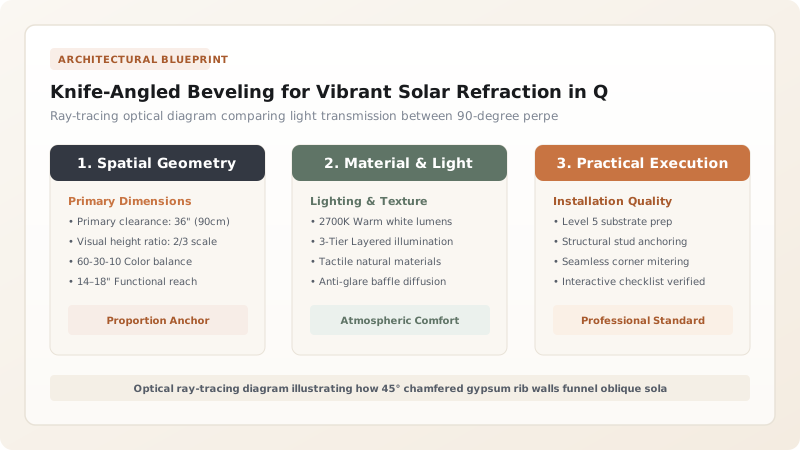
Knife-angled beveling is the critical optical carving technique applied to the interior tracery ribs of Yemeni Qamariya fanlights. Rather than leaving the walls of the 50 mm thick carved gypsum apertures perpendicular (90 degrees to the face), the craftsman bevels every internal rib wall back at a crisp 45-degree chamfer. This inverted funnel geometry performs two vital optical functions: it prevents the thick gypsum matrix from casting dark shadows over the colored glass facets, and it transforms the chalk-white gypsum sidewalls into miniature refractive light-funnels that scatter low-angle morning, midday, and evening desert sunlight into vibrant ambient illumination across interior living spaces.
At a Glance: Key Takeaways
- Optical Technique: Knife-angled chamfer beveling (Tafrīgh al-Zawiyyah)
- Bevel Angle: 40° to 45° inward flare from glass plane to interior face
- Rib Wall Thickness: Tapers from 8 mm at front edge to 18 mm at base
- Reflective Surface: Micro-crystalline calcined white gypsum (90%+ diffuse reflectance)
- Solar Angle Capture: Extends direct solar light capture window by up to 3.5 hours daily
The Optical Challenge of Thick-Wall Vernacular Fenestration
In contemporary steel-and-glass architecture, windows are paper-thin membranes mounted in flush metal frames. In historic Yemeni vernacular architecture, windows must pierce massive, load-bearing walls of mud-brick and basalt measuring between 500 mm and 800 mm in thickness. Furthermore, the structural gypsum matrix of the Qamariya is itself a monumental 50 mm thick stone slab. If the negative apertures of this heavy slab are cut with perpendicular 90-degree sidewalls, a severe optical defect arises: the thick walls act like deep tunnels or light-collars.
In a 50 mm perpendicular aperture, any sunlight striking the window at an angle greater than 30 degrees from perpendicular is blocked by the deep side wall, casting a heavy black shadow across the glass. The room remains dim, while the small opening creates painful, high-contrast glare against the shadowed interior walls. To solve this fundamental physics problem, Yemeni master craftsmen devised knife-angled beveling (tafrīgh al-zawiyyah), carving every internal rib wall back at a continuous 45-degree chamfer.
Ray Tracing and the Physics of the Inverted Funnel
By carving a 45-degree bevel from the rear glass rebate toward the interior face, the craftsman transforms every individual aperture into an inverted optical funnel. When direct sunlight strikes the exterior glass, the rays that penetrate the colored shard expand outward into a cone. Because the gypsum walls flare away at 45 degrees, they sit completely outside this light cone, preventing any shadow from falling across the glass.
More importantly, the beveled geometry radically expands the window's solar capture window. In the early morning and late afternoon, when the sun is low on the horizon and strikes the tower house facade at an acute angle, the 45-degree chamfer intercepts these oblique rays. Rather than being blocked by a square stone wall, the light strikes the angled face of the white gypsum, which acts as a secondary reflector, bouncing soft colored rays across the ceiling and walls of the salon (mafraj) for hours after a flat window would have fallen into total darkness.
The Diffuse Reflectance of Crystalline White Gypsum
The optical efficacy of this beveling relies directly on the unique mineralogy of calcined al-qasab gypsum. Unlike dark wood or grey cement, hydrated calcium sulfate dihydrate is composed of an interlocking matrix of microscopic transparent crystals. When light strikes this surface, it does not undergo specular (mirror-like) reflection, which would cause blinding glare; it undergoes pure diffuse Lambertian scattering.
With a diffuse reflectance value exceeding 90%, the white gypsum chamfers catch the saturated jewel tones of the red, blue, yellow, and green glass shards and scatter them into the room with ethereal softness. The white tracery ribs seem to glow from within, creating a luminous halos of secondary colored light that dissolves the physical heaviness of the stone wall, turning the massive tower house facade into an ethereal lantern suspended in the sky.
Craft Technique: Hand Angles, Acute Corners, and Burnishing
Executing continuous 45-degree bevels across an intricate geometric arabesque requires virtuoso hand-eye coordination. Working on the green, leather-hard gypsum slab, the artisan holds a specialized angled knife (sikkīn mā'il) at an unwavering 45-degree tilt. In a single, fluid slicing stroke, the craftsman removes a triangular ribbon of plaster along the entire perimeter of a curved petal or polygonal star.
The supreme test of mastery occurs at acute intersections—such as the sharp points of an 8-pointed star (shamsiya). Here, two converging 45-degree bevels must meet in a razor-sharp, perfectly centered miter ridge. The artisan finishes the work using a polished bone or olive-wood burnisher, rubbing the damp plaster until the microscopic surface pores close, producing a silky, satin finish that resists airborne desert dust and maximizes radiant solar reflectance for centuries.
Aperture Wall Geometry: 45° Knife-Angled Bevel vs 90° Perpendicular Cut vs Rounded Bullnose Profile
Use this reference table to calculate exact physical dimensions, ratios, and specifications before purchasing:
| Aperture Geometry | 45° Knife-Angled Inward Bevel | 90° Perpendicular Straight Cut | Rounded Bullnose / Radiused Profile |
|---|---|---|---|
| Low-Angle Solar Capture (Morning/Evening) | Exceptional; wide chamfer funnel catches oblique sun rays and bounces them through the glass | Extremely Poor; 50 mm deep perpendicular walls create severe cut-off angles, blocking light | Moderate; rounded edges capture some oblique light but lack precise reflective planes |
| Interior Diffuse Glow & Ambient Throw | Maximum; brilliant white gypsum chamfers act as secondary light reflectors, casting jewel-toned light deep into salons | Low; dark internal shadows swallow light, producing harsh pin-prick glare with zero ambient throw | Moderate; soft rounded diffusion but creates muddy shadow halos around color borders |
| Shadow Casting on Glass Facets | Zero; beveled walls sit entirely outside the primary optical light cone of the glass shard | Severe; deep perpendicular walls cast heavy black shadows across 40% to 60% of the glass area | Minor; rounded shoulder casts partial shadows across glass perimeter edges |
| Visual Elegance & Apparent Thinness | Exquisite; creates the optical illusion that the heavy 50 mm stone slab is delicate paper lace | Heavy and Clumsy; deep tunnel walls make the tracery look bulky, thick, and primitive | Soft and Muted; lacks the crisp geometric sharpness of authentic classical Islamic strapwork |
| Carving Speed & Tool Complexity | Demands High Artisanal Precision; requires disciplined hand angle control on every curved rib | Fast and Simple; straightforward perpendicular plunge cutting | Slow; requires multi-pass scraping and continuous contour sanding |
Practical Constraints
Every successful decoration project must account for physical and environmental constraints:
Narrow Clearance Inside Acute Starburst Angles
In 8- and 12-pointed stars, adjacent rib intersections meet at extreme acute angles (less than 30°), making knife access difficult. Mitigation: Utilize micro-bladed specialty chisels with narrow 3 mm triangular profiles to carve crisp corner bevels without damaging opposing walls.
Fiber Pull-Out in Straw-Reinforced Gypsum Slabs
If traditional straw or animal hair reinforcement fibers cross the bevel cut line, the knife can snag and tear chunks from the rib. Mitigation: Hone knife edges to scalpel sharpness on fine 8000-grit waterstones and slice fibers with a dynamic drawing motion rather than pushing.
Execution Blueprint & Craftsmanship Sequence
Execute this professional sequence to achieve flawless results without backtracking:
Primary Aperture Inspection
Examine the freshly plunge-cut Qamariya slab to verify that all negative voids are cleanly evacuated and that the gypsum remains in its optimal leather-hard green state.
Tool Selection and Razor Honing
Select a single-beveled right-hand and left-hand angled carving knife (sikkīn mā'il). Hone the blades on a fine Arkansas or Japanese waterstone until they effortlessly shave hair, stropping on leather charged with chromium oxide paste.
Establishing Front Structural Lands
Scribe a light boundary line 4 mm in from the edge of each rib on the interior face. This establishes the structural flat land (the front face of the rib) that will remain untouched, preventing the bevel from feathering into an overly fragile knife-edge.
Rough Chamfer Slicing
Position the blade at a 45-degree angle relative to the slab face. Drawing the blade toward the body with smooth, controlled forearm motion, slice away the square internal corner of the aperture wall in a continuous ribbon of damp plaster.
Corner Apex and Cusp Detailing
Switch to a fine triangular-pointed detailing knife to bevel into the sharp acute corners of geometric stars and floral cusps, ensuring the two converging 45-degree bevels meet in a razor-sharp, mitered ridge.
Glass Rebate Clearance Verification
Inspect the rear face of the slab to ensure that the 45-degree front bevel does not encroach upon the rear 10 mm perimeter shoulder (the rebate where the colored glass shard will bed into pine resin).
Hardwood Burnishing and Surface Compaction
Take a polished hardwood burnishing tool (crafted from dense olive wood or boxwood) and rub it firmly along the damp beveled plaster faces. This compacts the micro-crystalline gypsum surface, creating a satin sheen that maximizes diffuse light reflectivity.
Optical Solar Alignment Test
Prop the carved slab up against an outdoor window or strong artificial light source. Inspect the beveled apertures from multiple oblique viewing angles, confirming that light passes cleanly through every aperture with zero obstruction from internal rib walls.
Common Mistakes & Countermeasures
Avoid these costly errors that compromise aesthetics, ergonomics, and budget:
Carving rib sidewalls completely straight at 90 degrees to the face
Over-thinning the front knife-edge of the tracery rib below 6 mm
Leaving rough, gouged tool chatter marks along the beveled sidewalls
Project Execution Checklist
Track your physical progress. Checkboxes persist automatically on this device:
Frequently Asked Questions
Why is the 45-degree angle considered the universal standard for Qamariya bevels?
The 45-degree angle represents the mathematically ideal compromise between optical light collection and structural mass. An angle steeper than 45 degrees (e.g., 60°) leaves excessive gypsum thickness that casts shadows during early morning and late afternoon. An angle shallower than 45 degrees (e.g., 30°) removes too much plaster, dangerously weakening the structural rib and making it prone to fracture.
Does the white color of the gypsum play a role in the optical lighting effect?
Yes, profoundly. Calcined al-qasab gypsum is composed of millions of microscopic interlocking calcium sulfate crystals that possess a pure white diffuse reflectance exceeding 90%. When sunlight passes through the red, blue, or yellow glass and strikes the angled 45-degree white bevel, the white plaster acts as a brilliant secondary reflector, bouncing colored light across the room with a soft, glowing intensity that direct sunlight through clear glass cannot produce.
How do beveled Qamariyas reduce eye strain in desert environments?
In high-altitude Yemen, exterior desert daylight is blindingly intense (often exceeding 100,000 lux). A standard flat window creates severe glare because of the brutal contrast between the bright window and dark interior walls. The 45-degree beveled white ribs create a graduated zone of luminous transition around each glass aperture, stepping down the harsh contrast and eliminating eye fatigue.
Are the exterior faces of Qamariya ribs also beveled at 45 degrees?
No. The exterior face of a Qamariya is kept relatively flat with square, slightly rounded 90-degree edges. The 45-degree beveling is carved almost exclusively on the interior face facing the living room. This asymmetric profile ensures that the exterior maintains maximum stone thickness to resist rain erosion and wind pressure, while the interior functions as an expanded light funnel.