The red-ochre kemar (also known as spang-ma or penma frieze) is the sacred architectural cornice band that crowns Tibetan Dzongs, royal palaces, and Buddhist monasteries. Spanning a continuous 1.0 to 1.5-meter vertical band beneath the overhanging roof eaves, the kemar is constructed from millions of tightly packed, horizontally laid mountain willow or tamarisk twigs (penma) boiled in red-ochre mineral dye and compressed between timber plates. Culturally, the kemar signifies high sacred religious authority and housing of Buddhist scriptures. Structurally, it acts as an ultra-lightweight, insulating parapet band that reduces dead loads on high stone walls while dissipating wind turbulence.
At a Glance: Key Takeaways
- Botanical Material: Mountain tamarisk (Myricaria germanica) or alpine willow twigs (penma)
- Mineral Dye: Natural red-ochre iron oxide earth (Tsag) mixed with yak bone glue
- Vertical Band Height: 800 mm to 1500 mm continuous frieze beneath the roof cornice
- Sacred Ornamentation: Gilded brass medallions (Gyalthsen) and mirror disks (Melong)
- Architectural Sumptuary Rule: Reserved exclusively for royal palaces, lamas' residences, and temple halls
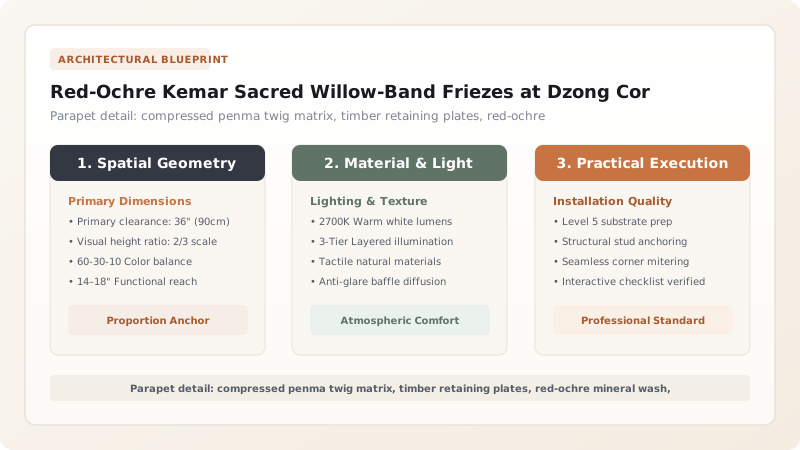
The Crown of the Sacred: Sumptuary Law & The Kemar Frieze
Approaching a Tibetan dzong or monastic fortress across the vast, barren expanse of the Himalayan plateau, the eye is captivated by a dramatic chromatic phenomenon. Above towering battered walls of dazzling whitewashed stone, immediately beneath the gilded copper roof eaves, runs a broad, deep, velvety band of rich reddish-brown or dark crimson. Known in Tibetan architectural parlance as the kemar (or spang-ma), this continuous frieze—measuring between 800 and 1500 millimeters in height—is one of the most distinctive visual signatures of the Roof of the World.
In the strict sumptuary hierarchy of traditional Tibet, the kemar was an emblem of the highest spiritual sovereignty. It was strictly prohibited on secular domestic houses, merchant estates, or utilitarian military barracks. By royal and monastic decree, the kemar could only be installed upon buildings that housed the sacred texts of the Buddhist canon (the 108 volumes of the Kangyur), the personal residences of high incarnate lamas (such as the Dalai Lama or Panchen Lama), or the supreme administrative council chambers of the state. Its presence announced from miles away that the structure was a sacred vessel of Dharma and divine protection.
Botanical Materiality: Mountain Tamarisk (Penma) Engineering
When foreign travelers first encounter a kemar, they almost universally assume it is a band of sculpted timber, pigmented stucco, or painted brick. In reality, the kemar is an astonishing triumph of bio-composite material engineering. It is constructed from millions of tightly packed, horizontally laid twigs of alpine tamarisk (Myricaria germanica) or dwarf mountain willow, known locally as penma.
These woody shrubs grow abundantly in the braided gravel riverbeds of high-altitude Himalayan valleys, such as the Yarlung Tsangpo and Lhasa River basins. Thriving in freezing, oxygen-thin alpine conditions, penma twigs develop an exceptionally dense cellular structure saturated with natural bitter resins and tannins that render the wood naturally impervious to rot, wood-boring beetles, and fungal decay. In late autumn, villagers harvest the straight, pencil-thick twigs, strip them of foliage, and trim them with heavy billhooks into uniform lengths matching the depth of the parapet wall (typically 300 to 450 millimeters).
The Mineral Dye: Sourcing & Boiling Tsag Red Ochre
The unforgettable, light-absorbing crimson-russet color of the kemar is achieved through a traditional mineral boiling process. The harvested twig bundles are transported to copper dyeing cauldrons erected near the construction site. The dyeing bath is prepared using natural red-ochre mineral earth, known in Tibetan as tsag.
Mined from geological iron-oxide clay deposits in the mountain cliffs of central Tibet, tsag is pulverized into an impalpable powder and boiled in water enriched with natural adhesive binders—traditionally bone glue extracted from boiled yak hooves and hides, mixed with a dash of fermented barley beer (chang) to reduce surface tension. The penma twig bundles are submerged in the boiling red-ochre cauldron for two to three hours. The intense heat forces the iron-oxide nanoparticles deep into the porous cellular tracheids of the twigs. When removed and sun-dried under high-altitude ultraviolet rays, the mineral pigment cross-links within the wood fibers, creating a permanent, weather-resistant crimson dye that will not fade or wash out even after centuries of exposure to torrential summer monsoon rains and harsh winter snows.
Compressive Assembly: The Mechanics of the Frieze
Installing the kemar on the high parapet of a dzong is an intensive physical operation requiring specialized carpenters and masons. Along the top of the stone wallhead, heavy squared timber base plates are laid. The dyed penma twigs are stacked horizontally in dense layers, with their cut ends pointing outward toward the exterior facade.
As the twigs are laid, carpenters apply immense mechanical compression. Using long timber lever presses weighted with heavy boulders, the artisans compress the loose twig mass with colossal downward force. Layer upon layer is hammered down until the twigs achieve the density of solid timber—so tightly compacted that birds cannot extract a single stem, nor can driving rain penetrate more than a few millimeters into the end-grain. Heavy upper timber cornice plates are bolted down over the compressed mass, clamping the frieze in permanent compression. When completed, the face of the frieze is trimmed flush with curved pruning knives, producing an exquisite, velvet-matte texture that absorbs harsh mountain glare. Finally, the frieze is adorned with repoussé gilded brass emblems: sacred circular mirrors (Melong) that reflect the unblemished nature of the enlightened mind, and flaming jewels (Norbu) that proclaim the eternal triumph of the Buddhist Dharma.
Cornice Frieze Typologies & Sacred Status in Tibetan Architecture
Use this reference table to calculate exact physical dimensions, ratios, and specifications before purchasing:
| Cornice Typology | Tibetan Name | Material Construction | Sacred Status | Building Application |
|---|---|---|---|---|
| Sacred Willow Frieze | Kemar (Penma / Spang-ma) | Compressed red-ochre willow/tamarisk twigs | Highest sacred authority; houses Kangyur scriptures | Potala Palace, main Dzong sanctuaries, monastic U-Tse |
| Timber Bracket Cornice | Zhu-Tseg Frieze | Stepped carved cedar bracket capitals | High monastic and civil status | Palace reception halls, monastic libraries, lamas' quarters |
| Slate Eaves Frieze | Yab-Khor Slate Band | Overlapping cantilevered slate slabs | Medium status; functional water shedding | Administrative offices, monastic dormitories, granaries |
| Whitewashed Stone Parapet | Chukhor / Tsen-Khar | Plain stone wall capped with lime wash | Standard civil/defensive status | Lower dzong bastions, defensive towers, curtain walls |
| Rammed Earth Parapet | Gyang-Khor | Unadorned rammed earth wallhead | Vernacular agricultural status | Domestic rural farmsteads and village outbuildings |
Practical Constraints
Every successful decoration project must account for physical and environmental constraints:
Massive quantity of wild tamarisk twigs required (millions of individual stems per dzong)
Over-harvesting can cause ecological damage to fragile high-altitude Himalayan riparian riverbanks. Mitigation: Establish sustainable rotational coppicing cycles across mountain valleys over 3-to-5-year regeneration periods.
Weathering and color wash-out of natural red-ochre dye under heavy monsoon driving rains
Can cause red pigment to wash down and stain the brilliant white stone walls below. Mitigation: Incorporate natural animal-bone glue binders into the dye bath and construct generous overhanging roof eaves.
Execution Blueprint & Craftsmanship Sequence
Execute this professional sequence to achieve flawless results without backtracking:
Penma Willow Twig Harvesting
Harvest straight wild tamarisk or alpine willow branches (5–10 mm diameter) along Himalayan river gravel beds during late autumn dormancy.
Trimming & Bundle Sizing
Strip leaves, trim twigs to uniform lengths matching the parapet depth (typically 350 mm), and bind into loose, workable bundles.
Red-Ochre Boiling & Mineral Impregnation
Boil twig bundles in copper cauldrons filled with natural iron-oxide red earth (Tsag) and animal bone glue for 2 hours until deeply dyed.
Sun Drying & Curing
Spread dyed twig bundles across timber racks, allowing the mineral pigment to cross-link and cure under high-altitude ultraviolet sunlight.
Parapet Timber Framing Erection
Install heavy timber base sills and top plates along the stone wallhead, anchoring them to internal roof collar beams with iron rods.
High-Pressure Twig Stacking & Compaction
Lay twigs horizontally with their cut ends pointing outward, compressing layers under heavy lever-press beams until reaching 1.2 m height.
Timber Retaining Lip Locking
Bolt the upper timber cornice plate down over the compressed penma mass, trimming protruding twig tips flush with a curved razor knife.
Gilded Brass Emblem Mounting
Affix hand-hammered repoussé gilded brass sun-moon medallions (Melong) and auspicious emblems onto the velvety red frieze face.
Common Mistakes & Countermeasures
Avoid these costly errors that compromise aesthetics, ergonomics, and budget:
Painting a solid plaster wall with red paint to imitate a traditional kemar frieze
Packing twigs loosely without mechanical compression during installation
Project Execution Checklist
Track your physical progress. Checkboxes persist automatically on this device:
Frequently Asked Questions
What is the botanical source of the penma twigs used in the kemar frieze?
The twigs are harvested from mountain tamarisk (Myricaria germanica) or shrubby alpine willow species that thrive in the cold, gravelly alluvial floodplains of the Tibetan Plateau. These shrubs produce dense, straight, flexible twigs rich in natural tannins that resist rot and insect infestation.
Why did Tibetan architects use compressed twigs instead of solid stone for the parapet?
Weight reduction was the primary structural reason. At the top of a massive battered stone wall seven stories in the air, adding another 1.5 meters of solid stone would exert colossal crushing dead load on the underlying timber floor joists. Compressed twigs provide a thick, opaque parapet wall with less than one-tenth the weight of stone, while offering superior thermal insulation against freezing mountain winds.
What do the gilded circular medallions mounted on the kemar represent?
The circular gilded brass disks are sacred mirrors known as 'Melong.' In Tibetan Buddhist iconography, the mirror symbolizes the pristine, unblemished nature of the enlightened mind—which reflects all phenomena clearly without being stained by them. They also function as apotropaic talismans that deflect negative spiritual influences away from the sanctuary.