Mineral pigment gouache sacred geometry and iconometric composition form the theological and visual core of Tibetan thangka art. Master artists (lhadri-ba) lay out compositions using the sacred Thig-tse grid system codified in the Kalachakra Tantra, calculating divine anatomical proportions in Sor-mo (finger-width) units. While garments and backgrounds are rendered in silk appliqué, divine faces, eyes, and sacred syllables are painted on smooth silk inserts using natural mineral gouache (lapis lazuli, malachite, cinnabar, orpiment) bound with yak-hide glue and illuminated with 24K pure gold ink (ser-yig).
At a Glance: Key Takeaways
- Iconometric Canon: Thig-tse (sacred proportional grid system from Buddhist Tantras)
- Proportional Unit: Sor-mo (finger-breadth) and Thig-chen (major bodily division units)
- Mineral Pigments: Lapis lazuli (blue), malachite (green), cinnabar (red), orpiment (yellow)
- Natural Binder: Purified yak-hide collagen glue (tsampa-glue / ping)
- Precious Metal Ink: Ser-yig (24K pure gold powder suspended in animal glue medium)
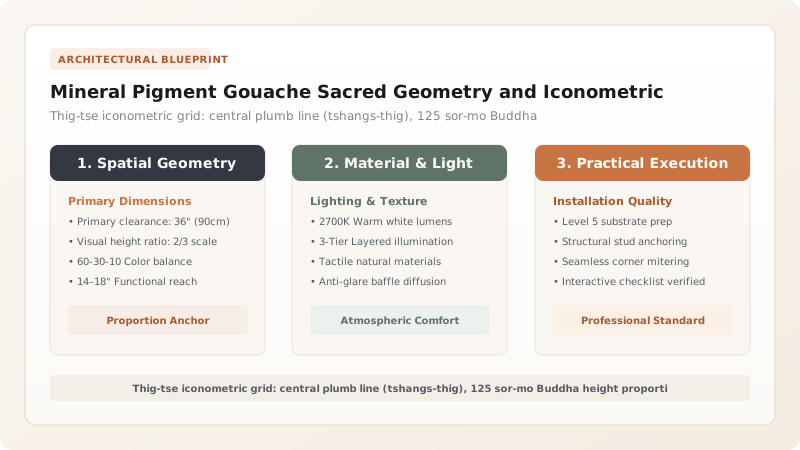
Iconometric Proportions: The Sacred Thig-Tse Grid
In Tibetan sacred art, the creation of an image of an enlightened being is an act of deep contemplative science, governed by the ancient iconometric canon known as the Thig-tse. Rooted in the Sanskrit Pratimamana-lakshana and the Kalachakra Tantra, the thig-tse establishes that the physical form of a Buddha or Bodhisattva is not an arbitrary artistic interpretation, but a visual manifestation of universal cosmic order, divine proportions, and spiritual geometry. The foundational unit of measurement is the sor-mo (the width of the artist’s middle finger joint) and the thig-chen (major proportional divisions).
Before any painting or textile cutting can commence, the master artist (lhadri-ba) establishes the geometric armature of the composition. A central vertical plumb-line—the tshangs-thig (the axis of Brahma)—is snapped down the center of the working surface, representing the central energy channel (avadhuti) of the subtle body. Symmetrical balance axes, horizontal guidelines, and radiating diagonal diagonals (zur-thig) are laid out with mathematical precision. Deities are categorized into strict proportional hierarchies: supreme Buddhas are rendered in the 125-sor-mo canon; peaceful Bodhisattvas (such as Avalokiteshvara and Manjushri) in the 120-sor-mo canon; fierce protective deities (Dharmapalas like Mahakala) in the 96-sor-mo stocky canon; and wrathful female deities in the 108-sor-mo canon. This sacred geometry ensures that the completed image radiates divine balance, stillness, and spiritual power.
Yak-Hide Glue Binder and Mineral Pigment Formulation
While the monumental body of a Gö-ku thangka is constructed from silk appliqué, the delicate facial features, lotus eyes, sacred hand mudras, and consecration syllables demand a precision that can only be achieved with brush and paint. These elements are painted on smooth silk inserts using traditional mineral gouache bound with pure animal collagen glue. In the high plateau of Tibet, the supreme binding medium is ping—refined collagen glue extracted by boiling the shaved hides of domestic yaks (Bos grunniens).
The preparation of yak-hide glue is a delicate craft. Shaved yak skins are simmered in pure spring water for days until the natural collagen dissolves into a clear, gelatinous broth. The broth is strained, poured into shallow pans, and dried into clear, amber-colored cakes. When preparing paints, the glue cake is dissolved in warm water; it provides extraordinary binding tenacity, high film elasticity, and a neutral pH that does not discolor delicate mineral pigments. The pigments themselves are sourced directly from Himalayan and Central Asian geological deposits: deep blue from Badakhshan lapis lazuli (mthing), vivid green from mountain malachite (spang-ma), pale blue from azurite, brilliant scarlet from crystalline cinnabar (li-khri), and golden-yellow from raw arsenic orpiment (ba-bla). The raw minerals are crushed in stone mortars and levigated in water to separate coarse heavy particles from fine, floating pigments, creating an opaque, crystalline gouache that reflects light with unearthly brilliance.
Facial Feature Delineation: Eyes, Lips, and Mudras
The painting of the deity’s face and hands is the most sacred phase of thangka creation, entrusted only to fully initiated master painters. The silk insert, having been sized with dilute yak-hide glue and burnished with a white conch shell (dung-dkar) to close the fabric pores, receives the initial underdrawing in fine red or black ink using delicate brushes crafted from the tail hair of mountain martens or weasels.
The painter builds up the divine flesh tones through a sophisticated technique known as dang-dkar (dry-brush shading). Multiple translucent washes of mineral pigments are applied and blended across the cheekbones, brow, and chin, creating the subtle, glowing three-dimensional volume of youth and divine radiance. The facial features are delineated according to sacred iconographic poetry: the eyebrows are curved like the wings of a soaring raven; the nose is straight and noble like the beak of a parrot; the lips are sculpted like the blooming red lotus petal; and the eyes—the spyan—are shaped like the bow of Kama or the petal of an aquatic blue water lily. The painter works in profound meditative concentration, often chanting mantras associated with the deity, ensuring that every brushstroke channels divine compassion and transcendent awareness.
Pure Gold Ink (Ser-Yig) Calligraphy and Consecration Syllables
The final illumination of the painted inserts and appliqué borders is executed with pure 24-karat gold ink, known as ser-yig. In Tibetan sacred art, gold is not merely an ornamental luxury; it is the physical embodiment of the unconditioned, immutable nature of the enlightened mind—incorruptible, radiant, and pure.
The creation of ser-yig requires monumental patience. The artist places sheets of pure 24-karat gold leaf into a porcelain saucer, adds a few drops of thick yak-hide glue, and rubs the mixture with the ball of the thumb against the porcelain for several hours. This mechanical grinding reduces the gold leaf into microscopic, colloidal gold particles suspended in the glue. The artist paints radiating halo lines, intricate brocade patterns, and delicate floral scrolls onto the thangka with fine-pointed brushes. Once the gold paint dries, the artist takes up an agate burnishing stylus: drawing the smooth stone tip along the gold lines compresses the microscopic gold flakes, transforming the dull yellow paint into a dazzling, mirror-like metallic gold line. Finally, on the reverse of the thangka, directly behind the forehead, throat, and heart of the deity, the master calligrapher writes the three sacred seed syllables in gold ink: OM (white/crown, representing enlightened body), AH (red/throat, representing enlightened speech), and HUM (blue/heart, representing enlightened mind), spiritually consecrating the monumental artwork for eternity.
Mineral Pigment Sourcing, Chemical Base & Iconographic Roles in Tibetan Thangkas
Use this reference table to calculate exact physical dimensions, ratios, and specifications before purchasing:
| Tibetan Color Name | Mineral / Organic Source | Chemical Base | Mulling Medium | Iconographic Application |
|---|---|---|---|---|
| Mthing (Deep Blue) | Badakhshan Lapis Lazuli | Complex sodium silicate sulfur (Lazurite) | Yak-hide glue (Ping) | Medicine Buddha, wrathful deity bodies, celestial skies |
| Spang-ma (Green) | Himalayan Malachite | Basic copper carbonate (Cu2CO3(OH)2) | Yak-hide glue (Ping) | Green Tara, peaceful landscape hills, botanical leaves |
| Li-khri / Tshos (Red) | Cinnabar (Chayilyam) / Ochre | Mercuric sulfide (HgS) / Hematite | Yak-hide glue (Ping) | Amitabha Buddha, deity robes, lotus petal shading |
| Ba-bla (Yellow) | Orpiment stone / Yellow ochre | Arsenic trisulfide (As2S3) | Yak-hide glue (Ping) | Ratnasambhava, golden body complexions, crowns |
| Ser-yig (Pure Gold) | 24K Gold leaf ground with glue | Pure metallic gold (Au) | Glue + drops of garlic juice | Radiating halo rays, robe embroidery, sacred mantras |
Practical Constraints
Every successful decoration project must account for physical and environmental constraints:
High toxicity of arsenic orpiment (Ba-bla) and mercuric cinnabar during manual grinding
Inhalation of mineral dust or skin absorption causes chronic poisoning in painters. Mitigation: Grind minerals strictly under wet conditions on porcelain plates with protective masks.
Extreme brittleness of mineral gouache on flexible fabric thangkas when rolled for storage
Thick gouache layers crack and delaminate when rolled around wooden transport cylinders. Mitigation: Apply gouache in ultra-thin, multi-layered transparent washes with flexible hide glue.
Execution Blueprint & Craftsmanship Sequence
Execute this professional sequence to achieve flawless results without backtracking:
Iconometric Grid Calculation
The master artist calculates the proportional coordinates based on the sor-mo unit (1/125th of total Buddha height). Snap the central plumb line (tshangs-thig) and diagonal balance lines.
Silk Insert Ground Preparation
Stretch fine white silk inserts onto wooden frames. Apply a thin sizing of yak-hide glue and chalk to fill pores, burnishing with a conch shell (dung-dkar) until smooth.
Underdrawing Transfer
Transfer the iconometric drawing onto the silk insert using fine carbon ink lines drawn with a bamboo reed pen or fine marten-hair brush.
Mineral Pigment Levigation & Mulling
Crush raw mineral stones (lapis, malachite, cinnabar) and levigate in water to separate color grades. Mull with warm yak-hide glue on porcelain saucers.
Base Color Washes & Shading
Apply flat base washes of mineral gouache for divine flesh, crowns, and auras. Build three-dimensional volume through delicate dry-brush shading (dang-dkar).
Facial Feature Painting
Using single-hair brushes, paint the compassionate arched eyebrows, the urna curl, and the half-closed lotus eyes (spyan), blending flesh tones with micro-stippling.
Ser-yig Gold Ink Preparation
Grind 24K gold leaf in a porcelain dish with glue and water until colloidal gold forms. Wash out binder with warm water, re-mixing with fresh hide glue and a drop of garlic juice.
Gold Line Detailing & Burnishing
Paint radiating gold rays and intricate textile patterns with gold ink. Once dry, burnish the gold lines with an agate or cat's-eye stylus to achieve a mirror shine.
Common Mistakes & Countermeasures
Avoid these costly errors that compromise aesthetics, ergonomics, and budget:
Drawing deity figures freehand without establishing the canonical Thig-tse grid
Using commercial synthetic watercolor or gouache paints containing chemical dyes
Adding too much yak-hide glue binder (>20%) to the mineral gouache mixture
Project Execution Checklist
Track your physical progress. Checkboxes persist automatically on this device:
Frequently Asked Questions
What is the "thig-tse" system and why is it mandatory for thangka painters?
Thig-tse is the classical Tibetan Buddhist canon of iconometry (sacred proportions), codified in treatises such as the Kalachakra Tantra and the Chitralakshana. In Buddhist metaphysics, an enlightened being's physical body is an expression of perfect cosmic harmony and enlightened mind. The thig-tse establishes exact mathematical grids where every anatomical dimension—from the length of the eyes to the span of the chest—is measured in standard units called sor-mo (finger-widths). Deities are classified into specific proportional classes: the Buddha measures 125 sor-mo; peaceful bodhisattvas measure 120 sor-mo; and wrathful deities measure 96 to 108 sor-mo. Deviating from these proportions is considered a spiritual defect that invalidates the painting.
How is pure gold ink (ser-yig) prepared from 24-karat gold leaf?
Ser-yig (literally "gold writing" or gold ink) is prepared through an extraordinary manual process. The artist places several sheets of pure 24-karat gold leaf into a clean porcelain saucer, adds a few drops of thick yak-hide glue and warm water, and rubs the gold leaf against the porcelain using the ball of the thumb for several hours. The intense friction shreds the gold leaf into microscopic, colloidal gold flakes suspended in the glue. The saucer is then flooded with water, allowing the gold to settle while excess glue is poured off. The concentrated gold sediment is re-mixed with fresh, dilute hide glue and a single drop of garlic juice (which acts as a natural surfactant, lowering surface tension). When painted onto the thangka, it flows like liquid gold.
Why is an agate stylus used to burnish gold ink on thangkas?
When gold ink (ser-yig) dries on silk or canvas, it has a dull, matte yellow appearance because the microscopic gold flakes are oriented randomly, scattering light diffusely. To unlock the metal's brilliant specular luster, the artist uses a burnisher tipped with a smooth, polished natural agate stone (or a cat's-eye gem). Drawing the hard agate tip firmly along the painted gold lines compresses and flattens the microscopic gold flakes into a continuous, mirror-like plane. The burnished gold reflects light with intense, shimmering brilliance, creating the radiant halos and glowing garments that symbolize divine illumination.