
Syrian Ablaq (أبلق, meaning 'particolored' or 'piebald') is a monumental Islamic architectural masonry technique defined by alternating horizontal courses of contrasting dark black basalt and cream-white limestone or yellow dolomite. Perfected across Damascus, Aleppo, and Cairo during the Ayyubid and Mamluk eras, Ablaq combines high-load ashlar masonry with sophisticated puzzle-like interlocking joggle joints (tajshir) across door lintels and arched voussoirs. Adorning the grand entrance portals (iwan) and central courtyard fountains of Damascene palatial residences (Beit), Ablaq mitigates thermal radiation while resisting regional seismic shear.
At a Glance: Key Takeaways
- Bedding Mortar: Hydraulic quicklime + pulverized basalt sand + egg-albumin slurry
- Dark Lithology: Extrusive Hauran Volcanic Basalt (Hajar Aswad, Mohs 6.0)
- Interlocking Joinery: Three-dimensional puzzle-keyed joggle voussoirs (Tajshir)
- Light Lithology: Metamorphic Mezzeh Limestone / Dolomite (Hajar Abyad, Mohs 3.5)
In-Depth Guides in this Directory
Explore specialized subtopic blueprints, technical dimensions, and execution checklists:
Basalt and Limestone Quarrying and Joggle-Joint Dressing in Syrian Masonry
Technical manual on Hauran basalt extraction, Mezzeh limestone dressing, tooth-chisel tooling (shahout), and precision template fabrication for joggle joints.
Mamluk and Ottoman Geometric Interlocking Lintels and Joggle Voussoirs
Structural engineering analysis of Mamluk and Ottoman interlocking joggle voussoirs (tajshir), seismic shear transfer, and flat arch mechanics.
Damascene Courtyard Fountains and Ablaq Conservation Techniques
Comprehensive conservation guide to Damascene courtyard fountains (bahra), hydraulic lime waterproofing, desalination poultices, and stone consolidation.
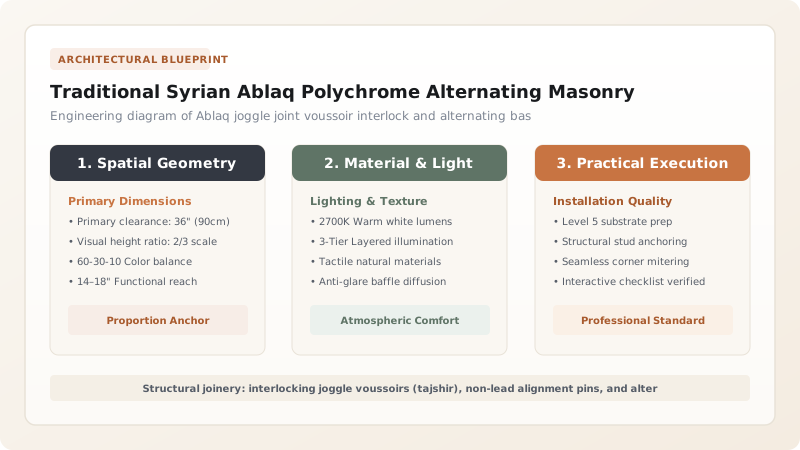
Architectural Evolution: The Damascene Synthesis of Stone and Shadow
Emerging from Roman and Byzantine striped brick-and-stone banding, Ablaq reached its artistic zenith under the Ayyubid and Mamluk Sultanates in the 13th and 14th centuries. In the sun-drenched Levantine landscape, monolithic stone facades can appear blinding and flat. Syrian master masons used the dramatic chromatic contrast of black basalt and white limestone to articulate architectural elements: highlighting monumental entrance arches (iwans), framing muqarnas canopies, and delineating interior courtyard water basins.
Beyond visual drama, Ablaq served profound psychological and civic functions in the traditional Damascene courtyard house (Beit Dimashqi). Stepping from the narrow, dusty, blank exterior alleys into an Ablaq-striped courtyard with splashing fountains and jasmine blossoms provided a multisensory shock of coolness, elegance, and sanctuary.
Material Science: Hauran Basalt and Damascus Mezzeh Limestone
Ablaq masonry is founded on geological contrast. The dark stone is extrusive volcanic basalt quarried from the southern Hauran plateau. Dense, fine-grained, and rich in iron-magnesium silicates, this black stone (hajar aswad) has immense compressive strength (>180 MPa) and resists weathering, but is extremely difficult to dress.
The white stone is Mezzeh limestone, a dense, fine-grained sedimentary calcite quarried from the hills surrounding Damascus. Slaters and masons could carve intricate arabesques into the softer limestone, juxtaposing it against the impenetrable black basalt blocks. A third warm amber stone—yellow dolomite from Qasyoun—was often introduced to form a tripartite polychrome scheme.
Mechanical Engineering: Interlocking Joggle Joints (Tajshir)
The crowning technical feat of Syrian Ablaq is the flat-arch lintel composed of interlocking joggle voussoirs (tajshir or mu'ashshaq). Instead of straight radial joints, each voussoir stone is carved with complex three-dimensional puzzle keys—sinuous curves, S-hooks, or stepped crenellations.
This puzzle-like interlocking locks adjacent stones in complete mechanical shear equilibrium. Even during violent regional earthquakes along the Dead Sea Fault System, individual voussoirs cannot slip downward or push outward. The entire flat arch functions as an integrated pre-stressed stone beam, dissipating seismic shock waves without mortar failure.
Courtyard Fountains, Thermal Mass, and Heritage Conservation
Ablaq masonry played a central thermodynamic role in vernacular Damascene climatology. Dark basalt absorbs solar thermal radiation during daylit hours and radiates warmth into courtyards on cold desert nights, while reflective white limestone remains cool to the touch. Central fountains (bahra) clad in Ablaq marble and basalt cooled courtyard air via evaporative microclimates.
Preserving historic Ablaq requires addressing differential stone decay. Because softer limestone erodes faster than impervious basalt under acid rain and gypsum crusting, historic walls develop stepped, uneven faces. Conservators utilize low-pressure micro-abrasive cleaning, poulticing with ammonium carbonate, and deep non-hydraulic lime pointing to stabilize stone beds without staining adjacent porous marble.
Syrian Ablaq Stone & Joggle Joint Specifications
Use this reference table to calculate exact physical dimensions, ratios, and specifications before purchasing:
| Architectural Zone | Dark Lithology | Light Lithology | Joint Geometry | Bedding Mortar |
|---|---|---|---|---|
| Portal Arch Voussoirs (Iwan) | Hauran Black Basalt (Mohs 6) | Mezzeh White Limestone (Mohs 3.5) | Interlocking S-curve joggles (Tajshir) | Pure slaked lime + crushed basalt dust |
| Courtyard Facade Banding | Porous Basalt Ashlar (250mm high) | Dense Calcified Mezzeh Stone | Straight 3mm hydraulic joints | Lime putty + fine river sand (1:2) |
| Flat Window Lintels | Dense Basalt Key Stones | Fine White Dolomite | Stepped dovetail joggle keys | Lead alignment pins + lime butter |
| Central Basin (Bahra) | Black Basalt Rim Slabs | Yellow Numidian & White Marble | Beveled tongue-and-groove | Waterproof pozzolanic ash-lime mortar |
Practical Constraints
Every successful decoration project must account for physical and environmental constraints:
Extreme Hardness and Brittle Fracturing of Volcanic Basalt
Dressing and carving interlocking curves into black basalt takes four times longer than limestone, demanding specialized tungsten-carbide chisels.
Differential Thermal Expansion Between Basalt and Limestone
Basalt expands at a different rate than limestone under direct 45°C summer sun, requiring flexible lime-ash mortar beds to absorb thermal shear.
Execution Blueprint & Craftsmanship Sequence
Execute this professional sequence to achieve flawless results without backtracking:
Stone Quarrying and Block Dressing
Quarry black volcanic basalt and Mezzeh white limestone; dress all ashlar blocks to uniform 250mm course heights using tooth chisels (shahout).
Full-Scale Joggle Template Layout
Draft the interlocking joggle arch on a flat plaster floor, cutting sheet-zinc templates for every male and female interlocking voussoir.
Precision Joggle Stone Carving
Carve the interlocking puzzle curves into alternating basalt and limestone voussoirs using diamond chisels and files, checking with templates.
Dry Assembly and Tolerance Verification
Dry-assemble the entire joggle lintel on the workshop floor, checking that all interlocking keys engage with less than 1.5mm tolerance gap.
Wall Erection in Alternating Courses
Lay alternating black and white courses on hydraulic lime mortar beds, inserting internal non-ferrous bronze alignment dowels.
Lead Pin Grouting and Joint Dressing
Melt molten lead or inject high-strength lime grout through concealed vertical channels to lock the voussoirs; tool joints flush with clean water.
Common Mistakes & Countermeasures
Avoid these costly errors that compromise aesthetics, ergonomics, and budget:
Using Modern Portland Cement for Bedding Ablaq Masonry
Carving Joggle Joints with Sharp 90-Degree Interior Corners
Project Execution Checklist
Track your physical progress. Checkboxes persist automatically on this device:
Frequently Asked Questions
What is the primary architectural purpose of joggle joints (Tajshir)?
Joggle joints lock individual stone voussoirs together mechanically like puzzle pieces. This prevents stones from slipping out of alignment during earthquakes, allowing flat lintels to span wide doorways without relying purely on mortar adhesion.
Did Syrian builders ever paint stones to simulate Ablaq?
In provincial or domestic renovations where basalt was scarce, plasterers sometimes painted alternating stripes with soot-and-lime wash. However, monumental Mamluk and Damascene palatial architecture strictly utilized solid, through-body natural stone ashlars.
How does Ablaq masonry perform structurally during earthquakes?
Ablaq structures exhibit exceptional seismic resilience. The three-dimensional interlocking joggle joints (tajshir) distribute shear stresses horizontally and prevent vertical voussoir dislodgement, while the dense basalt courses provide low-center-of-gravity ballast that anchors masonry arches against lateral ground accelerations.
What traditional mortar is used between the alternating basalt and limestone courses?
Traditional Syrian masons used hydraulic lime mortar formulated from slaked pit lime, crushed volcanic basalt dust (acting as a natural pozzolan), and sharp river sand. This breathable, sulfate-free mortar accommodates differential thermal expansion between the two stone types without fracturing.


