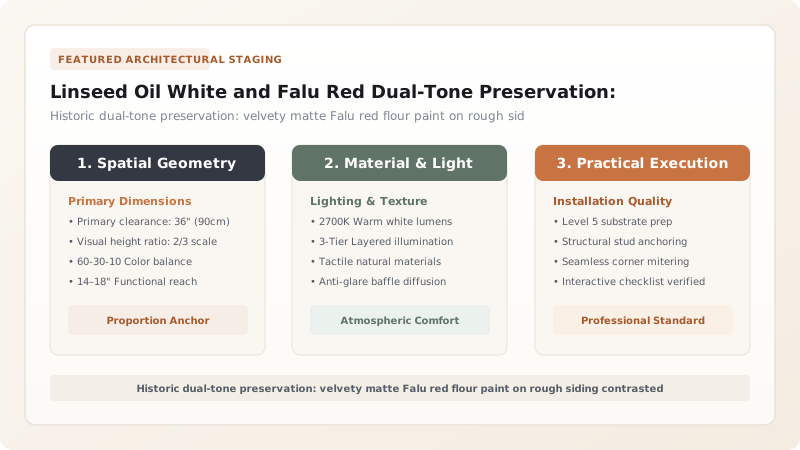
Linseed oil white and Falu red dual-tone preservation represents the iconic exterior paint technology of traditional Swedish wooden architecture. The rustic, rough-sawn vertical board siding is treated with breathable, matte Falu red paint (Falu rödfärg)—a mineral slurry composed of copper mine tailings, iron vitriol, and wheat flour starch. In dramatic contrast, delicate snickarglädje fretwork, porch posts, and window trims are finished in smooth, satin-sheen white paint formulated from pure cold-pressed boiled linseed oil (linoljefärg) and titanium/zinc white pigments, providing deep, non-flaking timber preservation.
At a Glance: Key Takeaways
- Wall Siding Paint: Traditional Falu red flour paint (Falu rödfärg / slamfärg)
- Fretwork Paint: Pure cold-pressed boiled linseed oil paint (kokt linoljefärg)
- White Pigments: Zinc oxide (anti-fungal) blended with titanium dioxide (opacity)
- Film Mechanics: Non-film-forming microporous breathability; zero blistering or flaking
- Maintenance Cycle: Falu red: brush and recoat every 10–12 yrs; Linseed oil: oil wash every 8 yrs
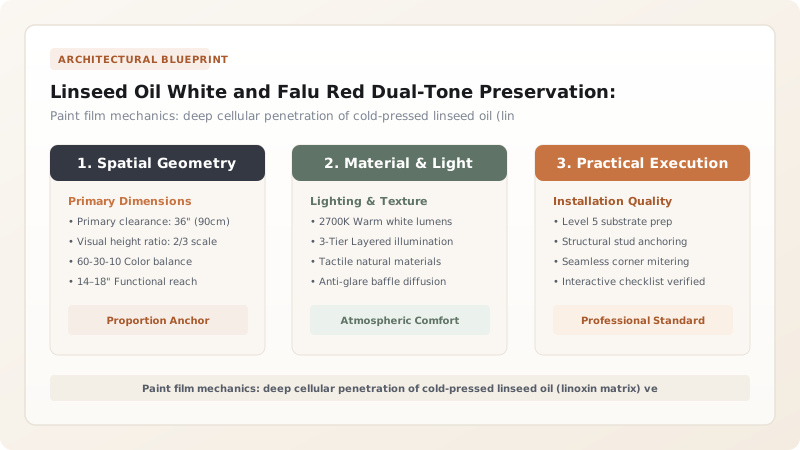
The Iconic Nordic Contrast: Red Earth and White Lace
In the architectural iconography of Scandinavia, nothing is more universally recognized than the Swedish red cottage (den röda stugan). The striking aesthetic harmony relies upon an intentional visual and material dialogue between two contrasting paint technologies: the deep, velvety, light-absorbing crimson of Falu rödfärg across the rough vertical timber siding, contrasted against the gleaming, radiant satin-white of linoljefärg (linseed oil paint) across the intricate snickarglädje fretwork verandas and window trims.
This dual-tone system was not merely a decorative whim; it was a masterclass in materials science and economic pragmatism. In the 18th and 19th centuries, wealthy Swedish aristocrats painted their urban stone palaces in red brick and white marble. Rural farmers and summerhouse builders democratized this high-status architectural language using low-cost local forest materials: mineral mine tailings for the house body and refined cold-pressed flaxseed oil for the delicate carved joinery.
Falu Rödfärg: The Copper Mine Tailings Biocide
The foundation of Swedish timber preservation is Falu rödfärg (Falu red flour paint / slamfärg). Sourced exclusively from the open slag heaps of the Great Copper Mountain (Stora Kopparberget) in Falun—a UNESCO World Heritage mining site operating since the 9th century—the pigment is a natural mineral composite rich in iron oxide, copper compounds, lead, and silica.
The paint is manufactured through an ancient, zero-chemical cooking recipe. Water is boiled in large kettles with iron vitriol (ferrous sulfate) and fine wheat or rye flour, creating a smooth starch paste. The pulverized red mineral pigment is stirred in, simmered for two hours, and allowed to cool. When brushed onto unplaned, rough-sawn pine siding, the paint forms an open, highly breathable mineral wash. The copper and iron vitriol act as powerful natural fungicides, arresting wood-decaying rot and insect infestation, while the porous mineral surface breathes moisture vapor freely, keeping the timber perpetually dry.
Linoljefärg Chemistry: The Linoxin Polymerization Matrix
While Falu red is ideal for rough structural siding, it cannot adhere to smooth, planed woodwork. For the delicate, fret-sawn snickarglädje verandas, turned balustrades, and window sashes, joiners used pure boiled linseed oil paint (kokt linoljefärg). Manufactured by cold-pressing the seeds of the common flax plant (Linum usitatissimum), linseed oil has unique chemical properties.
Unlike modern synthetic alkyd and acrylic paints—which consist of large petro-chemical polymer globules that sit on top of wood as a plastic film—linseed oil has a tiny molecular structure that is smaller than water molecules. When applied to pine, the oil wicks deep into the hollow wood tracheids and ray cells. Over 48 hours, the fatty acids (principally linolenic and linoleic acid) absorb atmospheric oxygen, cross-linking into a resilient, flexible, and completely natural polymer matrix known as linoxin. Because linoxin is integrated directly inside the wood cells rather than forming a surface skin, it moves with the timber across seasonal humidity cycles, never peeling, blistering, or flaking.
The Pigment Synergy: Zinc Oxide and Titanium White
Formulating a white linseed oil paint capable of enduring harsh Nordic summers—with 18 hours of daily ultraviolet radiation—demanded careful mineral balance. Historic painters relied on a synergistic blend of titanium dioxide and zinc oxide (zinkvitt).
While titanium dioxide provides brilliant white opacity and light reflection, zinc oxide performs a crucial chemical role. Zinc oxide acts as an active natural biocide, reacting with free fatty acids to form zinc soaps that harden the paint film and prevent black mold and green algae spores from colonizing the damp timber surface. Applied in multiple razor-thin, scrubbed coats, this traditional paint system protects delicate snickarglädje fretwork across generations, ensuring that Sweden's historic wooden lace continues to gleam beneath the Nordic sun.
Swedish Traditional Exterior Coating Systems Comparison
Use this reference table to calculate exact physical dimensions, ratios, and specifications before purchasing:
| Paint Coating System | Chemical Composition | Substrate Compatibility | Finish Texture & Luster | Preservation & Curing Mechanism |
|---|---|---|---|---|
| Falu Red (Falu Rödfärg) | Copper mine tailing pigment + iron vitriol + wheat flour water | Rough vertical sawn timber siding only | Completely matte, velvety chalky mineral sheen | Open porous mineral wash; breathes freely; copper salts act as natural biocide |
| White Linseed Oil Paint | Boiled cold-pressed linseed oil + zinc/titanium white | Planed smooth pine fretwork, posts, windows | Warm satin sheen; ages to noble eggshell | Cross-links into elastic linoxin; penetrates cellular wood structure; never peels |
| Linseed Glaze / Wash (Halvolja) | 50% raw linseed oil + 50% gum turpentine | Bare unpainted wood & weathered fretwork | Transparent penetrative soaking oil | Saturates wood tracheids; arrests biological oxidation; revives weathered paint |
| Modern Acrylic Dispersion | Petrochemical synthetic acrylic polymers + water | Modern pre-primed construction lumber | Rubbery plastic film; artificial gloss | Forms impermeable vapor barrier; traps moisture in old wood; peels in sheets |
Practical Constraints
Every successful decoration project must account for physical and environmental constraints:
Spontaneous Combustion Hazard of Linseed-Oil-Soaked Rags
Linseed oil generates exothermic heat as it oxidizes; crumpled rags can self-ignite and burn down the workshop. Mitigation: Immediately submerge all oil-soaked rags in water-filled metal containers or burn them outdoors under supervision.
Slow Drying Time of Pure Linseed Oil in Cold Humid Nordic Weather
Linseed paint takes 36 to 72 hours per coat, remaining vulnerable to dust and sudden rain showers. Mitigation: Paint during warm, dry summer months (June–August) with good air circulation and indirect sunlight.
Execution Blueprint & Craftsmanship Sequence
Execute this professional sequence to achieve flawless results without backtracking:
Substrate Surface Preparation
Scrape peeling paint from fretwork with sharp carbide scrapers, washing with lin-soap (linsåpa) and drying thoroughly.
Falu Red Batch Cooking
Dissolve iron vitriol (ferrous sulfate) in boiling water, add rye flour slurry, stir in red Falun earth pigment, and simmer for 2 hours.
Falu Red Siding Application
Brush warm Falu rödfärg generously across rough vertical board-and-batten siding using large round distemper brushes.
Fretwork Penetrative Priming
Mix 50% raw linseed oil with 50% white linseed paint; brush deeply into all fretwork end-grain and pierced profiles.
Priming Cure and De-nibbing
Allow primer to cure for 48 hours; lightly de-nib raised grain fibers with 180-grit sandpaper, dusting clean.
Intermediate Coat Application
Apply a thin, scrubbed intermediate coat of undiluted white linseed paint, working paint out until brush drag increases.
Topcoat Application
Apply the final full-bodied white linseed oil topcoat with a high-density natural bristle brush, creating a uniform satin luster.
Long-Term Maintenance Regimen
Maintain fretwork by wiping every 7–10 years with a rag moistened with boiled linseed oil, restoring luster without repainting.
Common Mistakes & Countermeasures
Avoid these costly errors that compromise aesthetics, ergonomics, and budget:
Applying modern acrylic latex or alkyd paint over historic Falu rödfärg siding
Painting linseed oil paint in thick, heavy single coats on delicate fretwork lace
Applying Falu rödfärg to planed, smooth-sawn snickarglädje fretwork woodwork
Project Execution Checklist
Track your physical progress. Checkboxes persist automatically on this device:
Frequently Asked Questions
What is Falu red paint (Falu rödfärg) made of and why is it so durable?
Falu rödfärg is a traditional Swedish flour-based paint manufactured from the mineral-rich tailings of the ancient copper mine in Falun, Dalarna. The recipe combines water, iron vitriol (ferrous sulfate, which acts as a powerful wood fungicide), rye or wheat flour (which forms the starch binder), and the calcined red mineral pigment containing copper, zinc, silica, and iron oxide. It creates a porous, breathable mineral coating that preserves rough wood for decades without trapping moisture.
Why does authentic linseed oil paint never peel like modern acrylics?
Modern plastic acrylic paints dry into an impermeable latex film that sits on top of the wood like plastic wrap. When moisture inevitably enters the wood from behind, the trapped water pushes the paint film off in large peeling blisters. Linseed oil paint, by contrast, has microscopic molecules smaller than wood pores; it soaks deeply into the cellular structure of the timber, polymerizing into an elastic, breathable matrix (linoxin) that moves with the wood, gradually chalking over decades rather than flaking.
Why is zinc oxide pigment added to white linseed oil paint for outdoor fretwork?
Pure titanium dioxide provides brilliant white opacity but has no biological resistance. Zinc oxide (zinkvitt) is a natural fungistatic mineral pigment. When blended into linseed oil paint (typically 20% to 30% of the pigment load), zinc oxide prevents the growth of black surface mold and green algae in damp Nordic coastal environments, while increasing the hardness and UV resistance of the white paint film.