Epigraphic Kufic bands and ataurique foliate arabesques constitute the two supreme decorative pillars of Andalusian and Mudéjar yesería. Integrating monumental geometric Kufic and fluid cursive Thuluth inscriptions with undulating split-palmettes, lotus blossoms, and pinecone motifs, master plasterers created dense iconographic tapestries across palace walls. Interweaving sacred Quranic scripture, royal poetry, and cosmic floral geometries, these hand-carved friezes transformed physical architecture into a living literary and spiritual monument.
At a Glance: Key Takeaways
- Epigraphic Styles: Fluriated Kufic (geometric, floriated ascenders) and flowing Andalusian Thuluth
- Botanical Language: Ataurique (stylized acanthus, split-palmettes, pinecones, and vines)
- Geometric Underlay: Sebka (rhomboid diamond tracery) and intersecting polyhedral star grids
- Architectural Zones: Wall friezes, arch dados, window alfices, and spandrels (albanegas)
- Textual Genres: Quranic surahs, court poetry (Ibn Zamrak), and dynastic mottos
Architecture as Text: The Epigraphic Tapestry of Al-Andalus
In the architectural imagination of the Islamic world, the written word occupies the supreme pinnacle of visual expression. In Al-Andalus, this sacred reverence for scripture merged with a passionate devotion to courtly lyricism, transforming buildings into literal talking books. Through the medium of hand-carved yesería, walls ceased to function as mere passive structural barriers; instead, they became articulate, vocal surfaces inscribed with Quranic theology, royal panegyrics, and romantic poetry.
Across the halls of the Alhambra, the Alcázar of Seville, and the Madinat al-Zahra, epigraphy appears in two distinct, complementary voices: monumental Kufic and fluid Thuluth (often termed nasjí andaluzí). Kufic, with its solemn vertical shafts and strict geometric cadences, was deployed along continuous architectural entablatures to proclaim fundamental religious truths. Thuluth, with its sinuous, intertwining ribbons and dancing ascenders, was woven into wall cartouches and window arches, celebrating the generosity of the monarch and the celestial beauty of the surrounding gardens.
The Geometry of Ataurique: The Endless Foliate Garden
Inextricably intertwined with the epigraphic text is the lush vegetal universe of ataurique (from the Arabic al-tawriq, 'foliation'). Deriving from classical Hellenistic and Roman acanthus scrolls, the Andalusian ataurique was elevated into an abstract geometric science. Master carvers discarded realistic botanical depiction in favor of stylized leaves, bifurcated palmettes, ribbed pinecones, and spiraling tendrils that unfurl from central stem axes in continuous mathematical harmony.
In Islamic theology, the arabesque embodies the continuous, infinite generative power of the Creator. An ataurique vine has no apparent beginning and no ultimate termination; it branches endlessly across wall planes, passing behind and through adjacent motifs in a continuous rhythm of cosmic renewal. When carved in deep relief, the swelling lobes of the palmettes capture light while their hollow flutes cast deep shadows, creating a dynamic surface that ripples with life as the sun traverses the southern sky.
The Spatial Hierarchy of the Dual Relief Plane
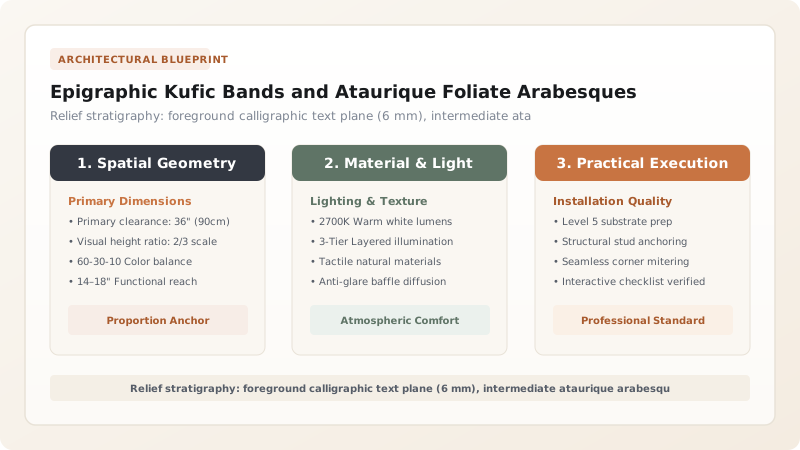
The supreme technical achievement of master yeseros was their ability to interlace dense calligraphic inscriptions and complex ataurique foliage across the same surface without descending into visual chaos. This was accomplished through a rigorous dual-plane relief hierarchy. The calligraphic text was reserved strictly for the primary foreground plane, carved at full plaster depth (typically 6 to 8 millimeters above the wall base).
Behind this floating textual screen, the ataurique foliage was carved on a secondary, recessed intermediate plane (approximately 3 to 4 millimeters deep). The stems and palmettes duck beneath the vertical shafts of letters, creating an unmistakable illusion of physical spatial depth. Finally, the deepest background floor was excavated and textured with microscopic point stippling or diagonal hatching. This textured floor absorbs incident light, preventing distracting reflections and ensuring that the polished letters and leaves stand out with immaculate clarity.
Mudéjar Adaptation: Cultural Convergence in Plaster
Following the Christian conquest of major Andalusian cities—Cordoba in 1236, Seville in 1248—the art of yesería did not perish. Instead, it entered a fascinating new phase under Christian rule known as the Mudéjar style. Christian monarchs, nobility, and ecclesiastical patrons recognized that no Western European artisans could match the technical brilliance and luxurious elegance of Islamic plaster carvers.
Muslim master artisans (Mudéjares) were commissioned to adorn Christian palaces (such as King Pedro I's Palace within the Seville Alcázar) and Jewish synagogues (such as Toledo's Sinagoga del Tránsito). In these magnificent hybrid spaces, Arabic calligraphic prayers, Hebrew liturgical hymns, Castilian heraldic castles and lions, and classical ataurique arabesques intertwine upon the same plaster friezes—a testament to a shared Mediterranean visual language that transcended political and religious divides.
Decorative Taxonomy of Andalusian Yesería Carvings
Use this reference table to calculate exact physical dimensions, ratios, and specifications before purchasing:
| Motif Typology | Geometric Profile | Relief Hierarchy | Architectural Placement | Thematic Content |
|---|---|---|---|---|
| Fluriated Kufic (Cúfico Florido) | Rigid vertical shafts with leafy floral finials | Forefront Primary (6–8 mm) | Continuous upper wall friezes and door arch cornices | Solemn Quranic verses, divine attributes, and foundational dedications |
| Cursive Thuluth (Nasjí / Tulut) | Fluid, sinuous horizontal ribbons with soaring shafts | Forefront Primary (6–8 mm) | Central dado panels, alcove cartouches, and niche borders | Courtly poetry, royal eulogies, and the Nasrid motto |
| Ataurique (Vegetal Arabesque) | Continuous spiraling stems with acanthus and palmettes | Mid-Ground Secondary (3–5 mm) | Spandrels (albanegas), arch soffits, and background fields | Eternal life, paradise gardens, cosmic abundance, and renewal |
| Sebka (Rhomboid Grid) | Interlacing undulating multi-foil lobed arches | Overall Geometric Field (4–6 mm) | Expansive wall planes above dados and tower facades | Infinite celestial order, structural harmony, and spatial dissolution |
Practical Constraints
Every successful decoration project must account for physical and environmental constraints:
Visual Crowding and Illegibility at High Viewing Distances
Delicate calligraphic diacritical marks become an unreadable blur when viewed from the palace floor 8 meters below. Mitigation: Scale letter heights proportionally to wall elevation and paint background fields with dark contrasting ultramarine pigments.
Extreme Fragility of Slender Undercut Letter Ascenders
Thin gypsum vertical letter shafts can snap off under accidental physical contact during maintenance. Mitigation: Keep letter stems connected to adjacent background foliage via concealed structural plaster bridges on their reverse.
Execution Blueprint & Craftsmanship Sequence
Execute this professional sequence to achieve flawless results without backtracking:
Architectural Framing and Baseline Layout
Snap horizontal chalk lines to frame epigraphic friezes along the wall, establishing proportional margins for upper moldings and lower dentils.
Script Proportioning and Cartoon Drafting
Draft the calligraphic text in full scale, ensuring that vertical letter ascenders terminate in harmonious floriated palmettes that mirror adjacent arabesques.
Cartoon Pouncing onto Leather-Hard Plaster
Align the paper cartoon over the setting yeso blanco and pat charcoal dust through the pin-pricked lines, imprinting sharp guidelines onto the wall.
Foreground Calligraphic Silhouette Incision
Carve vertical perimeter stop-cuts around every letterform using fine straight knives, isolating the sacred words on the highest relief plane.
Mid-Ground Ataurique Foliage Modeling
Excavate the space between letters down to a 3-mm intermediate depth, carving spiral vine stems, acanthus lobes, and split-palmettes beneath the words.
Deep Background Relieving and Texturing
Chisel out the deepest negative ground voids to 6 mm depth, texturing the floor with fine point punches to eliminate surface glare.
Sinuous Undercutting and Micro-Profiling
Shave inward 45-degree undercuts beneath all letter edges and leaf lobes, creating crisp shadow boundaries that separate text from background.
Detail Burnishing and Polychromatic Highlighting
Smooth relief faces with fine agate burnishers, gilding letter crests with gold leaf and infusing recessed grounds with lapis lazuli tempera.
Common Mistakes & Countermeasures
Avoid these costly errors that compromise aesthetics, ergonomics, and budget:
Carving calligraphy and background foliage onto the exact same relief plane
Disregarding letter baseline alignments across expansive horizontal wall runs
Drawing ataurique vines with sudden angular bends or unnatural kinks
Project Execution Checklist
Track your physical progress. Checkboxes persist automatically on this device:
Frequently Asked Questions
What is the difference between Kufic and Thuluth scripts in yesería?
Kufic is the oldest formal Islamic script, characterized by rigid, rectilinear strokes, geometric right angles, and vertical austerity; in yesería, it is often 'floriated,' meaning the tops of letters burst into delicate leaves. Thuluth is a sweeping cursive script with fluid, sinuous curves, diagonal descenders, and interlacing ascenders, conveying dynamic energy and lyrical poetry.
What is the origin of the term 'ataurique'?
The word 'ataurique' derives from the Arabic 'al-tawriq' (التوريق), meaning 'foliation' or 'the production of leaves.' In Andalusian art, it designates the intricate stylized vegetal ornamentation—based on classical Mediterranean acanthus, Greco-Roman vine scrolls, and Byzantine palmettes—transformed into an infinite, continuous geometric arabesque.
Who wrote the poems carved into the walls of the Alhambra?
Many of the magnificent poetic verses carved into the yesería of the Alhambra were composed by the greatest court poets and viziers of the Nasrid kingdom, notably Ibn Zamrak (1333–1393) and Ibn al-Khatib. The walls literally speak in the first person, praising the sultan, describing the sparkling fountains, and celebrating the palace's beauty.
How did Christian kings come to use Islamic calligraphy in Mudéjar palaces?
Christian monarchs—such as King Pedro I of Castile who built the Alcázar of Seville—deeply admired the sophistication, luxury, and prestige of Moorish court culture. They employed master Muslim artisans (Mudéjares) to decorate their palaces, incorporating Arabic inscriptions containing blessings, poems, and even the Nasrid motto alongside Christian heraldic shields.