
Traditional Scottish slating is a distinctive vernacular roofing system engineered to withstand severe North Atlantic gale-force winds and driving rain. Utilizing metamorphic Dalradian slates quarried from historic Scottish island and highland sites (Ballachulish, Easdale, Highland Boundary), slaters sort thick, irregular slates into 'diminishing courses'—laying the largest, heaviest slates along the eaves and graduating to the smallest at the ridge. Nailed directly into solid Scots pine timber sarking boards using heavy copper nails, Scottish slating creates an undulating, storm-proof stone skin with an operational lifespan exceeding 150 years.
At a Glance: Key Takeaways
- Fastener System: Direct single-nailing with heavy-gauge solid copper or silicon bronze nails
- Roofing Typology: Diminishing courses in random widths (from 400mm at eaves to 150mm at ridge)
- Slate Geology: Metamorphic Dalradian Slate (Ballachulish Black / Easdale Slate)
- Substrate Decking: Solid Scots pine timber sarking boards (19mm–22mm thick)
In-Depth Guides in this Directory
Explore specialized subtopic blueprints, technical dimensions, and execution checklists:
Ballachulish and Easdale Dalradian Slate Geological Fissility and Hand-Dressing
Geological analysis of Scottish Dalradian metamorphic slate, cleavage fissility, quarry splitting wedges, and traditional slater's zax dressing techniques.
Diminishing Course Laying, Random-Width Sorting, and Scots Pine Sarking Boards
Technical manual on laying diminishing courses in random widths, headlap calculations, Scots pine sarking deck installation, and gauge lines.
Direct Nailing, Rolled Lead Valleys, and Water-Table Skew Detailing in Scottish Roofing
Technical manual on solid copper nailing into pine sarking, milled sheet lead valleys, bottle-roll ridges, and water-table skew stone detailing.
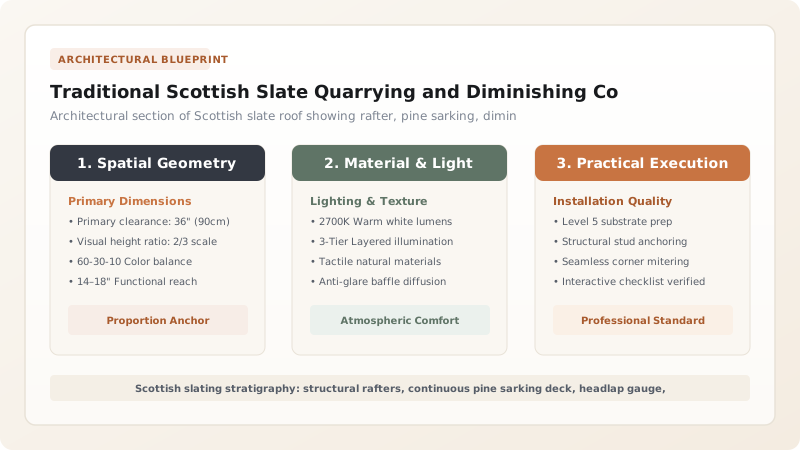
Geological Origins: Dalradian Metamorphism and Historic Quarries
Scotland’s historic slate reserves were forged during the Caledonian Orogeny over 400 million years ago, when marine mudstones were subjected to extreme tectonic heat and pressure. The resulting Dalradian slates exhibit a rugged, rough-textured cleavage with distinctive mineral inclusions.
Four primary quarry regions supplied Scotland: Ballachulish (deep blue-black slate studded with brassy cubes of non-reactive iron pyrite), the Slate Islands of Argyll (Easdale and Luing, producing dark durable slate with rich carbonaceous content), the Highland Boundary (Aberfoyle, famed for unique purple, green, and heather tones), and the Foundland quarries of Aberdeenshire.
Diminishing Courses: Hydraulic Logic and Random-Width Laying
Unlike modern uniform rectangular slates (such as Welsh or Spanish slates laid to rigid parallel battens), Scottish slating is laid in diminishing courses in random widths. Slaters sort deliveries on the ground into multiple size categories—from heavy 'out-sizes' (400mm long) down to miniature 'tops' (150mm long).
This arrangement reflects pure hydraulic and structural engineering: at the bottom of the roof, the eaves receive the accumulated runoff of the entire slope, demanding massive slates with wide laps. Near the ridge, runoff volume is minimal, allowing smaller slates to shed water efficiently while reducing roof deadweight at the building apex.
Substrate Engineering: Continuous Scots Pine Sarking Boards
A defining hallmark of Scottish construction is the complete absence of open battens. Scottish roofs are sheathed in sarking—continuous, rough-sawn Scots pine (Pinus sylvestris) boards (19mm to 22mm thick) nailed directly across structural rafters with narrow 3mm breathing gaps.
Sarking provides a rigid, continuous structural diaphragm that braces the timber roof frame against hurricane-force Atlantic wind gusts. Slaters nail slates directly into the sarking boards using thick-gauge, flat-headed solid copper or silicon-bronze nails, providing localized flexibility and preventing wind uplift pressures from lifting individual slates.
Leadwork Detailing (Skews and Valleys) and Heritage Conservation
Where slate meets masonry gable walls, traditional Scottish roofs dispense with mortar fillets. Instead, builders incorporate lead secret gutters, soakers, and bottle-rolled lead skews (milled sheet lead Code 5 to 7), providing watertight, maintenance-free flashing that accommodates building settling.
With all major Scottish slate quarries closed since the 1960s, conservation slating demands meticulous salvage protocols. Existing slates are carefully stripped, de-nailed, and dressed with a traditional slater's axe (zax). Re-slating blends salvaged Dalradian slates with compatible metamorphic imports (such as high-grade Westmorland or Spanish heavy-cleaved slates), maintaining Scotland’s rugged architectural vernacular.
Scottish Slate Quarry Characteristics & Roofing Metrics
Use this reference table to calculate exact physical dimensions, ratios, and specifications before purchasing:
| Quarry Region | Geological Slate Color | Nominal Thickness | Pyrite Content | Typical Historic Setting |
|---|---|---|---|---|
| Ballachulish (Loch Leven) | Deep Blue-Black / Charcoal | 5mm to 10mm (rugged cleavage) | Inert iron pyrite cubes (FeS2) | Edinburgh New Town & Highland Mansions |
| Easdale & Luing (Argyll) | Dark Gray / Gunmetal | 4mm to 8mm (fine wavy grain) | Microscopic organic carbon | Glasgow Tenements & West Coast Castles |
| Aberfoyle (Highland Edge) | Heather Purple & Sea Green | 6mm to 11mm (dense cleavage) | Trace chlorite & iron oxide | Trossachs Cottages & Baronial Estates |
| Macduff / Foundland | Blue-Gray with soft sheen | 5mm to 9mm (tough splits) | Low mineral inclusion | Aberdeenshire Farmsteads & Manors |
Practical Constraints
Every successful decoration project must account for physical and environmental constraints:
Total Depletion of Active Scottish Commercial Slate Quarries
New Scottish slate is unavailable commercially; restoration projects must source certified architectural salvage or compatible English/Spanish matches.
Extreme Roof Weight on Structural Timber Trusses
Heavy-cleaved Scottish slate roofs weigh up to 60 kg/m², requiring robust highland timber framing to support combined snow and stone loads.
Execution Blueprint & Craftsmanship Sequence
Execute this professional sequence to achieve flawless results without backtracking:
Slate Sizing and Ground Sorting
Sort salvaged Scottish slates on the ground into 10 to 14 distinct length categories; dress broken edges square using a traditional slater's zax.
Sarking Board Inspection and Breathable Felt
Inspect Scots pine sarking boards for rot; nail loose boards firmly to rafters, and install breathable roofing underlay (vapor-permeable membrane).
Eaves Course Gauge and Tilt Fillet
Fix an oak or pine tilt fillet along the eaves; nail a double-course of heavy out-sized slates (undereaves and full eaves slate) to project 50mm into gutters.
Diminishing Course Progression
Chalk horizontal gauge lines across sarking, gradually decreasing course exposure (gauge) from 180mm at eaves down to 75mm at the ridge.
Random-Width Laying and Staggered Laps
Nail slates with single copper nails through pre-punched head-holes, maintaining a minimum 75mm side lap (bond) between vertical slate joints.
Lead Ridge Roll and Skew Flashing
Dress Code 6 milled sheet lead over a 50mm round timber ridge roll; install stepped lead soakers beneath gable slate edges (skews) for watertight seals.
Common Mistakes & Countermeasures
Avoid these costly errors that compromise aesthetics, ergonomics, and budget:
Laying Scottish Slates on Open Timber Battens Without Sarking
Using Thin Galvanized or Steel Nails
Discarding Historic Scottish Slates for Cheap Uniform Imports
Project Execution Checklist
Track your physical progress. Checkboxes persist automatically on this device:
Frequently Asked Questions
Why are Scottish slate roofs laid in 'diminishing courses'?
Diminishing courses maximize the utility of hand-split quarry slate (which naturally yielded pieces of all sizes), place the largest, heaviest stones where rainwater runoff volume is highest at the eaves, and reduce deadweight at the roof apex.
What is 'sarking' in Scottish roofing?
Sarking refers to continuous rough-sawn pine or spruce timber boarding nailed directly across roof rafters beneath the slates. It acts as an internal wind barrier, provides a solid nailing deck for random-width slates, and adds tremendous structural rigidity.
Are the brass-colored cubes in Ballachulish slate harmful to the stone?
No. The golden cubes are crystals of iron pyrite (FeS2). In Ballachulish slate, this pyrite is chemically inert and non-reactive, meaning it does not oxidize, rust, or cause stone decay even after two centuries of exposure to highland rain.


