
Grading diminishing courses of Ballachulish and Easdale slate is an exacting craft combining sorting heuristics with geometric calculation. Slaters sort random quarry slates into 12 to 18 distinct dimensional classes on the ground using wooden sizing rods. By calculating the margin gauge (exposure) based on slate length and minimum 75mm head-lap, slaters create an aerodynamic, weather-tight roof plane that diminishes gracefully toward the ridge.
At a Glance: Key Takeaways
- Quarry Petrography: Ballachulish (high-grade pyritic phyllite) & Easdale (fine-grained mica slate)
- Sorting Sticks: Notched wooden batten (*Slater's rule*) marking length increments
- Course Count: Typically 12 to 18 graded courses on a standard 6-meter roof rafter
- Gauge Formula: Margin / Gauge = (Slate Length - Head-Lap) / 2
- Dressing Tool: Slater's axe (*Zax*) with pick point and sharpened cutting edge
- Sorting Hierarchy: Sorted simultaneously by length, width, and thickness
Petrographic Comparison: Ballachulish vs. Easdale Slate
Understanding the petrology of Scottish slates is vital for historic conservation:
- Ballachulish Slate: Quarried near Loch Leven in Argyll. It is a Dalradian metamorphic chlorite-mica phyllite characterized by a deep charcoal or metallic blue-black tone. It famously contains macroscopic, perfectly formed cubic crystals of brass-colored iron pyrite (FeS2). Because the pyrite crystallized at high metamorphic pressure, it is chemically inert and will not oxidize or rust, even after 200 years of exposure to Atlantic sea spray.
- Easdale / Slate Islands Slate: Harvested from the Firth of Lorn islands (Easdale, Luing, Seil). It is finer-grained than Ballachulish, with a slightly darker lead-black coloration and higher fissility, allowing slightly thinner splitting (6–10 mm). It exhibits remarkable flexural strength and natural water impermeability (< 0.2% absorption).
Grading Heuristics and the Mathematics of Diminishing Margin
When a pallet of reclaimed or quarry-run Scottish slate arrives, stones vary wildly in length (from 150 mm to 550 mm) and width. The slater never carries unsorted stone onto the roof; all grading is performed on the ground:
Slaters use a notched wooden rod called a sizing stick. Stones are measured from tail to head, discarding cracked pieces, and arranged into separate stacks (often labeled 1 to 14 from largest to smallest). The margin (the exposed face of the slate) for each course is determined by the formula:
Gauge (Margin) = (Length - Required Headlap) / 2
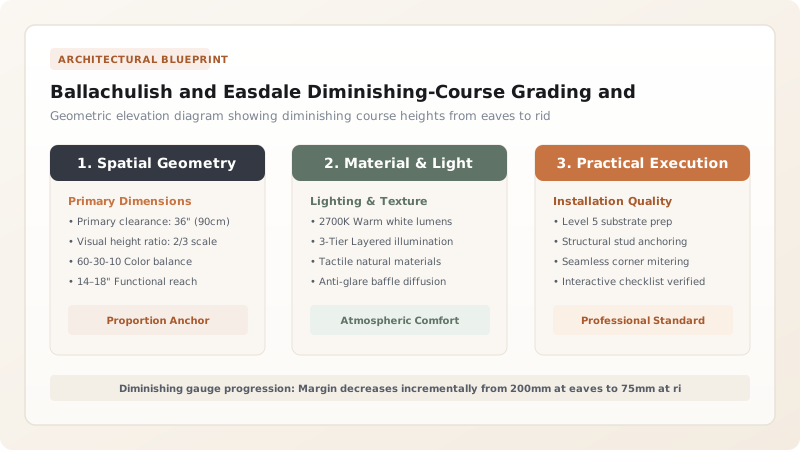
With a fixed minimum head-lap of 75 mm, a 475 mm bottom slate yields a margin of 200 mm, while a 225 mm top slate yields a margin of only 75 mm. The slater calculates course increments so that course exposure decreases smoothly and imperceptibly up the roof, creating a harmonious architectural taper.
Ballachulish and Easdale Diminishing-Course Grading and Sizing in Scotland Architectural Decision Matrix
Use this reference table to calculate exact physical dimensions, ratios, and specifications before purchasing:
| Course Position | Slate Length | Average Width | Head-Lap | Exposed Margin (Gauge) |
|---|---|---|---|---|
| Under-Eaves Course | 250–300 mm | 300–400 mm | Full lap under | Concealed |
| Eaves Course (Course 1) | 450–500 mm | 350–450 mm | 80 mm | 185–210 mm |
| Lower Courses (2–5) | 375–425 mm | 250–350 mm | 75 mm | 150–175 mm |
| Mid Courses (6–10) | 300–350 mm | 200–250 mm | 75 mm | 112–137 mm |
| Top Courses (11–15) | 200–250 mm | 150–200 mm | 75 mm | 62–87 mm |
Practical Constraints
Every successful decoration project must account for physical and environmental constraints:
Extensive Ground Sorting Footprint
Salvage Breakage Rates
Ground Sorting and Sizing of a Slate Batch
Execute this professional sequence to achieve flawless results without backtracking:
Acoustic Ring Test
Hold each slate loosely between fingertips; strike center with a light wooden mallet; keep only stones that emit a clear, high-pitched metallic ring.
Length Measurement
Measure stone length along its true axis using the notched sizing rod; place in designated size stack (e.g., 18-inch, 16-inch, 14-inch).
Shoulder Dressing
Dress ragged top corners with the cutting blade of the zax, cutting at an angle from the rear face to produce a clean, beveled face edge.
Nail Holing
Punch a single nail hole 25–30mm from the top head edge using the pick point of the zax, punching from the back face so the spall forms a countersink.
Thickness Sorting
Sub-divide each length stack into heavy (thick) and light (thin) piles so thick slates are placed in the center of roof bays and thin ones under laps.
Hoisting in Order
Bundle sorted slates into strapped bundles; hoist to the scaffold in reverse order (smallest first to upper staging, largest to lower).
Common Mistakes & Countermeasures
Avoid these costly errors that compromise aesthetics, ergonomics, and budget:
Punching nail holes from the front face
Abrupt gauge jumps between adjacent courses
Discarding irregular triangular slates
Project Execution Checklist
Track your physical progress. Checkboxes persist automatically on this device:
Frequently Asked Questions
What is a Zax and how is it used?
A zax is a traditional slater's tool combining a heavy steel cutting blade, a straight edge for trimming, and a pointed back pick for punching nail holes in slate. The slater rests the slate on a steel dressing iron and chops downward, cleanly shearing the metamorphic rock along natural cleavage lines.
Why do Scottish slates have only one nail hole instead of two?
Scottish slates are traditionally head-nailed with a single heavy nail through the center top. Because they are bedded tightly into solid timber sarking and weighted down by the overlapping courses above, a single nail allows the heavy slate to rotate microscopically with thermal movement without splitting across two rigid fixings.


