
Calçada Portuguesa relies on the petrographic pairing of white microcrystalline limestone (*vidraço*) and dense black volcanic basalt. In regional quarries, raw stone blocks are split with mechanical guillotines and finished by hand into tapered cubic stones graded into specific dimensional classes, balancing compressive strength, slip resistance, and chromatic contrast.
At a Glance: Key Takeaways
- White Rock Type: Microcrystalline compact limestone (*Calcário Vidraço / Lioz*)
- Black Rock Type: Tholeiitic basalt from the Lisbon Volcanic Complex or Açores
- Compressive Strength: Limestone: 120–160 MPa | Basalt: 180–240 MPa
- Shape Geometry: Truncated pyramid / keystone cube with 5°–10° downward taper
- Abrasion Resistance: Amsler wear test loss < 2.5 mm under heavy pedestrian traffic
- Quarry Dressing: Hydraulic splitter followed by hand hammer trimming (*rajado*)
Petrographic Characteristics of Vidraço and Basalt
Not every stone is suitable for Calçada. The white stone must be authentic Calcário Vidraço—a high-density, low-porosity limestone featuring micro-fossils and cryptocrystalline calcite matrices. Soft chalks or porous travertine wear down too fast and crumble under foot traffic, while marbles can fracture along cleavage planes.
The dark contrast stone is basalt, an igneous extrusive rock composed of plagioclase feldspar, pyroxene, and olivine. Its crystalline interlocking texture gives it immense compressive hardness and resistance to chemical weathering. When cut, basalt creates a deep charcoal or obsidian-black silhouette that does not fade under blistering Mediterranean sunshine.
Quarry Splitting and the Keystone Taper
In the quarry, large dimensional blocks unsuitable for building ashlars are channeled to the Calçada splitting yard. Using hydraulic wedge splitters, quarrymen cleave the stone into manageable strips (rachões) and then into rough cubes.
On site, the calceteiro shapes each cube with rapid, precise hammer blows. Crucially, the stone is trimmed not as a perfect square cube, but as a slight truncated inverted pyramid:
- Top Face: Square or slightly polygonal, flat and clean for pedestrian contact.
- Tapered Sides: Slanted inward at 5 to 10 degrees. When set into the sand bed, adjacent stones touch only along their upper 15–20mm perimeter.
- Base Void: The downward-tapering space between stones fills with fine sand. When compacted, this creates lateral soil wedging that locks the pavement in place through 3D arch action.
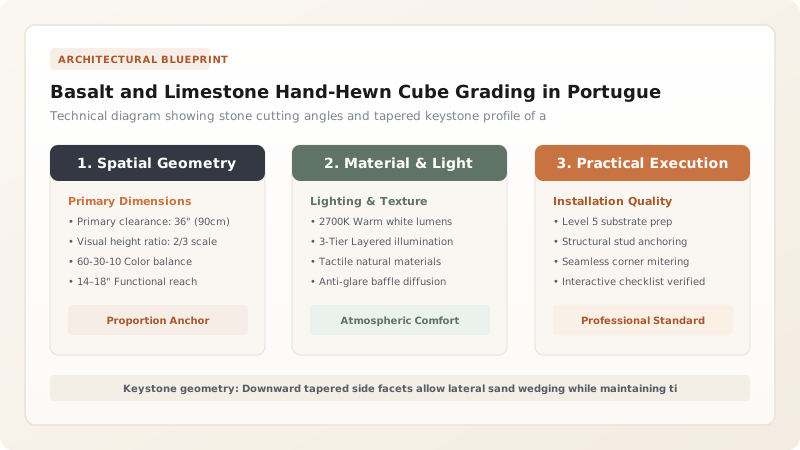
Basalt and Limestone Hand-Hewn Cube Grading in Portuguese Paving Architectural Decision Matrix
Use this reference table to calculate exact physical dimensions, ratios, and specifications before purchasing:
| Stone Variety | Petrographic Class | Color / Tone | Porosity (%) | Density (kg/m³) |
|---|---|---|---|---|
| Vidraço Branco | Dense microcrystalline limestone | Creamy chalk white | < 1.2% | 2,650–2,700 |
| Vidraço Amarelo | Iron-tinted limestone | Warm golden buff | < 1.5% | 2,600–2,650 |
| Basalto Negro | Tholeiitic volcanic rock | Charcoal to jet black | < 0.8% | 2,850–3,000 |
| Calcário Encarnado | Hematitic limestone | Warm terracotta red | < 1.8% | 2,580–2,620 |
Practical Constraints
Every successful decoration project must account for physical and environmental constraints:
Noise Regulations in Historic Quarters
Quarry Waste and Material Yield
Grading and Hand-Dressing Paving Stones on Site
Execute this professional sequence to achieve flawless results without backtracking:
Cull Defective Stones
Inspect quarry delivery; discard stones with clay veins, open fissures, or excessive mica laminations.
Size Sorting
Pass stones through wire grading riddles to segregate into fine (miúdo) for lettering and coarse (graúdo) for borders.
Edge Dressing (Afeiçoamento)
Hold the stone against a steel anvil or wooden block; strike corner protrusions with the wedge peen of the paving hammer to achieve square edges.
Undercut Beveling
Knap the lower four flanks inward to form the 7-degree keystone taper, ensuring the top face remains undamaged.
Batch Stacking
Stack dressed white and black stones in organized shallow crates adjacent to the paver's work zone for rapid selection.
Common Mistakes & Countermeasures
Avoid these costly errors that compromise aesthetics, ergonomics, and budget:
Leaving top face convex (pillow-shaped)
Dressing stones with reverse flare (top smaller than bottom)
Mixing stone grades within the same geometric pattern line
Project Execution Checklist
Track your physical progress. Checkboxes persist automatically on this device:
Frequently Asked Questions
Can marble cubes be used instead of limestone for Calçada?
While marble has been used in rare historic instances, it is generally avoided because crystalline marble polishes rapidly under foot traffic, becoming dangerously slick in wet weather, and has distinct cleavage planes that cause splitting.
How many stones does a calceteiro handle in a single working day?
An experienced paver laying medium-sized Calçada handles, trims, and sets between 1,500 and 3,000 individual stones per day, demonstrating incredible speed, ergonomic muscle memory, and hand-eye coordination.


