Crimped crepe paper pom-poms and ribbon suspension represent the decorative soul of Polish pająki, rooted in the regional craft of 'bibułkarstwo' (crepe paper floristry). Artisans transform heavy-grade crepe paper (bibuła) through hand-crimping, rolling, and fringing into spiky spherical pom-poms called 'jeżyki' (hedgehogs or urchins), scalloped florets ('kalijki'), and cascading accordion streamers. These vibrant paper ornaments provide visual rhythm, conceal straw joinery, and act as lightweight aerodynamic sails that catch gentle air currents.
At a Glance: Key Takeaways
- Folk Craft Tradition: Polish Bibułkarstwo (crepe paper floristry & decorative papercraft)
- Key Ornament Forms: Jeżyki (spiky urchin pom-poms), kalijki (fluted lilies), wstążki (streamers)
- Paper Specifications: Heavy Italian/German floristic crepe paper (140–180 gsm, 250% elongation)
- Traditional Adhesives: Cooked wheat flour starch paste (kluska) or natural gum arabic
- Color Palette: High-contrast Łowicz rainbow: magenta, cobalt, goldenrod, emerald, vermilion
Bibułkarstwo: The Polish Art of Crepe Paper Floristry
In the traditional peasant homes of Poland, the dark, monochromatic landscape of winter was held at bay by the brilliant craft of bibułkarstwo (crepe paper floristry). Developed to a virtuoso standard in regions such as Łowicz, Kurpie, and the Sącz Beskids, this folk art transformed simple rolls of commercial crepe paper (bibuła marszczona) into extraordinarily lifelike or stylized botanical creations. When integrated into the architectural framework of the straw pająk, these paper ornaments brought vitality, texture, and festive joy to the household.
Crepe paper was prized for its remarkable mechanical elasticity. Unlike standard paper, which folds with sharp, rigid creases, crepe paper can be stretched by over 200% along its grain. This property allows artisans to mold three-dimensional curves, ruffle petal edges between their fingertips, and sculpt structural cones that hold their shape indefinitely without internal wire armatures. Through bibułkarstwo, rural makers replicated the flowers of the Polish summer—poppies, cornflowers, marigolds, and dahlias—suspending them in vibrant indoor gardens.
Anatomy and Construction of the Jeżyk (Urchin Pom-Pom)
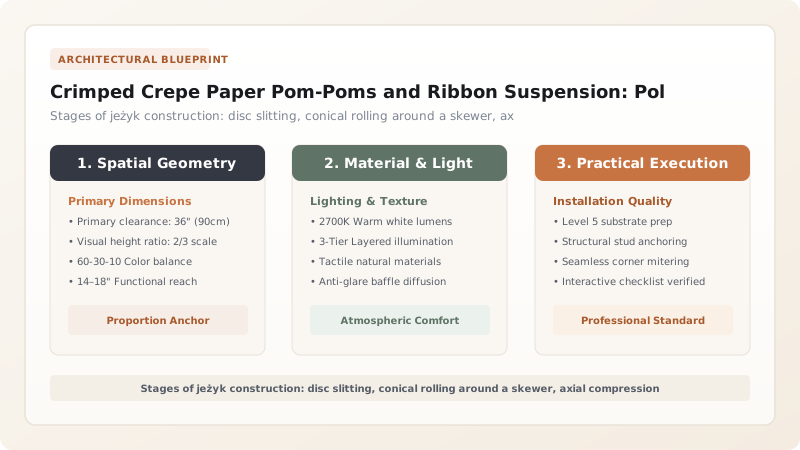
Among the vast vocabulary of bibułkarstwo ornaments, none is more iconic to the pająk than the jeżyk (literally 'little hedgehog' or spiky urchin). These spherical, multi-pointed pom-poms resemble crystalline sea urchins or radiant starbursts. Crafting an authentic jeżyk requires patience, precision, and a disciplined tactile rhythm. The artisan begins with a series of circular paper blanks cut from heavy-grade floristic crepe paper, which are folded and slit into eight or twelve radial petals.
Using a slender wooden skewer or large darning needle, each individual petal is rolled into a tight, hollow conical quill. The craftsperson rolls the paper diagonally across the grain, pinching the base of the cone to impart mechanical friction that locks the paper fibers in place. Once ten to twelve identical discs have been rolled, they are stacked along a central linen cord and compressed axially with great pressure. When released, the quills spring outward into a dense, perfect sphere of dozens of sharp points, radiating symmetrically in all directions.
Kalijki, Harmonijki, and Cascading Ribbons
Complementing the spiky geometry of the jeżyki are softer floral and ribbon elements. The kalijka (fluted lily or bell) is crafted by stretching the edge of a crepe paper strip through a technique called marszczenie (crimping). By pinching the paper between the thumbs and rolling the edges in opposing directions, the maker creates a delicate, undulating ruffle reminiscent of petals. The strip is then wrapped around a short rye straw core, forming a flared trumpet blossom that hangs downward like a miniature bell.
Connecting the various vertical tiers of the chandelier are the harmonijki (accordion garlands) and flowing ribbons (wstążki). Accordion streamers are fabricated by interlocking two long paper strips at right angles, folding them alternately back and forth to create a springy, kinetic paper braid. These garlands not only establish vibrant diagonal sightlines across the mobile but also dampen sudden air turbulence, allowing the structure to oscillate gracefully without violent swinging.
Aerodynamic Function and Chromatic Equilibrium
While paper ornaments are undeniably decorative, they perform a critical engineering role in the kinetic behavior of the pająk. The hundreds of individual paper quills, petals, and fringes dramatically increase the surface area of the mobile. Acting as miniature airfoils and wind-vanes, they capture the faintest convective drafts rising from the hearth or tile stove. The balanced distribution of paper elements ensures that air friction is applied equally across all radial quadrants.
Furthermore, traditional makers adhered to strict rules of chromatic balance. In the classic Łowicz tradition, contrasting complementary colors—such as violet against yellow, or crimson against forest green—were alternated along concentric hoops to create a dazzling visual vibration. As the pająk rotates slowly in the warm, rising air, these contrasting hues blend into a dynamic optical halo, casting dancing shadows and colored reflections across the whitewashed cottage walls.
Traditional Polish Bibuła Paper Ornaments for Pająki
Use this reference table to calculate exact physical dimensions, ratios, and specifications before purchasing:
| Ornament Name | Visual Form | Construction Technique | Structural Role | Paper Weight |
|---|---|---|---|---|
| Jeżyk (Urchin/Hedgehog) | Spiky multi-pointed sphere | Conical rolling of fringed radial discs | Conceals straw vertices and hoop intersections | 140–180 gsm |
| Kalijka (Fluted Lily) | Trumpet-shaped floret with stamen | Crimped-edge cone wrapped around straw core | Suspended vertically along dropper lines | 90–120 gsm |
| Harmonijka (Accordion Streamer) | Zig-zag folding paper ribbon | Alternating pleat folds with notched edges | Connects upper ceiling hub to lower hoops | 60–90 gsm |
| Różyczka (Cabbage Rose) | Multi-layered ruffled blossom | Individually stretched and gathered petals | Focal centerpiece beneath the master core | 140–160 gsm |
Practical Constraints
Every successful decoration project must account for physical and environmental constraints:
Photodegradation and Color Fading of Aniline Dyes
Traditional crepe paper dyed with fugitive aniline pigments fades quickly when exposed to direct sunlight. Mitigation: Hang pająki in indirect lighting and treat modern exhibition pieces with UV-filtering archival spray mist.
Moisture Absorption and Paper Creep
High relative humidity relaxes the mechanical crimp of the paper, causing pom-poms to flatten into limp masses. Mitigation: Ensure crimped cones are rolled tightly with a touch of starch at the tips to permanently lock the paper fibers.
Execution Blueprint & Craftsmanship Sequence
Execute this professional sequence to achieve flawless results without backtracking:
Paper Blank Template Cutting
Layer multiple sheets of heavy crepe paper with the grain running parallel, and cut crisp circles of 70-mm diameter using sharp shears and a circular metal die.
Radial Sector Slitting
Fold each paper disc into quarters and make eight evenly spaced radial incisions from the perimeter inward, stopping 10 mm short of the center point.
Conical Quill Rolling
Place a thin wooden skewer against the edge of each slit petal, roll the paper tightly around the wood into a sharp cone, and pinch the base to set the shape.
Jeżyk Spherical Assembly
Thread 10 to 12 prepared multi-quill discs onto a double-strand linen thread, compressing them tightly together face-to-face to form a dense, 360-degree spiky pom-pom.
Floral Petal Crimping (Marszczenie)
For kalijki florets, cut rectangular paper strips, stretch the upper edge between the thumbs and forefingers in opposing directions to produce a rippled, ruffled border.
Floret Core Mounting
Wrap the crimped paper strip around a short 20-mm straw spacer, bind the base with fine cotton thread, and flare the ruffled petals outward to mimic a blooming lily.
Accordion Ribbon Garland Folding
Fold long 25-mm paper ribbons in alternating 45-degree accordion pleats, creating spring-like kinetic streamers that stretch and bounce with air movement.
Attachment and Kinetic Balancing
Tie the finished pom-poms, florets, and streamers to the straw junctions and perimeter hoops, checking that every quadrant retains identical weight and wind resistance.
Common Mistakes & Countermeasures
Avoid these costly errors that compromise aesthetics, ergonomics, and budget:
Using thin, low-density craft party streamers instead of floristic crepe paper
Applying wet synthetic PVA glue directly to crepe paper petals
Unequal paper density between opposing radial pom-pom clusters
Project Execution Checklist
Track your physical progress. Checkboxes persist automatically on this device:
Frequently Asked Questions
What is the history of bibułkarstwo in Polish folk culture?
Bibułkarstwo emerged in the mid-nineteenth century when commercially manufactured crepe and tissue paper became widely accessible in rural Poland. Peasant women, already skilled in embroidery, paper cutouts (wycinanki), and weaving, quickly adopted this flexible, brightly colored medium to decorate holy corners (święty kąt), wayside shrines, bridal crowns, and seasonal pająki during harsh winter months when live flowers were unavailable.
How do jeżyki pom-poms contribute to the movement of a pająk?
Beyond their decorative appeal, jeżyki function as aerodynamic drag surfaces. Their hundreds of conical paper points catch rising thermal currents and subtle cross-breezes like miniature turbine blades, imparting a gentle, continuous rotational torque to the suspended mobile.
What is the best way to clean dust from intricate crepe paper pająki?
Never use wet cloths or liquid cleaners, which immediately dissolve the paper and bleed the dyes. Use a soft, natural goat-hair makeup brush or an electric camera lens blower on its lowest setting to gently dislodge dust from paper quills and straw internodes.
Can tissue paper be used instead of crepe paper for jeżyki?
Tissue paper lacks the internal elasticity and mechanical 'memory' provided by the creping process. While tissue can be used for flat fringes or folded flowers, it cannot be rolled into the rigid, self-supporting conical spikes required for authentic spiky jeżyki.