Lapis and gold glazed faience mosaic niche revetments represent the peak of Persian ceramic cladding. Master tilecutters hand-cut monochrome glazed ceramic tiles into microscopic mosaic tesserae (kashi moqarraq) using beveled hammers, assembling them over the compound curves of gypsum muqarnas cells to cloak vaults in brilliant lapis blue, turquoise, saffron gold, and pure 24-karat gold leaf.
At a Glance: Key Takeaways
- Ceramic Techniques: Kashi Moqarraq (cut mosaic faience) and Kashi Haft-Rangi (seven-color overglaze tiles)
- Signature Color Palette: Lapis lazuli cobalt blue, Persian turquoise (firuzeh), saffron yellow, and gold leaf
- Cutting Tooling: Hand-forged stonecutting mosaic hammer (Tisheh-ye Kashi-tarashi)
- Backing Bedding: Porous slaked lime and calcined gypsum mortar slurry (saruj / gach-o-khak)
- Optical Phenomenon: Fractured sunlight scattering across compound curved glazed facets
The Ceramic Zenith of the Safavid Empire: Architectural Kashi-Kari
When Shah Abbas the Great relocated the capital of the Safavid Empire to Isfahan in 1598, he initiated an urban and architectural renaissance that produced some of the most breathtaking monuments in human civilization. In royal masterpieces such as the Shah Mosque (Masjed-e Shah) and the Sheikh Lotfollah Mosque on the Naqsh-e Jahan Square, architecture and ceramic art dissolved into a unified, transcendent whole known across the Islamic world as Kashi-kari (architectural tilework).
Nowhere is this synthesis more dazzling than upon the soaring, faceted surfaces of the monumental muqarnas vaults. While earlier dynasties left muqarnas in raw terracotta brick or carved white gypsum, Safavid master artisans cloaked entire portals, domes, and niches in an impenetrable armor of glazed ceramic faience. Under the intense, unclouded sunlight of the Iranian desert, these jewel-like vaults appear to levitate, dematerializing heavy masonry into shimmering cascades of turquoise, cobalt, and gold that mirror the vaulted dome of heaven itself.
Kashi Moqarraq: The Art of Beveled Cut-Faience Mosaic
The most precious, technically demanding method of ceramic revetment is kashi moqarraq (cut-mosaic faience). Unlike ordinary ceramic tiles, which are painted and fired as flat squares, moqarraq is pure jigsaw mosaic. Artisans first fire hundreds of monochrome terracotta tiles glazed in individual pure colors: cobalt blue, Persian turquoise, saffron yellow, emerald green, milk white, and manganese black.
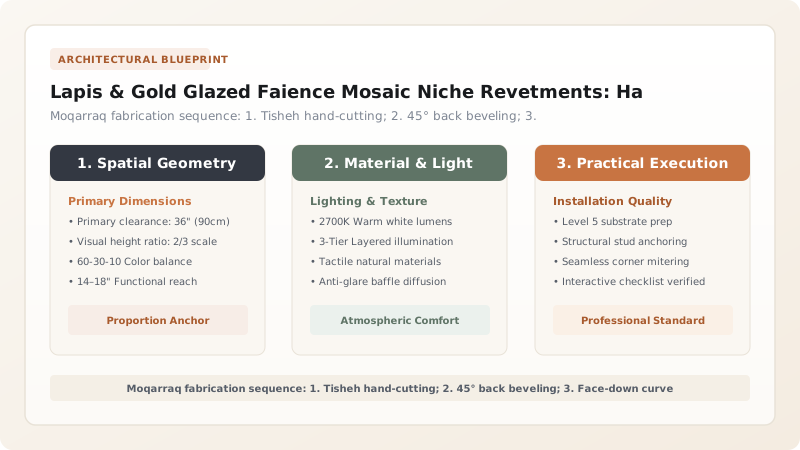
To fit these tiles to the complex, compound curves of a three-dimensional muqarnas cell, master tilecutters use a specialized hand tool: the tisheh (stonecutter’s mosaic hammer). Featuring twin chisel-like blades of hardened carbon steel, the tisheh is used to hand-chip each microscopic leaf, petal, and geometric star out of the glazed tiles. Crucially, the artisan chisels the back clay edges at an acute forty-five-degree bevel. This beveling allows adjacent pieces to meet at their glazed front faces with virtually zero joint gap, enabling the mosaic to bend smoothly across complex concave and convex muqarnas curves without unsightly grout lines.
Face-Down Assembly and Curved Plaster Casting Beds
Assembling millions of tiny, beveled mosaic pieces across a soaring twenty-meter vault is an exercise in astounding spatial organization. Because working overhead on scaffolds with individual tiles is physically impossible, craftsmen assemble the revetment in pre-fabricated curved panels on the workshop floor.
Artisans cast positive plaster beds that replicate the exact three-dimensional curvature of each muqarnas facet. Over this bed, the paper cartoon is laid out, and the craftsmen assemble thousands of tiny mosaic pieces face-down, like a reverse puzzle. Once the design is assembled, artisans pour a fifteen-millimetre layer of breathable slaked lime and gypsum mortar slurry—reinforced with sisal hemp fiber—over the porous, beveled backs of the tiles. When set, this mortar creates a rigid, curved mosaic shell that locks the thousands of individual tesserae into a monolithic ceramic shield. These panels are then hoisted to the ceiling and bedded into the gypsum muqarnas cells with lime slurry and bronze tie-wires.
The Chromatic Symphony: Lapis Lazuli, Persian Turquoise, and Gold Leaf
The emotional and spiritual resonance of a Persian muqarnas revetment is governed by its sacred color palette. Dominating the field is lapis lazuli cobalt blue (lajvard), derived from rich cobalt oxide ores. In Persian mystical poetry, deep blue represents the unfathomable depths of the spiritual cosmos, inner contemplation, and divine mystery. Intertwined with the cobalt is brilliant Persian turquoise (firuzeh), created with copper oxide glazes. Turquoise represents celestial joy, renewal, and the life-giving waters of Paradise.
Accenting these blue heavens are vibrant ribbons of saffron yellow, crisp white calligraphic ribbons, and genuine 24-karat gold leaf (tala-kari). Applied along the projecting ridges, pendant drops, and stalactite tips using natural oil size, the gold catches the low-angle rays of dawn and dusk. As natural daylight filters through the portal arches, the fractured compound surfaces of the muqarnas scatter the light in a kaleidoscope of jewel-toned reflections, dissolving physical space and creating an enduring vision of eternal paradise on Earth.
Ceramic Revetment Typologies, Glaze Minerals & Muqarnas Placement
Use this reference table to calculate exact physical dimensions, ratios, and specifications before purchasing:
| Ceramic Cladding Technique | Glaze Mineral Oxides | Tooling & Fabrication | Fired Color Character | Muqarnas Structural Placement |
|---|---|---|---|---|
| Kashi Moqarraq (Cut Mosaic) | Cobalt oxide (blue), copper oxide (turquoise) | Hand-beveled with tisheh hammer | Vivid, saturated, glass-hard pure monochrome planes | High-wear portal iwans, entrance niches & dome vaults |
| Haft-Rangi (Seven-Color Tile) | 7 overglaze enamels with manganese cordon | Square glazed tiles fired once in muffles | Lyrical narrative floral arabesques with thin black lines | Upper drum friezes and secondary interior muqarnas bays |
| Zarrin-fam (Lustreware Tile) | Silver and copper nanoparticle reduction | Specialized reduction smoke kiln firing | Iridescent metallic golden and ruby-red reflections | Sacred mihrab prayer niches and royal sanctuary vaults |
| Gold Leaf Gilding (Tala-kari) | 24-karat beaten pure gold leaf | Oil-based gold size (mixtion) & squirrel mop | Radiant, mirror-like specular metallic reflection | Projecting stalactite ribs, stalactite drops & central sunbursts |
| Turquoise Glazed Trim (Firuzeh) | Alkaline flux + Copper carbonate oxide | Custom-cast curved ceramic bead mouldings | Luminous robin-egg and deep Persian sky turquoise | Perimeter architraves, vaulting ribs & framework borders |
Practical Constraints
Every successful decoration project must account for physical and environmental constraints:
Extreme Thermal Shock on Exterior Courtyard Portals
Desert temperatures fluctuate from -5°C on winter nights to +45°C under summer sun; thermal expansion shears tile panels off gypsum vaults. Mitigation: Incorporate breathable lime-sand expansion buffers between panels and maintain deep overhangs to shelter vaults from direct sun.
Colossal Labor Requirements of Hand-Cut Moqarraq Mosaic
A single monumental muqarnas portal requires millions of individually hand-chiseled mosaic pieces, demanding years of skilled artisan labor. Mitigation: Organize multi-generational craft ateliers, dividing labor into pattern draftspersons, tile chippers, bevelers, and master assemblers.
Execution Blueprint & Craftsmanship Sequence
Execute this professional sequence to achieve flawless results without backtracking:
3D Plaster Template Impression (Qaleeb-Giri)
Cover the curved gypsum muqarnas cells with damp paper sheets, smoothing with thumbs to create three-dimensional patterns of every compound facet.
Color-Coded Mosaic Drafting
Lay paper patterns flat on workshop tables. Draft intricate floral arabesques (eslimi) and geometric stars, color-coding each individual piece for cobalt, turquoise, or gold.
Monochrome Glazed Tile Biscuits
Fire high-fired terracotta tiles glazed in pure monochrome colors: cobalt blue (lapis), copper turquoise, saffron yellow, manganese black, and milk white.
Hand-Chiseling Mosaic Tesserae with the Tisheh
Glue paper patterns to tile faces. Using a sharp-edged stonecutter's hammer (tisheh), chip out each tiny piece, beveling the back clay edge at 45 degrees.
Face-Down Panel Assembly on Curved Beds
Lay thousands of beveled mosaic pieces face-down inside a curved plaster mold that matches the muqarnas cell curvature, ensuring glazed faces meet with zero gaps.
Pouring the Reinforced Backing Mortar
Pour a 15 mm layer of lime-gypsum mortar reinforced with sisal hemp fiber over the back of the mosaic pieces, locking the tesserae into rigid, curved panels.
Mounting Mosaic Panels onto Gypsum Cells
Hoist the curved mosaic panels onto the vault. Bed against the plaster cells with fresh lime slurry, securing with temporary props and permanent copper pins.
Grout Polishing and 24k Gold Leaf Application
Wipe fine lime-marble grout across seams, polishing tile faces with flannel rags. Apply oil-based gold size and 24-karat gold leaf along projecting stalactite ribs.
Common Mistakes & Countermeasures
Avoid these costly errors that compromise aesthetics, ergonomics, and budget:
Failing to bevel the rear edges of cut mosaic tile pieces
Using rigid modern epoxy adhesives to bed ceramic mosaics onto gypsum vaults
Applying gold leaf directly over unsealed, porous ceramic glazes
Project Execution Checklist
Track your physical progress. Checkboxes persist automatically on this device:
Frequently Asked Questions
What is the difference between "moqarraq" mosaic and "haft-rangi" tiles on muqarnas?
Moqarraq (cut mosaic) involves firing separate monochrome tiles in pure colors, then hand-chiseling millions of tiny puzzle pieces and assembling them together; it produces intensely vibrant, glass-hard, permanent colors that never bleed. Haft-rangi (seven-color) involves painting multiple colors onto a single pre-fired square tile separated by manganese lines; while faster to produce, it lacks the brilliant intensity and compound-curve flexibility of moqarraq.
Why is lapis lazuli cobalt blue paired with copper turquoise in Persian architecture?
This chromatic duality carries profound spiritual meaning in Persian Sufism. Cobalt blue (lapis lazuli / lajvard) represents the deep, contemplative infinity of the divine cosmos and mystical night, while bright turquoise (firuzeh) represents the life-giving water of paradise and clear daytime sky. Together, they create a vibrating, celestial harmony that cools the senses in the scorching desert heat.
How does the "tisheh" hammer cut ceramic tiles without shattering the glass glaze?
The tisheh is a specially balanced hammer with sharp, chisel-like hardened steel heads. The master tilecutter strikes the edge of the tile at an acute angle, combining a rapid percussive tap with a shearing wrist motion. The force cleaves the soft terracotta clay beneath while allowing the brittle glass glaze on top to fracture cleanly along the desired line.
How do conservators prevent mosaic pieces from falling off historic vaults?
Over centuries, water infiltration can dissolve the backing plaster, causing tiles to detach. Conservators tap cells with wooden mallets to detect hollow sounds, inject low-viscosity hydraulic lime or ethyl silicate grouts through microscopic joint holes to re-bond loose mosaics, and repoint seams with breathable lime putty.