
Persian Haft-Rang (literally 'Seven Colors') is a glorious polychrome architectural tile technique perfected during the Safavid dynasty in 17th-century Isfahan under Shah Abbas I. Unlike tedious mosaic tilework (mo'arraq) where shapes were chiseled individually, Haft-Rang paints entire complex floral and arabesque compositions across square glazed fritware tiles using seven specific mineral pigments—cobalt, turquoise, manganese, antimony, iron red, copper green, and tin white—fired simultaneously in a single glost firing separated by an oily manganese black outline (maggan).
At a Glance: Key Takeaways
- Historical Golden Age: Safavid Dynasty (1501–1736), centered in Isfahan (Shah Mosque, Sheikh Lotfollah Mosque).
- The Seven Canonical Pigments: Black (manganese), White (tin), Cobalt Blue, Turquoise (copper), Yellow (antimony), Green (copper oxide), Fawn/Red (iron).
- The Maggan Barrier Innovation: Manganese-oil outline preventing adjacent colored glazes from bleeding during firing.
- Firing Discipline: Single glost firing at 950°C–1,020°C requiring precisely calibrated eutectic flux points.
- Body Formulation: Siliceous fritware body (10 parts crushed quartz, 1 part glass frit, 1 part plastic white clay).
- Architectural Function: Cladding monumental entrance iwans, minarets, soaring squinches, and turquoise ribbed domes.
In-Depth Guides in this Directory
Explore specialized subtopic blueprints, technical dimensions, and execution checklists:
Maggan Black Outline Glaze Containment Chemistry
Chemical and rheological analysis of Persian maggan manganese-iron outline barriers preventing glaze bleeding in Haft-Rang tiles.
Mineral Oxide Pigments and Single-Firing Temperature Control
Technical ceramic guide to formulating Haft-Rang raw mineral glazes and balancing eutectic melting points during single glost firing.
Dome and Iwan Tile Assemblies: Grout Formulation and Conservation
Architectural installation and conservation guide for Persian Haft-Rang tiles on monumental mosque domes, iwans, and minarets.
Safavid Isfahan and the Technological Rise of Haft-Rang
When Safavid monarch Shah Abbas I moved the imperial capital to Isfahan in 1598, he launched an unprecedented monumental building campaign, including the grand Naqsh-e Jahan Square and the Royal Shah Mosque. Up to this period, Iranian monumental architecture relied on cut-tile mosaic (kashi mo'arraq)—a painstaking process where monochrome glazed tiles were chiseled into tiny individual tesserae and assembled like puzzles.
Mo'arraq was too slow to clad the millions of square meters of soaring vaults, squinches, and domes envisioned by the Shah. Royal master ceramists perfected Haft-Rang (Seven-Color) tiles: square 20cm x 20cm or 25cm x 25cm tiles upon which expansive continuous narrative scenes, Quranic thuluth calligraphy, and sweeping arabesques (eslimi) could be painted directly in the workshop and rapidly installed on site.
The Seven Mineral Oxides and Siliceous Fritware Body
The name Haft-Rang refers to the seven canonical mineral glaze colors mandated by classical Iranian guild treatises (such as the 1301 CE treatise of Abu'l-Qasim):
- Cobalt Blue (Lajevard): Ground cobalt oxide mined from Qamsar near Kashan.
- Turquoise (Firuzeh): Copper oxide in a high-alkaline sodium flux glaze.
- Antimony Yellow (Zard): Lead antimonate (Naples yellow).
- Emerald Green (Sabz): Copper oxide in a lead glaze base.
- Manganese Purple/Black (Siah/Banafsheh): Pyrolusite manganese dioxide.
- Opaque White (Sefid): Tin oxide (cassiterite) suspended in transparent glaze.
- Iron Red / Fawn (Qermez/Khahesti): Calcined iron oxide ochre.
The tiles are formed from a siliceous kashi fritware body: 80% finely pulverized quartz sand, 10% potash-soda glass frit, and 10% fine plastic white bentonite clay, yielding a low-shrinkage ceramic body that perfectly matches the thermal expansion of siliceous glazes.
Maggan Containment Chemistry: The Non-Bleeding Outline
The greatest technical obstacle in firing multi-colored glazes side-by-side on a flat tile is that molten glazes naturally pool and bleed into one another at 1,000°C, turning crisp floral vines into muddy brown puddles. Persian ceramists resolved this with an ingenious chemical dam known as maggan.
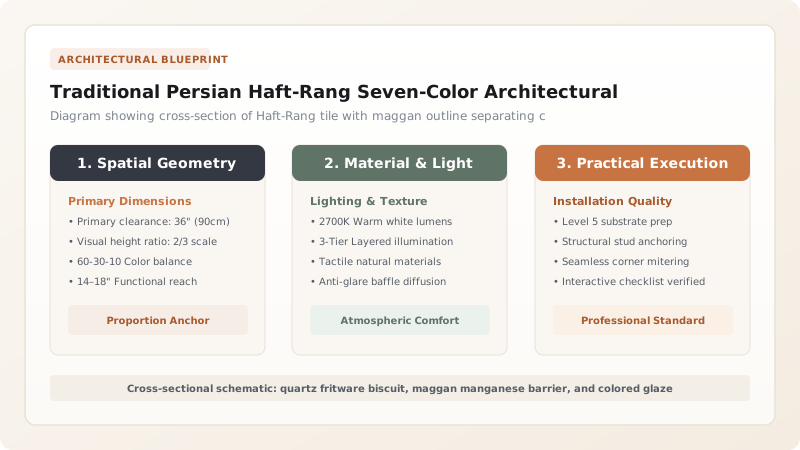
Maggan is an ink-like paint formulated from pulverized manganese dioxide and iron chromite ground with vegetable oil (mustard or grape seed oil) and animal tallow. The artist paints all outlines with maggan using a fine camel-hair brush. During kiln firing, the oil burns away, leaving behind a dry, high-melting refractory line of manganese-iron oxide. This line possesses high interfacial surface tension, physically repelling the molten alkaline glazes on either side and preserving razor-sharp decorative boundaries.
Architectural Comparison: Persian Kashi Mo'arraq vs Haft-Rang Tiles
Use this reference table to calculate exact physical dimensions, ratios, and specifications before purchasing:
| Technical Parameter | Kashi Mo'arraq (Cut Mosaic) | Haft-Rang (Seven-Color) | Cuerda Seca (Spanish Moresque) |
|---|---|---|---|
| Fabrication Method | Chiseled from monochrome glazed tiles | Painted on flat square fritware tiles | Grease-resist wax lines on red clay |
| Production Speed | Extremely slow (1–2 m² per week) | Rapid (10–20 m² per week) | Moderate (3–5 m² per week) |
| Curved Surface Fit | Flawless on compound dome curves | Stepped facets on tight spherical curves | Primarily flat vertical wall planes |
| Firing Stage | Tiles fired before cutting (zero glost risk) | Single glost firing of all 7 pigments | Single firing with wax-grease burn-off |
| Seam Aesthetics | Dense mosaic grout joints following shapes | Regular 20x20cm grid joint lines | Square grid tile joints |
Practical Constraints
Every successful decoration project must account for physical and environmental constraints:
Extreme climatic temperature swings on high-altitude Iranian desert mosque domes (-15°C winter to +45°C summer)
Mitigation: Formulate lime-and-gypsum bedding mortar (saruj) possessing flexibility and high vapor permeability.
Execution Blueprint & Craftsmanship Sequence
Execute this professional sequence to achieve flawless results without backtracking:
Formulate Siliceous Quartz Fritware Body
Blend 80% crushed quartz, 10% crushed alkali glass frit, and 10% white plastic clay; press into 200mm x 200mm wooden molds.
Bisque-Fire Tiles at 950°C
Fire raw tiles in updraft kiln to sinter quartz grains into rigid, porous ceramic biscuits; verify zero warpage.
Pounce Continuous Master Cartoon (Tarh)
Lay out large multi-tile arabesque cartoon on drafting floor; transfer outlines onto bisqued tiles using charcoal pounce bags.
Draw Maggan Manganese Boundary Lines
Paint all outlines using viscous manganese dioxide suspended in mustard oil with fine horsehair calligraphic brushes.
Fill Color Cells with Formulated Mineral Glazes
Brush or drop liquid raw glazes (cobalt, turquoise, antimony yellow, copper green) inside the maggan compartments.
Single Glost Firing to 1,000°C
Fire in gas or oil kiln with neutral atmosphere. Maintain 1-hour soak at 1,000°C to fuse glazes into brilliant glossy glass.
Common Mistakes & Countermeasures
Avoid these costly errors that compromise aesthetics, ergonomics, and budget:
Using red terracotta clay with high iron content for Haft-Rang tile bodies
Overfiring the glost kiln past 1,050°C
Project Execution Checklist
Track your physical progress. Checkboxes persist automatically on this device:
Frequently Asked Questions
Why did Shah Abbas I prefer Haft-Rang over Mo'arraq cut mosaic for Isfahan's mosques?
Shah Abbas wanted to complete his monumental architectural vision rapidly during his reign. Haft-Rang allowed large tile surfaces to be painted and fired simultaneously in weeks, whereas cut mosaic took years of chiseling.
What is the difference between Haft-Rang and Spanish Cuerda Seca?
While both use resist lines, Spanish Cuerda Seca uses a manganese-and-grease mixture that leaves an unglazed dry matte channel between colors, whereas Persian Haft-Rang often glazes over the line or produces an integrated crisp black glassy partition.


