Sphagnum moss chinking is the natural thermal insulation and gasket sealing system of Norwegian lafteverk. Harvested from mountain peat bogs and packed into the parabolic mosefar groove between log courses, sphagnum moss acts as an elastic, airtight spring gasket. Rich in natural sphagnan, the moss is biologically rot-resistant, antibacterial, and breathes moisture naturally, protecting raw pine logs from decay.
At a Glance: Key Takeaways
- Insulation Material: Wild Sphagnum Peat Moss (Huldremose / Torvmose species)
- Active Preservative: Sphagnan (natural pectin-like polysaccharide that inhibits fungal rot)
- Installation Location: Continuous longitudinal mosefar groove and corner notch sockets
- Thermal Performance: Equivalent to R-13 to R-18 in combination with 200 mm solid pine log core
- Hygroscopic Action: Absorbs up to 20x its dry weight in water vapor without wetting timber
The Ecological Miracle of Sphagnum: Nature's Super-Insulator
In the harsh, unforgiving sub-arctic climate of Norway, traditional timberwrights discovered that the greatest insulating material on earth was not manufactured in an industrial chemical plant; it grew wild in the spongy, mist-covered mountain bogs of their native valleys. The material is Sphagnum peat moss (torvmose or huldremose).
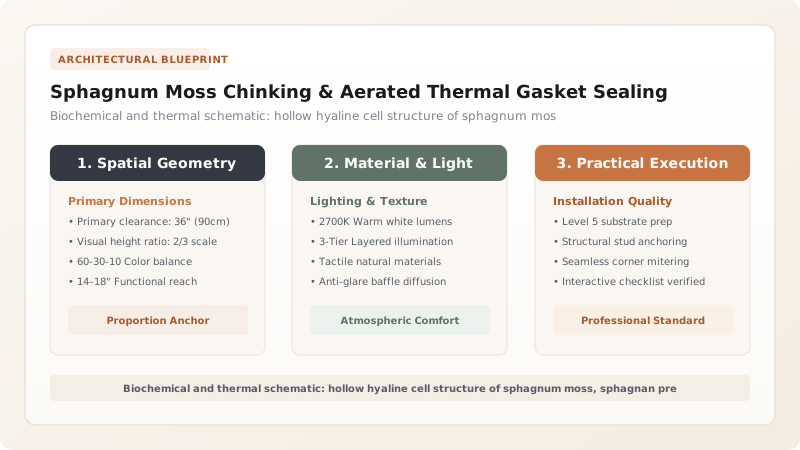
Sphagnum is a botanical marvel. Under a microscope, the leaves of Sphagnum moss are revealed to consist of two distinct cell types: small, living green photosynthetic cells and colossal, hollow, dead cells known as hyaline cells. These hollow hyaline cells—reinforced with delicate spiral rings that prevent them from collapsing under pressure—comprise over 80 percent of the moss's total volume. This unique honeycomb architecture allows sphagnum moss to trap immense volumes of still, dead air, creating a thermal insulation barrier with an extraordinarily low thermal conductivity that rivals modern mineral wool and polyurethane foams.
Sphagnan Biochemistry: The Natural Wood Preservative
The superiority of sphagnum moss over synthetic insulation is not merely thermal; it is profoundly biochemical. In modern construction, when fiberglass or rockwool is placed against unventilated solid wood, it acts as a moisture sponge: ambient humidity condenses inside the insulation, creating a stagnant, damp environment that accelerates black mold, fungal hyphae growth, and rapid structural rot within a few seasons.
Sphagnum moss behaves in the exact opposite manner. The cell walls of Sphagnum moss are saturated with a complex, pectin-like polysaccharide known as sphagnan. Sphagnan actively extracts metal cations (such as calcium and magnesium) from its environment, releasing hydrogen ions and creating a naturally acidic, sterile, antimicrobial microclimate. This is the exact biochemical phenomenon that preserves prehistoric 'bog bodies' (such as the Tollund Man) in northern European peat bogs for over two thousand years with hair, skin, and organs intact. Inside a lafteverk wall, sphagnan acts as a continuous, organic wood preservative, chemically sterilizing the dark mosefar cavity and protecting the raw pine heartwood from fungal attack across centuries.
The Mosepølse: Gasket Fabrication and Capillary Break Physics
Installing moss chinking into a lafteverk wall is a disciplined craft governed by strict physical principles. Master carpenters do not stuff loose, dry moss into exterior cracks after the building is erected. Instead, the moss is placed during the assembly of each horizontal course, laid in a continuous, dense ribbon known as the mosepølse (moss sausage).
The artisan harvests fresh moss, cleans out twigs and soil, and air-dries it to a supple, pliable moisture content (around 20 percent). Rolling the moss into a thick, uniform cylinder roughly 60 to 80 millimeters in diameter, the builder lays it along the crowned upper spine of the lower log. Crucially, the carpenter uses a thin wooden spatula to tuck all loose moss fibers inward, away from the exterior boundary lines. The moss must never protrude past the exterior scribed seam. This creates a critical capillary break: when driving rain strikes the exterior wall, the two knife-edge wooden lips (lepper) make direct, tight wood-on-wood contact, shedding water downward, while the moss rests dry and protected in its deep inner parabolic cavern.
The Dynamic Elastic Spring: Accommodating Wall Settling
Perhaps the most extraordinary physical property of sphagnum moss is its elastic spring memory. When the upper log—weighing hundreds of kilograms and loaded with heavy turf roof ballast—is lowered onto the moss gasket, the hollow hyaline cells of the moss are compressed under immense mechanical pressure, flattening from 70 millimeters down to a dense 5-millimeter felt barrier.
Yet unlike synthetic foams that suffer from permanent compressive set—flattening out and failing to rebound—sphagnum moss retains its structural resilience indefinitely. As the massive pine logs expand and shrink radially with seasonal changes in indoor humidity, the compressed moss acts as a dynamic, living spring. In winter, when logs shrink slightly, the moss expands outward, maintaining continuous, airtight pressure against the surrounding wood. In summer, when logs swell with humidity, the moss compresses without buckling. This miraculous dynamic elasticity guarantees that a properly constructed lafteverk wall remains completely airtight, draft-free, and thermally sound across generations of mountain winters.
Natural Chinking Materials, Botanical Species & Insulating Characteristics
Use this reference table to calculate exact physical dimensions, ratios, and specifications before purchasing:
| Insulation Material | Botanical / Material Source | Antibacterial Mechanism | Elastic Recovery | Long-Term Rot Resistance |
|---|---|---|---|---|
| Sphagnum Peat Moss (Optimal) | Sphagnum palustre / magellanicum | Sphagnan polysaccharide tanning action | High elastic spring memory (compresses & expands) | Over 500 years documented in historic Norwegian buildings |
| Mountain Haircap Moss | Polytrichum commune | Low tannin content (poor antibiotic action) | Medium elasticity (stiff wiry stems) | Breaks down into brittle powder after 20–30 years |
| Animal Sheep's Wool | Unwashed raw sheep fleece (lanolin) | Lanolin natural water repellent | High spring memory and resilience | Prone to clothes moth infestation if not treated with salt |
| Lax Linen Oakum (Hamp) | Flax tow infused with pine tar | Pine wood tar antimicrobial barrier | Low elasticity (packs dense and firm) | Traditional for marine caulking and drystone window frames |
| Synthetic Mineral Wool | Industrial glass fiber / rockwool | Zero biological defense (holds stagnant water) | Poor wet recovery (collapses when damp) | Catastrophic rot risk in traditional unvented log walls |
Practical Constraints
Every successful decoration project must account for physical and environmental constraints:
Seasonal Bog Freezing & Harvest Windows
High-mountain peat bogs freeze solid from October to May, making moss harvesting impossible for half the calendar year. Mitigation: Harvest annual moss requirements in large bulk during late July and August, drying and storing in breathable burlap sacks.
Nesting Birds Plucking Exposed Moss Chinking
Mountain swallows and sparrows aggressively pull exposed moss strands out of wall crevices for spring nest building. Mitigation: Execute knife-tight log scribing that completely conceals the moss cavity behind compressed, zero-clearance wooden lips.
Execution Blueprint & Craftsmanship Sequence
Execute this professional sequence to achieve flawless results without backtracking:
Bog Siting and Ethical Harvesting
Identify pristine mountain peat bogs above the agricultural runoff line. Pull top clusters of living Sphagnum moss by hand, leaving roots intact to ensure complete bog regeneration within two seasons.
Cleaning and Debris Separation
Spread harvested moss on wire mesh drying tables. Hand-pick out sticks, fallen pine needles, roots, and soil clumps, rinsing gently with clean spring water.
Conditioning to Pliable Moisture State
Air-dry the moss under covered, breezy drying sheds. The moss is ready when it transitions from emerald green to pale golden straw, feeling soft and springy like sheep's wool.
Rolling the Moss Sausage (Mosepølse)
Grasp handfuls of conditioned moss and twist them into a continuous, uniform rope or sausage (mosepølse) roughly 60 to 80 mm in diameter matching the mosefar channel width.
Laying the Gasket Along the Lower Log Ridge
Lay the continuous moss rope along the crowned upper spine of the lower log course, pressing it lightly into the hollow corner notch sockets.
Inward Tucking and Capillary Break Formatting
Use a thin wooden paddle (mosetre) to tuck all loose moss tendrils inward at least 15 mm from the outer scribed line, ensuring a complete capillary break against wind-driven rain.
Lowering the Upper Log Course
Roll the upper log down over the moss gasket. The parabolic mosefar groove engulfs the moss rope, compressing it under the immense deadweight of the pine timber.
Beetle Compaction and Seam Inspection
Strike the top of the log with a heavy wooden beetle (klubbe) to bed the wood-on-wood lips firmly together. Walk the wall course with an inspection blade to verify zero protruding moss fibers.
Common Mistakes & Countermeasures
Avoid these costly errors that compromise aesthetics, ergonomics, and budget:
Leaving moss strands protruding out past the exterior log contact line
Using dried hair-cap moss (Polytrichum) or reindeer lichen instead of true Sphagnum
Installing soaking-wet moss directly from the bog into the wall
Project Execution Checklist
Track your physical progress. Checkboxes persist automatically on this device:
Frequently Asked Questions
How does sphagnum moss prevent wood rot inside the dark mosefar groove?
Sphagnum moss produces a specialized pectin-like complex polysaccharide called 'sphagnan' in its cell walls. Sphagnan naturally binds free metal ions and inhibits bacterial and fungal enzymes, creating an acidic, sterile environment. This is the exact biochemical mechanism that preserves 'bog bodies' in European peat bogs for thousands of years. Inside a lafteverk wall, sphagnan actively protects the raw pine heartwood from fungal rot and mold.
How does sphagnum moss act as a dynamic 'spring gasket'?
The cellular structure of Sphagnum consists of large, hollow, dead cells called 'hyaline cells' reinforced with spiral rings. When compressed under heavy timber, these hollow cells flatten like tiny mechanical springs. As the building settles and logs expand and contract with seasonal humidity swings, the compressed moss cells expand back outward, maintaining continuous, unbroken physical contact against the wood without crumbling.
Can moss chinking freeze and lose its insulating value during winter?
No. Because sphagnum moss absorbs water vapor at the molecular level within its hollow cellular walls without forming bulk liquid water, it contains no free-standing water droplets. Even at -30°C, the moss remains soft, dry, and filled with millions of microscopic trapped air pockets, preserving its high R-value throughout the harshest Scandinavian winters.
Why shouldn't modern caulking compounds or synthetic sealants be applied over the log seams?
Modern elastomeric caulks and silicone sealants form an impermeable rubber barrier. While they seem to seal the exterior, water inevitably penetrates behind the caulk through microscopic checks in the wood. Once inside, the impervious caulk prevents the water from evaporating outward, causing rapid rot and decay inside the log seam. Authentic lafteverk must breathe naturally through wood and moss.