
Tadelakt hammam and basin detailing relies on continuous curved geometry, waterproof substrate preparation, and seamless junction transitions. By eliminating sharp 90-degree internal corners in favor of 30-50 mm radius fillets, shaping vaulted dome ceilings to control condensation runoff, and mechanically locking into brass drains, Tadelakt delivers lifelong mold-free wet-room envelopes.
At a Glance: Key Takeaways
- Environment: Continuous 100% RH hammam steam rooms, sunken basins, and wet rooms
- Substrate Requirement: Solid masonry, terracotta brick, or rigid waterproof cement backer-board
- Internal Corner Radius: Continuous concave fillet: 25 mm to 50 mm radius
- Ceiling Profile: Catenary vault, dome, or minimum 5-degree sloped pitch
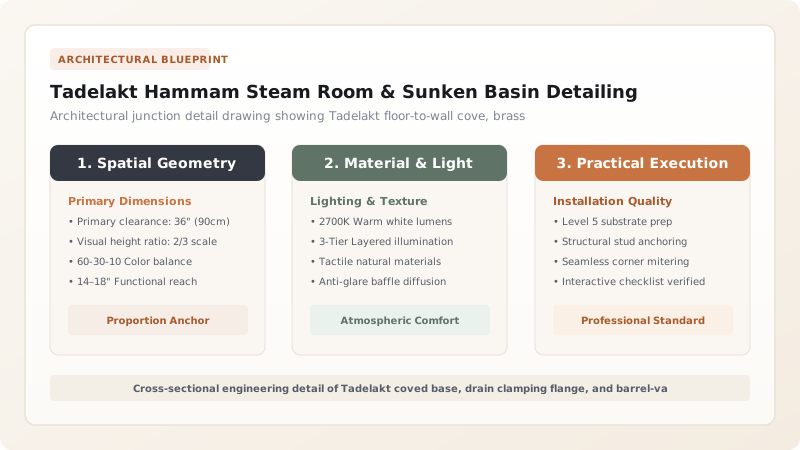
Principles of Hammam Geometry and Moisture Dynamics
In Moroccan hammam design, geometry is an active water management system. Flat horizontal ceilings are strictly avoided because condensing steam aggregates into heavy droplets that rain unpleasantly on bathers. Instead, hammam ceilings are shaped as domes, barrel vaults, or pitched catenary curves.
Condensed water forms a continuous micro-film on the slick, burnished Tadelakt surface, smoothly flowing down the curved walls into perimeter drainage gullies without dripping. Every internal and external junction where walls meet floors, benches, or niches is shaped into a flowing concave or convex fillet with a radius between 25 and 50 mm.
Substrate Engineering and Thermal Movement
Hammams undergo severe thermal expansion cycles as temperatures fluctuate between 20°C and 55°C under pressurized steam. The substrate behind Tadelakt must be entirely inert, structurally rigid, and chemically compatible with lime. Ideal substrates include kiln-fired terracotta brickwork, cellular concrete blocks, or solid cast hydraulic concrete.
Gypsum plaster and standard drywall are strictly prohibited because moisture migration will soften gypsum, triggering catastrophic delamination. If drywall construction is mandatory in modern builds, heavy-duty cementitious backer-boards mounted on doubled 16-gauge steel framing at 300 mm centers must be used, reinforced with alkaline-resistant fiberglass mesh.
Sunken Basin and Plunge Pool Detailing
When lining sunken bathtubs, font basins, and cold plunge pools with Tadelakt, hydrostatic water pressure requires specialized waterproofing redundancy. While Tadelakt is water-resistant, it is a micro-porous mineral membrane; prolonged immersion requires a dual-barrier approach.
The structural basin is first cast from waterproof concrete or lined with a flexible two-component cementitious slurry (e.g., polymer-modified slurry). The Tadelakt scratch coat is applied directly over this keyed waterproof substrate. The top lip of the basin is rounded into a comfortable 30 mm bullnose roll that feels warm and organic to human touch.
Drain Interfaces and Fixture Penetrations
The interface between mineral lime plaster and metallic plumbing fixtures (brass, copper, or bronze drains) is the most vulnerable failure point in wet-room construction. Thermal expansion differentials between metal and lime can cause hairline perimeter fractures if not detailed correctly.
Master artisans utilize brass flange drains with mechanical clamping rings and wide geotextile bonding collars. The Tadelakt mortar is tapered down into the clamping recess, burnished tightly against the brass lip, and sealed with a flexible bead of hybrid polymer or silicone concealed beneath the drain strainer grate.
Hammam Detailing: Traditional Tadelakt Architecture vs Modern Tiled Wet Rooms
Use this reference table to calculate exact physical dimensions, ratios, and specifications before purchasing:
| Feature | Tadelakt Hammam Architecture | Standard Tile & Grout Wet Room |
|---|---|---|
| Corner Joints | Curved monolithic coves (zero expansion joints) | Perimeter silicone joints prone to mold and tearing |
| Ceiling Condensation | Sheet drainage along vaulted curves into drains | Random cold dripping from flat tiled ceilings |
| Tactile Ergonomics | Velvety, smooth, warm-to-touch mineral stone | Cold, rigid ceramic tiles with sharp grout edges |
| Biological Hygiene | Naturally antiseptic (pH 12–13 inhibits mold/bacteria) | Grout joints absorb soap scum and harbor fungal spores |
| Basin Integration | Custom fluid organic forms, built-in benches, niches | Rigid modular shapes constrained by tile cuts |
Practical Constraints
Every successful decoration project must account for physical and environmental constraints:
Complex 3D curves require bespoke stone burnishing techniques.
Standard flat burnishing stones cannot reach tight concave niches or basin corners. Mitigation: Curate an artisan kit of spherical, egg-shaped, and thumb-shaped agate stones to match every cove radius.
Hard water mineral staining in steam environments.
High-mineral water supplies leave white calcium carbonate scale rings around basin waterlines. Mitigation: Install a whole-house water softening system and rinse basins with soft water followed by periodic olive soap washes.
Execution Blueprint & Craftsmanship Sequence
Execute this professional sequence to achieve flawless results without backtracking:
Vault and Wall Framing Construction
Construct solid masonry walls and build ceiling vaults using curved brick ribs or contoured steel framing clad with rigid cement backer-boards.
Primary Waterproof Membrane Application
Apply two coats of flexible cementitious waterproofing slurry across the floor, basin walls, and up 2 meters on steam room walls, embedding alkali-resistant mesh in corners.
Cove Fillet Shaping
Form 35 mm radius coves at all wall-to-floor junctions and bench corners using dense hydraulic lime mortar (NHL 3.5) prior to finish plastering.
Drain Flange Mechanical Clamping
Install two-piece clamping brass floor drains, bedding the drainage flange in polyurethane sealant and anchoring the waterproof membrane into the collar.
Continuous Tadelakt Base and Finish Application
Trowel the Tadelakt base coat continuously across the vault, down the walls, and into the sunken basin without cold joints or sharp corners.
Three-Dimensional Agate Burnishing
Use curved convex and concave river stones to thoroughly burnish inside corners, basin rims, bench curves, and drain collars.
Double Saponification Treatment
Apply two successive passes of warm Savon Noir olive soap solution, burnishing vigorously between passes to maximize calcium oleate penetration.
Commissioning and Hydrostatic Testing
Allow the hammam to cure undisturbed for 30 days. Perform a 48-hour hydrostatic fill test in basins before introducing hot steam cycles.
Common Mistakes & Countermeasures
Avoid these costly errors that compromise aesthetics, ergonomics, and budget:
Creating sharp 90-degree internal corners at floor and wall junctures.
Introducing high-temperature steam before the lime has cured for 30 days.
Project Execution Checklist
Track your physical progress. Checkboxes persist automatically on this device:
Frequently Asked Questions
Can underfloor and under-bench heating cables be embedded under Tadelakt?
Yes. Hydronic hot-water pipes or low-voltage electric heating cables are routinely embedded in the masonry screed beneath Tadelakt in hammams. This warms the stone, accelerates surface drying, and creates luxurious radiating heat.
Will chlorinated or chemically treated pool water damage a Tadelakt basin?
Yes. High levels of chlorine, bromine, or chemical shock treatments attack the calcium oleate lipid seal and degrade the limestone matrix. Tadelakt basins and plunge pools should be maintained with fresh water, saline systems, or gentle ozone/UV sanitizers.
How do you repair a chip or scratch in a Tadelakt shower wall?
Clean the damaged spot, moisten the cavity, fill with freshly pigmented Chaux de Marrakech putty, allow to reach leather-hard firmness, burnish with a small agate stone, and re-soap with warm Savon Noir.
Is Tadelakt slippery underfoot when used on shower and hammam floors?
Surprisingly, no. While smooth, genuine Tadelakt has a soft, skin-like tactile texture. When wet, the soap-saponified surface develops a slight surface tension that provides superior barefoot grip compared to glazed porcelain tiles.


