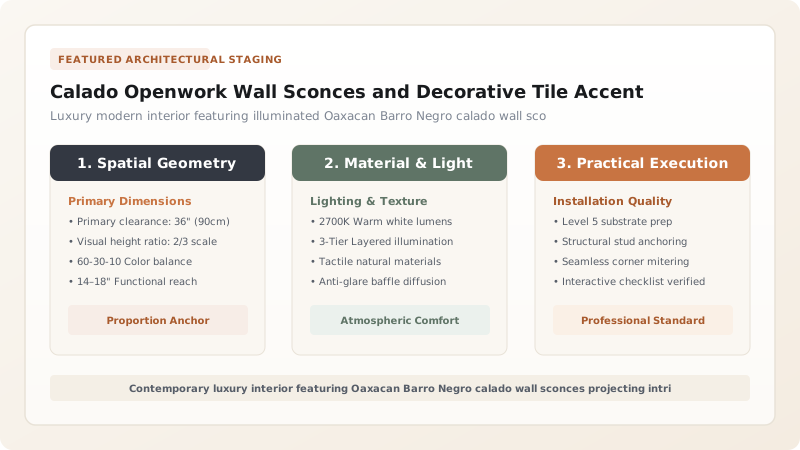
Calado openwork wall sconces and decorative tile accents represent the architectural evolution of Oaxacan Barro Negro. Master artisans execute 'calado'—an intricate pierced fretwork technique—by carving negative geometric, floral, and astronomical voids into leather-hard black clay using fine scalpels and curved gouges. When fired to their signature metallic obsidian finish and paired with modern interior lighting, these sculptural wall sconces cast dramatic, lace-like shadow projections across living spaces, while unburnished matte Barro Negro acoustic tiles provide sound damping and rich textural contrast in luxury contemporary environments.
At a Glance: Key Takeaways
- Carving Technique: Calado: manual openwork fretwork piercing during the leather-hard (cueroso) phase
- Architectural Element: Pierced wall sconces, hanging pendant globes, and decorative relief tiles
- Illumination Dynamic: Intricate shadow-lace projection cast on adjacent walls via warm LED lighting
- Acoustic Property: Matte low-fire ceramic tiles dampening high-frequency flutter echoes
- Mounting System: Concealed powder-coated aluminum cleats and flexible silicone-lime adhesives
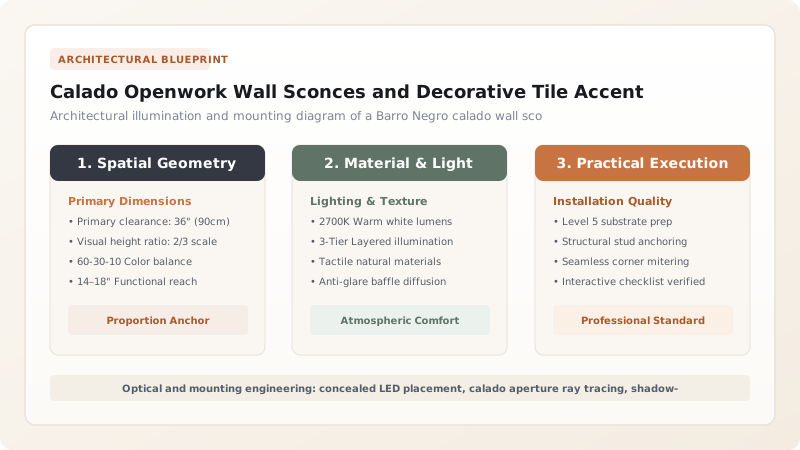
The Evolution of Calado: From Folk Craft to Architectural Sculpture
In traditional Zapotec ceramics, openwork piercing was originally restricted to functional apertures—such as drainage holes in colanders or ventilation slits in charcoal braziers (sahumadores). However, during the mid-twentieth-century ceramic renaissance in San Bartolo Coyotepec, master potters began experimenting with purely decorative perforations, creating the technique known as calado (fretwork openwork).
Today, calado has evolved from miniature decorative vases into monumental architectural elements. Contemporary architects collaborate directly with master artisan workshops to create custom pierced wall sconces, hanging pendant globes, and modular relief screen panels. These architectural pieces bridge the ancient and the modern, combining the primal material honesty of hand-dug, smoke-reduced earth with sophisticated geometric abstraction, serving as dramatic focal points in luxury residential, boutique hospitality, and gallery interiors.
The Geometry and Execution of Calado Piercing
The execution of calado requires virtuoso timing and razor-sharp manual precision. The carving cannot be performed while the clay is wet and plastic, as the material would deform, sag, and tear under tool pressure; nor can it be performed once the clay has dried to bone-dryness, as the brittle ceramic would shatter into micro-fissures.
The artisan must operate during the exact cueroso (leather-hard) phase—when the clay retains approximately 12% to 15% moisture content. The clay feels like firm cold cheese, cutting cleanly under a blade with zero drag. The master transfers intricate patterns—often inspired by the ancient geometric stone mosaics (grecas) of Mitla or indigenous tropical flora—onto the clay surface. Using ultra-fine surgical scalpels and miniature steel gouges, the artisan carves out hundreds of individual voids, maintaining a delicate structural balance where the remaining clay bridges (typically 4 to 8 mm wide) bear the dead weight of the piece without collapsing during firing.
The Optics of Shadow Projection: Architectural Chiaroscuro
The true magic of a Barro Negro calado sconce is revealed only when it is illuminated. In modern architectural lighting design, the sconce is not merely a light fixture; it is an analog shadow projector. When paired with a point-source warm LED lamp (ideally 2700K with a high Color Rendering Index), the perforated black clay transforms the surrounding space through dramatic chiaroscuro.
Because Barro Negro absorbs virtually 100% of visible light within its deep metallic body, there is zero light bleed through the ceramic wall. All light is forced through the precision-cut calado apertures. As these sharply defined light beams travel outward, they project an expanded, high-contrast lace of light and shadow across adjacent walls and ceilings. The effect is atmospheric, immersive, and transformative, turning a plain white plaster wall into an ever-shifting tapestry of sacred Mesoamerican geometry.
Acoustic Damping and Tactile Surface Accents
Beyond its lighting virtues, Barro Negro is increasingly deployed in architectural interiors for its superior acoustic and tactile qualities. In contemporary minimalist architecture, extensive use of polished concrete, large glass panes, and hard stone floors creates severe acoustic problems, including excessive reverberation and harsh flutter echoes.
By installing feature walls clad in matte or relief Barro Negro tiles, architects introduce a high-performance acoustic diffuser. The unglazed, microporous structure of the low-fire ceramic naturally absorbs high-frequency sound energy, while the undulating, hand-carved relief profiles scatter acoustic reflections, significantly softening room acoustics. Combined with its velvety, non-reflective charcoal surface that contrasts beautifully with natural timber and brass accents, Barro Negro brings ancient artisanal soul and acoustic tranquility to contemporary living spaces.
Barro Negro Architectural Elements: Optical and Spatial Characteristics
Use this reference table to calculate exact physical dimensions, ratios, and specifications before purchasing:
| Architectural Element | Perforation Density (% Void) | Primary Light Interaction | Acoustic Behavior | Recommended Room Setting |
|---|---|---|---|---|
| Calado Wall Sconce | 35% to 55% open pierced area | Direct shadow casting; intricate lace patterns | Moderate sound diffusion across perforated facets | Dining rooms, entry vestibules, luxury hotel corridors |
| Pendant Ceiling Globe | 40% to 60% open pierced area | 360-degree ambient spherical shadow projection | High diffusion of mid-frequency sound waves | High-ceiling living rooms, stairwells, and reception atriums |
| Relief Accent Tile (Matte) | 0% (solid surface relief) | Low specular reflection; deep light absorption | Excellent absorption of high-frequency flutter echo | Media rooms, bedroom accent walls, and wine cellars |
| Burnished Frieze Tile | 0% (solid mirror surface) | High specular highlight; reflects architectural light | Sound-reflective lithic boundary layer | Fireplace surrounds, luxury bathroom vanity backsplashes |
Practical Constraints
Every successful decoration project must account for physical and environmental constraints:
Structural Fragility of Intricate Calado Openwork during Shipping and Installation
Slender clay bridges between pierced voids can fracture under mechanical shock. Mitigation: Engineer minimum 5 mm bridge widths between openings and cushion pieces in custom foam packaging.
Low Chemical Resistance of Non-Vitrified Clay to Harsh Bathroom Cleaners
Acidic or alkaline cleaning sprays etch the burnished magnetite surface, leaving permanent white stains. Mitigation: Advise building maintenance to clean Barro Negro strictly with dry microfiber cloths or neutral water mists.
Execution Blueprint & Craftsmanship Sequence
Execute this professional sequence to achieve flawless results without backtracking:
Architectural Design and Template Drafting
Draft full-scale fretwork patterns for wall sconces or tiles on drafting vellum, incorporating Zapotec step-fret (grecas) or stylized floral motifs.
Clay Slab or Vessel Preparation
Roll out a uniform 8 mm clay slab or shape a curved sconce cylinder on the platos zapatistas, allowing it to dry to the firm leather-hard state.
Pattern Transfer (El Trazo)
Position the paper template over the leather-hard clay, using a bone or brass stylus to indent the geometric contours cleanly into the surface.
Precision Calado Fretwork Piercing
Using fine scalpels and miniature hollow gouges, cut out the negative voids, holding the blade at 90 degrees to ensure clean, perpendicular sidewalls.
Edge Dressing and Deburring
Dip a fine sable or camelhair brush into clean water and dress all cut edges, smoothing away burrs and rounding internal corners to prevent stress concentrations.
Selective Quartz Burnishing
Burnish the solid exterior relief borders with a polished river quartz crystal, leaving the internal pierced channel walls matte for dramatic visual contrast.
Hermetic Reduction Firing
Fire the pierced pieces in the subterranean pit kiln to 800°C, sealing all openings with mud and green wood to achieve the signature metallic obsidian finish.
Architectural Mounting and Electrical Commissioning
Mount the finished sconce to an interior wall using a concealed aluminum mounting plate, installing a 2700K warm LED fixture centered within the ceramic body.
Common Mistakes & Countermeasures
Avoid these costly errors that compromise aesthetics, ergonomics, and budget:
Carving calado fretwork with dull, thick blades that crush clay edges
Using high-wattage incandescent or halogen bulbs inside enclosed Barro Negro sconces
Mounting heavy Barro Negro tiles with rigid Portland cement mortar directly to drywall
Project Execution Checklist
Track your physical progress. Checkboxes persist automatically on this device:
Frequently Asked Questions
How does calado openwork create dramatic lighting patterns in interior spaces?
When a warm point-source light (such as a clear LED bulb) is placed inside a calado wall sconce, the pierced voids act as miniature optical apertures. The opaque, light-absorbing black clay blocks light completely, while the open geometric cutouts allow direct beams to project outward. As these sharp light rays strike adjacent light-colored plaster or stone walls, they project an expanded, high-contrast silhouette of intricate Zapotec lace patterns across the room.
Can Barro Negro tiles be used as flooring?
No. Barro Negro is a low-fired (750°C–850°C) unglazed ceramic with high porosity and low abrasion resistance compared to porcelain or vitreous ceramic pavers. Foot traffic would quickly scratch the burnished surface and chip delicate edges. It is designed strictly for vertical architectural applications—such as wall sconces, decorative friezes, fireplace surrounds, and acoustic wall panels.
What tools are used to cut the intricate calado piercings?
Traditional master artisans use a combination of simple hand tools: fine surgical scalpels, sharpened steel needles, miniature watchmaker's chisels, and small curved gouges fashioned from umbrella ribs or bicycle spokes. The key is extreme blade sharpness, which allows the artisan to slice through leather-hard clay cleanly without tearing or deforming the delicate adjacent walls.
How do Barro Negro acoustic tiles function in sound dampening?
Unburnished matte Barro Negro tiles possess an open, microporous capillary pore network. When sound waves strike the unglazed clay, acoustic energy enters these microscopic pores and is dissipated as heat through frictional resistance. Deploying relief Barro Negro tiles across large reflective wall expanses breaks up flutter echoes and dampens high-frequency harshness, creating serene acoustic environments in dining halls and galleries.