Geum-danchong (literally 'gold or brocade danchong') represents the most opulent, complex, and sacred grade of traditional Korean architectural painting, reserved exclusively for royal throne halls (such as Gyeongbokgung's Geunjeongjeon) and supreme Buddhist sanctuaries (Daeungjeon). Unlike lower grades that leave beam centers plain, Geum-danchong blankets structural timbers from end to end in intricate continuous patterns: interlocking geometric silk brocade diapers (geummun), blooming water lilies and lotus medallions (yeondwamun), multi-seeded pomegranates (seokryumun) symbolizing royal fertility, and soaring dragons and phoenixes embellished with 24-karat gold leaf.
At a Glance: Key Takeaways
- Danchong Classification: Geum-Danchong (금단청 / 錦丹靑): Supreme brocade royal grade
- Signature Motifs: Lotus blossoms (Yeondwa), pomegranates (Seokryu), silk diapers (Geummun)
- Pattern Density: 100% full surface coverage; zero unornamented timber ground
- Gilding Accents: Genuine 24-karat gold leaf (Sun-geum-bak) on dragon eyes and royal crests
- Architectural Context: Royal throne halls, coronation pavilions, main Buddha sanctuaries
The Pinnacle of Court Painting: The Glory of Geum-Danchong
Within the rigid architectural codification of the Joseon royal court, no decorative expression surpassed the magnificence of Geum-danchong (금단청, 錦丹靑)—literally 'silk brocade and gold danchong.' While utilitarian administrative buildings received restrained border pinstripes and secondary shrines featured beam-end floral caps, the grand ceremonial centers of state authority—such as the Geunjeongjeon throne hall at Gyeongbokgung and the Injeongjeon hall at Changdeokgung—were transformed by Geum-danchong into celestial palaces of optical splendor.
The hallmark of Geum-danchong is absolute, unbroken surface saturation. Unlike lower grades where the central midsection of long structural beams is left as a tranquil, unadorned field of solid celadon-green (noerok), Geum-danchong leaves not a single square centimeter of wood uncovered. The entire structural timber—from its complex tenon joints at the bracket capitals to the deep under-soffits of high purlins—is wrapped in an unbroken, continuous skin of interlocking geometric diapers, sacred floral medallions, celestial clouds, and mythical beasts. Walking into a Geum-danchong hall creates the dizzying, awe-inspiring illusion that the colossal, multi-ton pine timbers supporting the roof are weightless ribbons of shimmering silk brocade suspended in the heavens.
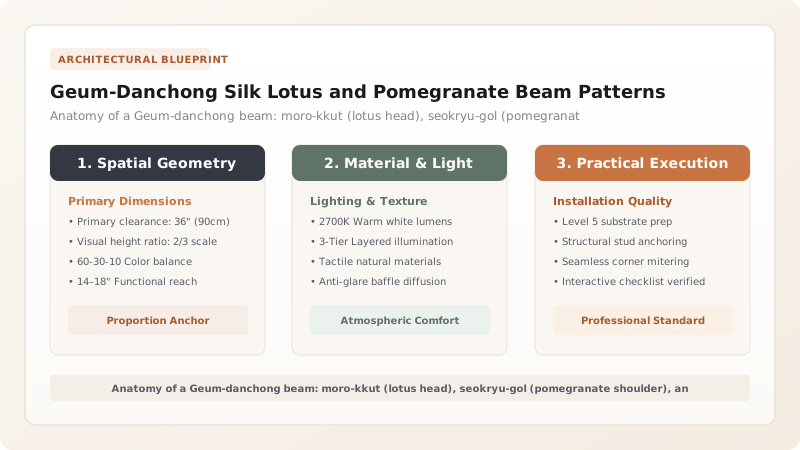
The Anatomy of a Beam: Moro-kkut, Seokryu & Geummun
Despite the overwhelming visual density of a Geum-danchong beam, the ornamentation is governed by strict, mathematically balanced anatomical zones. The composition begins at the beam ends with the moro-kkut (head pattern), anchored by the magnificent Yeondwamun (lotus blossom medallion). The lotus—sacred to both Buddhism and Confucian scholar-officials for rising unblemished from muddy waters—is rendered as an expansive, multi-tiered rosette with petals radiating outward in concentric waves of white, pink, crimson, and deep wine.
Immediately following the lotus head is the seokryu-gol (pomegranate shoulder). Here, the painter depicts the sacred pomegranate fruit (seokryu), carved or painted split open to reveal dense clusters of translucent red seeds. In the dynastic ideology of the Joseon court, the pomegranate was the supreme emblem of fertility and generational prosperity, embodying prayers for an abundance of royal heirs to secure the eternal stability of the Kingdom. Transitioning from the shoulders into the expansive central span, the composition resolves into the geummun—a continuous, interlocking field of geometric silk brocade diapers based on repeating hexagons (geobuk-deungmun or turtle-shell patterns for longevity), interlocking T-frets (gokja), and circular coin diapers that weave the disparate structural members into a single harmonic tapestry.
The Pounce Stencil: The Science of Chobon Transfer
A royal palace throne hall contains hundreds of structural rafters, purlins, and tie-beams, each requiring identical, symmetrical patterns that must align with millimeter precision across thirty-meter spans. Freehand drafting on the wood would result in unacceptable dimensional variations and require decades of labor. To solve this, master painters developed the ingenious chobon (초본) pounce stencil system.
The master painter drafts the complex geometric pattern once onto heavy, oil-soaked Korean mulberry paper (hanji). Using a hardened steel needle, the artisan punches thousands of tiny, uniform perforations at 1.5-millimeter intervals along every single drawn line. On site, this perforated stencil is pressed tightly against the primed timber beam. The artisan takes a soft cotton pouch (tapa) filled with finely pulverized oyster-shell powder (for dark grounds) or pine soot (for light grounds) and taps it rhythmically across the paper. The powder filters through the perforations, leaving an indelible, razor-sharp dotted outline on the wood surface below. A master team can pounce dozens of identical beams in a single morning, ready for the painting crew to begin mineral infilling.
Gilding the Dragon: 24-Karat Sun-geum-bak Accents
While mineral pigments provide chromatic richness, the ultimate celestial radiance of Geum-danchong is achieved through the application of genuine 24-karat gold leaf (Sun-geum-bak). In royal throne halls, the sovereign monarch sat beneath an elevated ceiling coffer (jungjeong) depicting two soaring five-clawed imperial dragons (ssang-nyong) swirling amidst auspicious clouds, grasping the wish-fulfilling jewel (cintamani).
The application of gold leaf is an exacting ritual. The master painter prepares a traditional gold size adhesive—either refined drying lacquer (ot-chil) or concentrated animal-hide glue tempered with garlic juice to increase surface tack. The adhesive is carefully applied only to the highest-status focal elements: the bulging pupils of dragon eyes, the royal monarchical crowns, and the flaming borders of the celestial jewels. Holding a booklet of paper-thin beaten gold leaf, the gilder transfers the delicate sheets using a squirrel-hair gilding brush, pressing them into the tacky size and burnishing with smooth agate stones or velvet cloths. When the throne room doors are opened to the morning sun, the gold leaf catches the low dawn rays, exploding with a blinding metallic luminescence that illuminated the King’s throne, demonstrating to all court officials and foreign ambassadors the divine majesty and cosmic mandate of the Joseon sovereign.
Iconography & Symbolic Lexicon of Geum-Danchong Motifs
Use this reference table to calculate exact physical dimensions, ratios, and specifications before purchasing:
| Motif Name | Korean Term | Visual Form / Geometry | Symbolic Meaning | Placement on Timber Frame |
|---|---|---|---|---|
| Lotus Blossom Medallion | Yeondwamun (연화문) | Concentric multi-layered blooming lotus petals | Spiritual purity, rebirth, divine enlightenment | Beam heads (morogot), brackets, ceiling coffer centers |
| Pomegranate Cluster | Seokryumun (석류문) | Split fruit revealing dense clusters of seeds | Abundant royal progeny, fertility, prosperity | Terminal caps of longitudinal tie-beams (jangyeo) |
| Silk Brocade Diaper | Geummun (금문) | Interlocking swastikas, hexagons, & fretwork diapers | Eternal cosmic continuity, woven luxury | Continuous central spans of tie-beams and purlins |
| Imperial Twin Dragons | Ssang-nyongmun (쌍룡문) | Five-clawed dragons swirling amidst clouds | Supreme sovereign majesty, rainmaking power | Ceiling canopies directly above royal thrones |
| Flying Phoenix Pair | Bonghwangmun (봉황문) | Celestial birds with iridescent tail feathers | Peaceful reign, benevolent queen, virtuous rule | Palace pediments and royal bedchamber gables |
Practical Constraints
Every successful decoration project must account for physical and environmental constraints:
Colossal labor intensity requiring thousands of artisan hours per single palace hall
Full Geum-danchong restoration requires multi-year schedules and massive specialized budgets. Mitigation: Utilize traditional master-apprentice teams with specialized division of labor (stencil pricking, infill, inking).
Complex compound curves of traditional curved structural pine beams (durim-bo)
Flat mulberry paper stencils buckle when wrapped around curved, irregular timber surfaces. Mitigation: Cut strategic relief slits in the paper stencils to allow them to conform to curved wood without distorting patterns.
Execution Blueprint & Craftsmanship Sequence
Execute this professional sequence to achieve flawless results without backtracking:
Geometric Grid Drafting on Hanji Paper
Draft full-scale Geum-danchong patterns on oiled Korean mulberry paper (hanji), calculating exact repeat modules for interlocking silk diaper webs.
Chobon Needle Perforation
Prick tiny, uniform needle holes at 1.5 mm intervals along every line of the drawing using a steel stylus resting on a felt pad.
Tapa Pounce Pattern Transfer
Press the perforated stencil firmly against the primed green beam, pouncing a cotton pouch filled with powdered white oyster shell across the holes.
Beam End Lotus (Yeondwa) Infilling
Paint concentric layers of lotus petals at the beam heads, applying five-tier color gradations from white tips to deep crimson bases.
Pomegranate (Seokryu) Detailing
Paint the multi-seeded pomegranate medallions at the beam shoulders, using bright vermilion and cadmium yellow mineral tempera.
Continuous Brocade Diaper (Geummun) Execution
Fill the central span of the beam with interlocking geometric diaper patterns (hexagons, swastikas, circles), maintaining mathematical symmetry.
24-Karat Gold Leaf Application
Apply thin oil gold size to dragon eyes, lotus stamens, and royal crest medallions, laying 24-karat loose gold leaf and buffing with velvet.
Meokseon Inking & Master Verification
Ink all pattern perimeters with razor-sharp black pine-soot lines (meokseon) and white highlight lines (baekseon), completing the brocade.
Common Mistakes & Countermeasures
Avoid these costly errors that compromise aesthetics, ergonomics, and budget:
Applying Geum-danchong on low-status residential or secondary administrative buildings
Using modern bronze-powder imitation gold paint instead of genuine 24-karat gold leaf
Project Execution Checklist
Track your physical progress. Checkboxes persist automatically on this device:
Frequently Asked Questions
Why is the highest grade of Danchong named 'Geum-danchong' (Brocade Danchong)?
The word 'Geum' (금, 錦) refers to exquisite polychrome silk brocade—the most precious and expensive luxury textile of the ancient Orient, woven with complex geometric patterns and metallic threads. Because Geum-danchong covers structural wooden beams so densely that they resemble heavy timbers wrapped in continuous bolts of woven silk brocade, it was named 'Brocade Danchong.'
What is the symbolic meaning of the pomegranate in royal palace Danchong?
In traditional Korean and East Asian royal symbolism, the pomegranate (seokryu) is celebrated as the premier emblem of fertility, abundance, and generational continuity. Because a ripe pomegranate splits open to reveal hundreds of jewel-like red seeds, its inclusion on palace beams was a visual prayer for the monarch to be blessed with numerous royal princes to ensure the unbroken continuation of the royal dynasty.
How do painters transfer identical complex patterns across dozens of ceiling beams?
They use the 'chobon' (or tapa) pounce stencil method. Master artisans draw the master design once on durable mulberry paper (hanji) and punch thousands of microscopic needle holes along every line. Holding this stencil against a beam, the painter taps it with a cloth pouch filled with powdered white chalk or soot. The powder filters through the holes, transferring a perfect, dotted outline onto the wood in seconds.