Slaked seashell lime and tender coconut water plaster ground (bhumibandhana) is the sacred foundation of Kerala mural art. Prepared from calcined sub-fossil bivalve shells from Vembanad Lake slaked in fresh water for 3 to 6 months, the ultra-pure calcium hydroxide is mixed with washed river sand and fermented tender coconut water (elaneer). Applied in three successive coats over laterite masonry and burnished with smooth river agates, the tender coconut sugars retard carbonation and catalyze a glass-smooth, micro-porous matrix that locks in mineral pigments permanently under tropical humidity.
At a Glance: Key Takeaways
- Lime Source: Calcined sub-fossil marine bivalve seashells (Vembanad Lake, Kerala)
- Slaking Duration: 90 to 180 days submerged in clean freshwater stone tanks
- Biochemical Additive: Fermented tender coconut water (elaneer) & kadukka fruit decoction
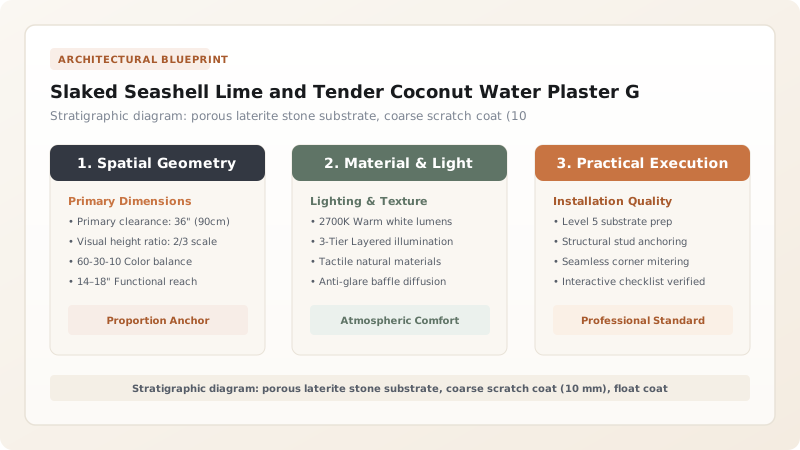
- Plaster Stratification: 3 coats: Coarse scratch coat (10 mm), fine float coat (5 mm), lime putty skim (2 mm)
- Burnishing Tool: Natural polished river agate and chalcedony stones
Calcining Vembanad Seashells and Multi-Month Slaking
The foundation of Kerala’s sacred mural tradition rests upon the unique geological wealth of Vembanad Lake—a vast estuarine wetland ecosystem stretching along the Malabar coast. Over millennia, receding sea levels and brackish backwaters created immense sub-fossil shell beds consisting almost entirely of white bivalve marine mollusks. Known locally as Kakkavaraku, these sub-fossil shells represent an extraordinarily pure form of biogenic calcium carbonate (CaCO3), containing virtually zero magnesium, iron, or clay impurities. In the traditional preparation codified in the Silparatna, these shells were gathered by specialized divers, washed in clean flowing river water to remove backwater silts and organic residues, and dried in the tropical sun.
Calcination was conducted in specialized updraft kilns fueled with dried coconut shells and seasoned hardwood logs. Fired at temperatures between 850°C and 900°C for approximately 24 hours, the shells underwent thermal decomposition, driving off carbon dioxide gas (CO2) and leaving behind pure white calcium oxide (CaO), or quicklime. The quicklime was immediately transferred into deep stone-lined pits and flooded with fresh well water in an energetic, exothermic slaking reaction. The resulting calcium hydroxide putty (chunnambu) was not used immediately; guild rules mandated that the lime putty remain submerged under standing water for a minimum of 90 to 180 days. During this multi-month underwater aging, the jagged, irregularly shaped calcium hydroxide particles underwent continuous dissolution and reprecipitation, transforming into flat, hexagonal sub-micron platelets with immense lubricity, plasticity, and water retention.
Tender Coconut Water and Herbal Ferments in Carbonation
The defining technological genius of the Kerala mural ground is the incorporation of organic plant juices into the inorganic lime matrix. The primary biochemical modifier is elaneer—fresh tender coconut water harvested from green coconuts (Cocos nucifera). Fresh tender coconut water contains approximately 4% to 5% dissolved sugars (primarily glucose and fructose), potassium salts, amino acids, and ascorbic acid. When added to the lime-sand mixture, the sugar molecules adsorb onto the surfaces of the hydrating calcium hydroxide crystals. This adsorption creates a protective steric barrier that retards premature crystal growth, extending the workable open time of the plaster by several hours in Kerala’s hot, humid climate.
Simultaneously, the artisans prepared a concentrated herbal decoction by boiling the crushed dried rinds of kadukka (chebulic myrobalan, Terminalia chebula) in copper cauldrons for four to six hours. Kadukka is exceptionally rich in polyphenolic tannins, particularly chebulinic acid and gallic acid. When blended into the alkaline lime mortar alongside fermented tender coconut water, the tannins cross-link with calcium ions to form insoluble calcium tannate salts. These organo-mineral complexes dramatically reduce the capillary porosity of the cured plaster, rendering it highly resistant to driving monsoon moisture. Furthermore, the natural biocidal properties of the tannins provide permanent, built-in protection against tropical mold (Aspergillus and Cladosporium), preventing biological defacement across centuries of temple use.
Coarse and Fine Sand Mortar Layering Protocols
The application of the mural ground over coarse, porous laterite stone (vettukallu) or fired clay brick walls is a multi-layered stratigraphic process known as bhumibandhana. Laterite stone is highly porous, irregular, and rich in iron and aluminum hydroxides. If a thin plaster coat were applied directly, the porous stone would pull water away from the mortar instantly, causing severe shrinkage cracking and adhesive failure. To prepare the wall, the masonry joints are raked clean, and the entire surface is drenched with fresh water continuously for 24 hours until the stone reaches complete hydraulic saturation.
The plaster is applied in three distinct, successive strata. The first layer—the coarse scratch coat (kharatva)—is mixed in a ratio of one part aged seashell lime putty to two parts coarse, washed river sand (grain size 1.0 to 2.0 mm), blended with kadukka decoction and jaggery water. Applied at a thickness of 8 to 12 millimeters, this layer bridges the unevenness of the laterite blocks. While still damp, its surface is scored with a wooden comb to create a mechanical key. After seven days of moist curing under damp burlap screens, the second layer—the float coat (madhyama)—is applied at a thickness of 4 to 6 millimeters. This layer utilizes finer washed sand (0.2 to 0.5 mm) in a 1:1.5 ratio with lime putty, mixed with fermented tender coconut water. The float coat is leveled with teakwood floats and compacted with wooden beaters to expel trapped air and eliminate voids.
Agate Stone Burnishing and Micro-Porosity Preparation
The final and most critical stage of ground preparation is the application and burnishing of the fine skim coat (sukshma). Once the intermediate float coat has set firm (typically after five to seven days), the surface is lightly misted with tender coconut water. The artisan then trowels on an ultra-thin skim coat—strictly 1.5 to 2.0 millimeters thick—composed of pure, triple-sifted seashell lime putty enriched with coconut water, completely free of sand aggregate. This paste is worked across the wall using flexible wooden or horn spatulas until the plane is completely flat and void-free.
As the skim coat begins to stiffen under finger pressure (the leather-hard state), the burnishing process begins. The master artisan works with natural river agates, chalcedonies, or smooth nephrite jade stones that have been polished over decades of use. Holding the oval stone firmly against the setting lime, the artisan moves it in tight, circular, overlapping strokes, periodically lubricating the surface with a rag dipped in fresh tender coconut water. The intense mechanical pressure exerted by the hard agate stone compresses the soft calcium hydroxide platelets, forcing them to align parallel to the wall plane. This mechanical compaction closes all macroscopic pores while leaving a uniform network of microscopic capillary pores. When the carbonation reaction completes over the subsequent weeks—as atmospheric carbon dioxide converts the calcium hydroxide into micro-crystalline calcite (CaCO3)—the wall acquires the cool, luminous, ivory-smooth surface of polished marble, perfectly receptive to the delicate brushstrokes of the Panchavarna mineral pigments.
Plaster Stratification, Mix Ratios & Curing Times for Kerala Mural Grounds
Use this reference table to calculate exact physical dimensions, ratios, and specifications before purchasing:
| Plaster Layer | Seashell Lime Putty | Sand Aggregate | Herbal Additive | Curing / Setting Time |
|---|---|---|---|---|
| Scratch Coat (Kharatva) | 1 Part matured lime putty | 2 Parts coarse river sand (1–2 mm) | Kadukka decoction + Jaggery water | 7 days moist curing |
| Float Coat (Madhyama) | 1 Part matured lime putty | 1.5 Parts fine washed sand (<0.5 mm) | Fermented tender coconut water | 5 days moist curing |
| Skim Coat (Sukshma) | 1 Part ultra-fine lime putty | 0.2 Parts crushed quartz dust | Pure tender coconut water (elaneer) | Burnish within 4–6 hours |
| Agate Burnish Ground | Zero sand / pure calcium putty | None / micro-porous surface | Coconut water rub-down | 14 days dry stabilization |
| Pre-Painting Conditioning | Washed surface with tender coconut water | None | Neem bark extract wash | Ready for charcoal sketch |
Practical Constraints
Every successful decoration project must account for physical and environmental constraints:
High soluble salt (efflorescence) risk in coastal laterite masonry walls
Nitrates and chlorides migrate to the surface, crystalizing behind the mural and spalling the paint film. Mitigation: Apply a sacrificial lime-sand poultice to extract salts from laterite masonry before final plastering.
Rapid drying and premature carbonation of thin lime skim coats in tropical heat (>32°C)
Plaster dries before burnishing can align calcite crystals, resulting in a chalky, weak ground. Mitigation: Work during early morning hours and maintain humid ambient microclimates with wet burlap screens.
Execution Blueprint & Craftsmanship Sequence
Execute this professional sequence to achieve flawless results without backtracking:
Seashell Sourcing & Calcination
Excavate prehistoric bivalve seashell deposits from Vembanad Lake. Burn in wood-fired updraft kilns fueled with dried coconut husks at 900°C for 24 hours to create pure calcium oxide (quicklime).
Underwater Slaking & Aging
Immerse quicklime into deep granite-lined water tanks. Slake vigorously and keep submerged under 15 cm of standing water for 90 to 180 days, allowing microscopic platelet restructuring.
Sand Washing & Aggregate Fractionation
Wash river sand through running water in settling troughs until turbidity is zero. Sieve into two fractions: coarse aggregate (1.0–2.0 mm) and fine aggregate (0.2–0.5 mm).
Herbal Modifier Extraction
Boil crushed dried kadukka fruits (Terminalia chebula) in water for 4 hours to extract concentrated tannins. Ferment fresh tender coconut water (elaneer) for 24 hours to activate organic acids.
Scratch Coat Application
Drench the laterite stone wall with water. Apply a 10 mm base coat of 1 part lime putty to 2 parts coarse sand mixed with kadukka extract. Cross-hatch with a wooden comb for mechanical keying.
Intermediate Float Coat
After 5 days of moist curing, apply a 5 mm float coat of 1 part lime to 1.5 parts fine sand mixed with fermented tender coconut water, floating flat with a teakwood hand float.
Ultra-Fine Skim Coat
Apply a 1.5 to 2.0 mm skim coat of pure, sifted seashell lime putty enriched with coconut water. Smooth with a flexible horn or wooden spatula until completely flat.
Agate Stone Burnishing
As the skim coat begins to set (firm to thumb pressure), burnish the surface vigorously using smooth, polished oval agate river stones lubricated with coconut water until an ivory-like, lustrous sheen is achieved.
Common Mistakes & Countermeasures
Avoid these costly errors that compromise aesthetics, ergonomics, and budget:
Using freshly slaked quicklime that has not matured in water tanks for at least 3 months
Applying the plaster ground over dry, un-wetted laterite masonry
Using metal steel trowels for final burnishing of the fine lime skim coat
Project Execution Checklist
Track your physical progress. Checkboxes persist automatically on this device:
Frequently Asked Questions
Why is seashell lime superior to limestone rock for mural painting grounds?
Seashell lime derived from marine bivalves consists of biogenetically precipitated calcium carbonate that is remarkably pure—typically over 98% to 99% pure CaCO3. Quarried limestone, by contrast, frequently contains iron oxides, magnesium carbonate (dolomite), clay silicates, and sulfur compounds. When calcined and slaked, seashell lime yields an exceptionally fine, silky, amorphous lime putty with extremely small particle size (sub-micron). This ultra-fine platelet structure allows the plaster to be burnished to a mirror-like, porcelain smoothness that limestone plasters cannot match.
How does fermented tender coconut water chemically modify lime plaster setting?
Tender coconut water contains a unique cocktail of simple monosaccharides (fructose and glucose), potassium electrolytes, and mild organic acids. When introduced into wet calcium hydroxide (Ca(OH)2), the sugar molecules act as a set-retarder: they adsorb onto the hydrating lime crystals, temporarily inhibiting the rapid growth of calcite crystals. This extends the working open-time by several hours, allowing artisans to meticulously trowel and burnish the surface. As the plaster slowly carbonates, the organic compounds cross-link, creating a denser, less permeable micro-crystalline calcite matrix.
What role does kadukka (chebulic myrobalan) play in traditional Kerala plaster?
Kadukka (Terminalia chebula) is a tannin-rich dried fruit used in traditional Ayurvedic medicine. When boiled into an aqueous decoction and added to lime plaster, the hydrolyzable tannins (gallic acid and ellagic acid) react with the alkaline calcium ions to form insoluble calcium tannate complexes. These complexes act as natural water-repellents, dramatically reducing capillary moisture absorption from humid monsoon air. Furthermore, the natural polyphenols provide powerful, permanent anti-fungal and anti-bacterial protection, preventing black mold from colonizing the plaster in Kerala's tropical climate.