
The protective performance of Yakisugi is directly determined by its carbonization depth and cell vitrification. High-heat chimney pyrolysis collapses wood cellular tracheids into a glassy, hexagonal carbon lattice 2mm to 4mm thick. This inert layer exhibits zero equilibrium moisture absorption, repels liquid water, blocks UV degradation of underlying lignin, and provides Class A/B flame spread resistance by functioning as a sacrificial thermal barrier.
At a Glance: Key Takeaways
- Primary Char Grade (Suyaki): Heavy unbrushed 'alligator skin' carbon crust 2.5mm–4.0mm thick.
- Brushed Grade (Gendai): Single-brushed surface leaving smooth blackened wood with raised carbon grain.
- Smooth Two-Tone Grade (Pika-Pika): Double-brushed exposing natural cedar earlywood with charred latewood grain.
- Cellular Vitrification: Tracheid cell walls collapse and vitrify into hydrophobic inorganic graphitic carbon.
- Flame Spread Performance: Pre-charred layer delays ignition and slows heat release rate (HRR) by 60%–75%.
- Moisture Dynamics: Vitrified char crust has near-zero hygroscopic swelling, eliminating paint-peeling stresses.
Microscopic Cell Vitrification and Hydrophobic Physics
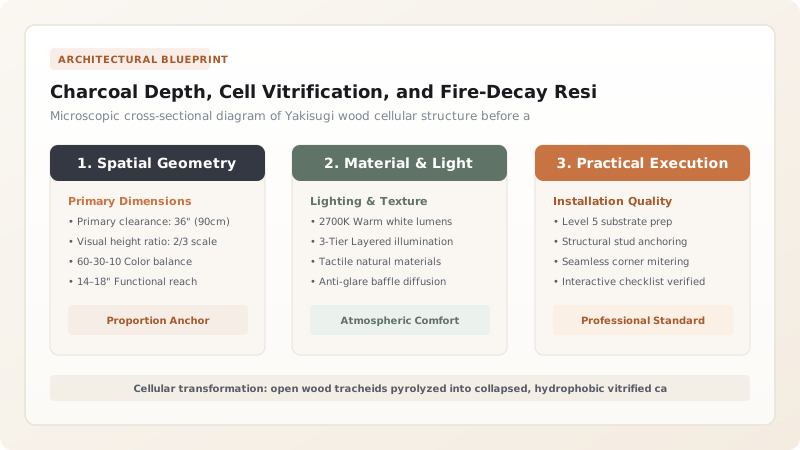
Under scanning electron microscopy (SEM), raw cedar wood exhibits open cellular conduits (tracheids and lumen) through which moisture and nutrients move. When subjected to rapid 950°C pyrolysis during sankaku-yaki, the water inside the cell walls flash-evaporates, and the organic polymer chains break.
The cell walls collapse inward and vitrify into a dense, amorphous carbon lattice. This crystalline transformation completely closes the microscopic pores. While liquid water easily wicks into raw cedar through capillary action, it forms a high contact angle (>120°) against the vitrified carbon crust, beading up and rolling off without penetrating the underlying timber core.
The Three Canonical Yakisugi Surface Grades
In Japanese architectural specification, Yakisugi is produced in three distinct surface textures depending on aesthetic and exposure requirements:
- Suyaki (Alligator Char): The pristine, unbrushed finish straight from the water quench. Features heavy, cracked polygonal carbon scales 3mm thick resembling alligator leather. Offers the ultimate 100-year durability for extreme coastal and exterior facades.
- Gendai (Single-Brushed): The surface is brushed once with a stiff wire brush to remove loose soot. Leaves a smooth, matte jet-black surface with subtle textural grain lines that will not smudge onto hands or clothing.
- Pika-Pika (Double-Brushed): Heavily wire-brushed twice to remove all soft carbon, leaving only the hard charred summerwood ridges standing proud against warm amber cedar wood in high architectural contrast.
Fire-Retardant Thermodynamics: The Sacrificial Thermal Shield
To the layperson, clad buildings in 'burned wood' sounds like a fire hazard. In reality, heavy Suyaki Yakisugi is remarkably fire-resistant. For wood to burn, heat must continuously vaporize solid timber into flammable volatile gases (syngas) that ignite in oxygen.
Because Yakisugi has already undergone complete pyrolysis, all volatile terpenes, resins, and combustible gases have already been expelled. The remaining 3mm carbon layer possesses exceptionally low thermal conductivity. When exposed to an external fire or flying embers, the char acts as a sacrificial thermal shield, preventing heat from reaching the critical flashpoint of the inner structural wood core.
Architectural Grades of Japanese Yakisugi Cladding
Use this reference table to calculate exact physical dimensions, ratios, and specifications before purchasing:
| Grade Name | Surface Treatment | Char Thickness | Primary Aesthetic | Optimal Architectural Zone |
|---|---|---|---|---|
| Suyaki (Alligator) | Zero brushing; raw quenched | 2.5 mm – 4.0 mm | Deep prismatic black scales | Exterior upper siding, gable ends, coastal walls |
| Gendai (Single-Brushed) | One pass with wire brush | 1.5 mm – 2.2 mm | Smooth matte black with grain | Ground-floor facades, entryways, pedestrian walls |
| Pika-Pika (Two-Brushed) | Two aggressive brush passes | 0.5 mm – 1.0 mm | High-contrast brown and black | Interior accent walls, ceilings, bespoke furniture |
| Torched Imitation | Propane weed torch burn | < 0.5 mm | Flat scorched soot smudges | Temporary interior displays (unsuitable for exterior) |
Practical Constraints
Every successful decoration project must account for physical and environmental constraints:
Modern building codes requiring third-party ASTM E84 or EN 13501-1 flame-spread certification
Mitigation: Utilize certified Yakisugi tested with factory fire-retardant vacuum impregnation behind the charred face.
Execution Blueprint & Craftsmanship Sequence
Execute this professional sequence to achieve flawless results without backtracking:
Measure Post-Quench Char Crust Thickness
Cross-cut a scrap end of burned board and measure carbon thickness using digital micrometer (target: 2.5mm–3.5mm).
Determine Target Surface Finish Grade
Select Suyaki (unbrushed), Gendai (single-brushed), or Pika-Pika (double-brushed) based on facade zone exposure.
Execute Calibrated Mechanical Wire Brushing
For Gendai grade, brush boards along the grain with medium brass-wire wheel to strip loose friable soot.
Vacuum and Wipe Residual Airborne Carbon Dust
Vacuum brushed faces with HEPA extractor and wipe with dry microfiber towels to prepare surface for oil bonding.
Perform Flame Spread Testing on Sample Batch
Expose charred face to direct 1,000°C blowtorch flame for 60 seconds to verify zero self-sustaining flame propagation.
Coat Side Shiplap Edges with Penetrating Black Tint
Brush dark iron-oxide oil into tongue-and-groove or shiplap rebates so no raw wood shows if boards contract.
Common Mistakes & Countermeasures
Avoid these costly errors that compromise aesthetics, ergonomics, and budget:
Aggressively pressure washing charred boards with a high-pressure rotary nozzle
Specifying heavy Suyaki unbrushed char on low interior hallway walls
Project Execution Checklist
Track your physical progress. Checkboxes persist automatically on this device:
Frequently Asked Questions
Does the charred 'alligator skin' peel or flake off over time?
No. In authentic sankaku-yaki, the carbon layer is not a coating applied to the wood; it is the molecularly transformed cellular structure of the wood itself, seamlessly bonded to the unburned core.
How does Yakisugi perform against Formosan subterranean termites?
Termites require cellulose and digestible carbohydrates to survive. The vitrified carbon crust contains zero food value; university laboratory tests prove termites will starve rather than bore through Yakisugi char.


