Traditional Japanese tatami (畳) is a modular architectural flooring system developed during the Heian and Muromachi periods that evolved into the primary spatial coordinate system for Japanese residential and tea house architecture (sukiya-zukuri). An authentic tatami mat consists of three handcrafted components: the doko (a dense, 50–55 mm thick core of cross-laminated, hydraulically compressed organic rice straw), the omote (a tightly woven surface matting crafted from natural soft rush, Juncus effusus var. decipiens or igusa, cured in mineral-rich mud slurry to preserve chlorophyll and impart a calming herbal aroma), and the heri (narrow side borders sewn from natural indigo-dyed cotton, linen, or silk brocade). Beyond aesthetic serenity, tatami acts as a dynamic indoor hygrometer—absorbing up to 500 ml of airborne humidity per mat during humid summer months and releasing it during dry winter spells—while dictating room layouts through standard 2:1 rectangular modules.
At a Glance: Key Takeaways
- Surface Textile: Woven soft rush (igusa) with hemp or cotton warp threads
- Substrate Core: Compressed natural rice straw (wara doko) or wood fiber board
- Standard Thickness: 50 to 60 mm (standard Japanese residential depth)
- Dimensional Module: 2:1 aspect ratio (e.g., Kyo-ma 1910 x 955 mm; Edo-ma 1760 x 880 mm)
- Humidity Buffering: Absorbs ~500 ml of ambient water vapor per mat
- Aromatherapeutic Volatiles: Vanillin, phytol, and dihydroactinidiolide
In-Depth Guides in this Directory
Explore specialized subtopic blueprints, technical dimensions, and execution checklists:
Igusa Soft Rush Agronomy: Dawn Harvesting, Volcanic Mud Sendo-Tsuchi Slurrying, and Loom Weaving
In-depth guide to cultivating, dawn harvesting, volcanic mud mud-dyeing (sendo), and high-tension loom weaving of authentic Japanese igusa soft rush for tatami.
Tatami Substrate Architecture: Compressed Rice Straw Doko Cores, Edge Bevelling, and Heri Ribbon Sewing
Master the carpentry and tailoring of authentic tatami substrates: cross-laminating rice straw doko cores, edge trimming, and hand-sewing cloth heri borders.
Kyo-ma versus Edo-ma Spatial Modules: Tatami Room Geometries, Column Grids, and Hygroscopic Care
Architectural analysis comparing Kyoto Kyo-ma and Tokyo Edo-ma tatami modules. Master column centerline grids, room configurations, and seasonal hygroscopic maintenance.
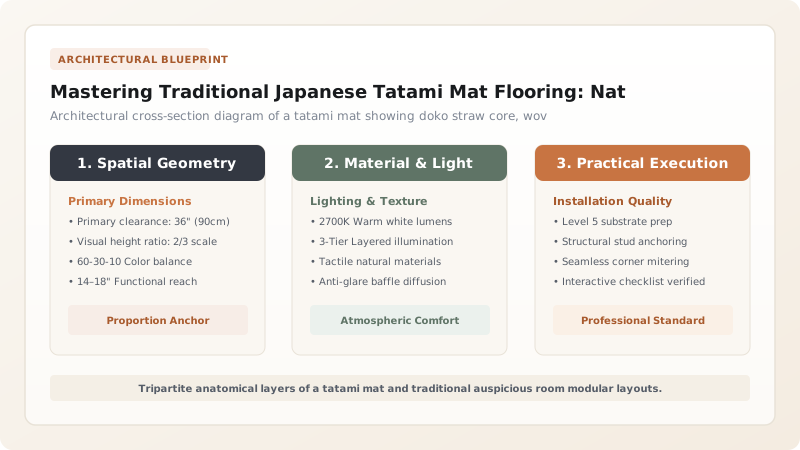
Architectural Evolution & The Tatami Dimension System
In early Japanese history, woven straw mats were portable luxury furnishings reserved for the emperor and high-ranking aristocrats to sit or sleep upon. During the Muromachi period (1336–1573) and the rise of the shoin-zukuri and sukiya-zukuri architectural styles, tatami transformed from individual seating pads into wall-to-wall fitted flooring (zashiki). This shift revolutionized Japanese architecture: room sizes ceased to be measured in arbitrary feet or meters and were instead defined by the number of mats (jō), such as 4.5-mat tea rooms, 6-mat family chambers, and 8-mat reception halls.
Because tatami mats adhere strictly to a 2:1 rectangular proportion, they establish a modular grid that coordinates the placement of timber posts (hashira), sliding paper partitions (shoji and fusuma), transoms (ranma), and alcoves (tokonoma). Regionally, two primary standards emerged: Kyo-ma (Kyoto standard: 1910 mm × 955 mm), where rooms are designed to fit mats based on fixed mat dimensions, and Edo-ma (Tokyo standard: 1760 mm × 880 mm), where mat sizes are derived by subdividing the column centerlines.
Igusa Rush Botany & Natural Mineral Mud Curing
The exterior surface of the tatami—the tatami-omote—is woven exclusively from the stems of Juncus effusus var. decipiens, locally known as igusa. Grown primarily in the fertile alluvial basins of Kumamoto Prefecture in Kyushu, high-grade igusa reaches a height of 120 to 150 cm with a perfectly uniform, unblemished triangular cross-section. The stem interior consists of a sponge-like honeycomb cellular structure (parenchyma tissue) that provides exceptional resilience, elastic foot cushioning, and acoustic dampening.
Immediately after harvest in midsummer, fresh igusa undergoes a signature traditional process: sendo (mud dyeing). The green rushes are immersed in a slurry of natural volcanic clay (sendo-tsuchi). This colloidal clay bath seals the stomata of the stems, preventing rapid oxidation and UV bleaching while locking in the natural green chlorophyll. As the mud-coated rushes dry slowly in specialized low-temperature kilns, chemical reactions between the minerals and plant sap produce the soothing, signature herbal fragrance composed of vanillin, phytol, and phenylethanol that defines traditional Japanese domestic air quality.
Compressed Rice Straw Doko Cores & Textile Heri Stitching
The load-bearing body of a traditional mat is the tatami-doko. An authentic doko requires approximately 30 to 40 kg of dried, uncrushed autumnal rice straw (wara). The straw is laid in multiple cross-laminated layers—alternating longitudinal and transverse directions across six to eight strata—and compressed under hydraulic pressure from a height of 40 cm down to a solid 50 to 55 mm thickness. The compacted bundle is stitched with hundreds of rows of high-tensile polypropylene or linen twine, producing an ultra-dense, fire-resistant thermal battery that insulates against cold sub-floor drafts while retaining foot-warmth in winter.
To assemble the finished mat, the woven igusa omote is stretched over the straw core under high tension and secured along the long edges with heri—woven cloth ribbons. In high-status historical residences, heri featured intricate silk brocade crests (monberi); in contemporary tearooms and dwellings, solid-color indigo cotton, dark brown linen, or black hemp tapes are hand-sewn with curved mattress needles, cleanly concealing the raw rush ends and providing crisp, geometric border lines across the floor.
Layout Geometries (Syugi-jiki vs Fusyugi-jiki) & Indoor Climate Science
Laying tatami mats requires strict adherence to traditional orientation rules. In residential architecture, mats are arranged in syugi-jiki (auspicious layout), where no four mat corners ever meet at a single cross junction (forming a '+' shape), as this was believed to invite misfortune. Instead, mats are placed in interlocking spiral or pinwheel patterns that form 'T' junctions, maximizing lateral friction between mats and preventing them from shifting under foot traffic.
Beyond cultural symbolism, tatami functions as an active environmental filter. A single tatami room absorbs up to 2.5 liters of moisture on humid rainy days, releasing it gradually when relative humidity drops below 50%. Furthermore, the open cellulosic structure of igusa rush naturally adsorbs airborne nitrogen dioxide (NO2) and volatile organic compounds (VOCs), maintaining healthy indoor air quality without mechanical ventilation. With seasonal airing and biannual surface reversal (omote-gaeshi), a well-maintained straw-core tatami installation lasts over 40 to 60 years.
Tatami Specification Standards: Core, Rush, and Dimensions
Use this reference table to calculate exact physical dimensions, ratios, and specifications before purchasing:
| Specification Class | Core Substrate (Doko) | Surface Weave (Omote) | Dimensional Module | Best Architectural Application |
|---|---|---|---|---|
| Hon-Tatami (Classical Grade) | 100% Compressed Rice Straw (40kg wara) | Kumamoto Grade-1 long igusa rush (hemp warp) | Kyo-ma (1910 x 955 x 55 mm) | Traditional tea houses, temples, luxury washitsu |
| Modern Residential Grade | Straw sandwich with polystyrene core | Kumamoto Grade-2 igusa rush (cotton warp) | Edo-ma / Kanto (1760 x 880 x 50 mm) | Contemporary urban apartments, family homes |
| Barrier-Free Thin Grade | High-density wood fiber board (insulation core) | Woven natural igusa or coated washi paper | Chukyo-ma (1820 x 910 x 15-30 mm) | Renovation over existing hardwood or underfloor heating |
| Ryukyu Square Borderless | Solid straw or wood fiber board | Split Shichito rush or woven twisted igusa | Half-mat square (880 x 880 x 55 mm) | Modern minimalist interiors, Zen living rooms |
Practical Constraints
Every successful decoration project must account for physical and environmental constraints:
High Sensitivity to Excess Atmospheric Humidity & Mold Growth
In unventilated rooms where relative humidity exceeds 70% for consecutive days, organic straw and rush naturally foster Aspergillus mold. Mitigation: Install cross-ventilating shoji screens, maintain indoor humidity below 60% with dehumidifiers during monsoon season, and perform seasonal sunshine airing (kage-boshi).
Ultraviolet Solar Degradation and Color Shifting
Direct sunlight oxidizes natural chlorophyll, turning vibrant green mats into golden-straw yellow within 6 to 12 months. Mitigation: Incorporate deep exterior eaves (hisashi), engawa verandas, and translucent washi shoji screens to diffuse direct solar radiation into gentle, non-destructive illumination.
Non-Standardized Metric Room Discrepancies in Modern Buildings
Modern concrete apartments rarely match historical Kyo-ma or Edo-ma grid dimensions, leaving awkward perimeter gaps. Mitigation: Commission bespoke custom-cut tatami mats crafted to the exact laser-scanned room dimensions, or frame the tatami zone with a flush hardwood border (ita-no-ma).
Execution Blueprint & Craftsmanship Sequence
Execute this professional sequence to achieve flawless results without backtracking:
Laser Verification of Room Rectangularity
Measure the room perimeter along the baseboards (kamoi/habaki) with laser distance meters. In Japanese joinery, rooms are rarely square; each individual mat position is assigned a custom number and measured to 1 mm tolerances.
Sizing the Compressed Rice Straw Doko
Square the compressed straw core (tatami-doko) using a heavy tatami knife (tatami-bōchō) or electric circular foam cutter, beveling the bottom edge slightly to ensure tight friction-fit seams.
Moistening and Stretching the Omote
Wipe the mud-cured igusa surface mat with a dry cotton cloth to remove superficial dust. Lightly mist the back of the weave with water to restore flexibility, and stretch under high mechanical tension over the straw core.
Securing the Rush Ends to the Core
Fold the excess igusa rush over the short ends (koguchi) of the straw core. Stitch through the 55 mm thick straw using a curved needle and heavy linen twine, hammering the edge flat with a wooden mallet.
Double-Stitch Border Ribbon Application
Fold the fabric ribbon (heri) lengthwise. Machine- or hand-stitch the ribbon face-down along the long edge, fold it back over the exposed rush boundary, and nail or blind-stitch into the side and underside of the straw core.
Sequenced Layout in Syugi-Jiki Geometry
Install perimeter mats first, working inward toward the center. Use a specialized flat pry-bar (tatami-age) to seat the final central mat firmly into place under high compression without buckling.
Common Mistakes & Countermeasures
Avoid these costly errors that compromise aesthetics, ergonomics, and budget:
Wiping Fresh Tatami Mats with a Wet Rag
Arranging Mats in Fusyugi-Jiki Pattern in Residential Rooms
Installing Heavy Flat-Bottom Furniture Directly on Tatami Without Cups
Using Chemical Insecticides or Synthetic Waterproof Sealers
Project Execution Checklist
Track your physical progress. Checkboxes persist automatically on this device:
Frequently Asked Questions
How often should traditional tatami mats be serviced or replaced?
Traditional tatami maintenance follows a three-stage lifecycle: (1) After 3 to 5 years, the surface mat is flipped over to expose the unused reverse side (omote-gaeshi); (2) After 7 to 10 years, the worn rush surface and cloth borders are replaced while retaining the original straw core (shin-omote); (3) After 30 to 50 years, when the rice straw core loses its elasticity, the entire mat is replaced.
Why do new tatami mats change color from green to golden yellow?
Fresh igusa rush contains active plant chlorophyll that gives new tatami its vibrant olive-green hue. Over time, exposure to ambient air and diffused daylight gently oxidizes the chlorophyll into natural lutein pigments, transforming the mat into a warm, lustrous golden tan (ame-iro) that is celebrated in Japanese aesthetics as a mark of mature elegance.
Can shoes or slippers be worn on authentic tatami flooring?
No. Tatami floors are strictly walked upon with bare feet or white cotton split-toe socks (tabi). Outdoor shoes, rubber soles, and even hard-soled house slippers abrade the delicate rush cuticle, crush the woven stems, and track abrasive grit into the weave.