Silk warp loom weaving is the central assembly process of traditional Japanese Sudare blinds, executed on a specialized upright wooden frame known as a sudare-bata. High-tensile raw silk or unbleached ramie warp yarns are suspended from a horizontal top rail, weighted by paired hardwood bobbins (tamago) that maintain constant dynamic tension. The weaver feeds calibrated bamboo higo splints into the warp shed one by one, manually crossing the weighted bobbins to execute a secure double-twist binding knot around each slat. The resulting micro-aperture grid (0.3 mm to 0.5 mm spacing) acts as a thermodynamic radiation baffle, eliminating solar glare while preserving outward garden sightlines and convective airflow.
At a Glance: Key Takeaways
- Loom Typology: Sudare-Bata (traditional upright vertical blind loom)
- Warp Yarn Material: Raw Japanese Silk (Kiito) or Unbleached Ramie / Linen
- Warp Pitch (Spacing): 25 mm to 35 mm on center across the blind width
- Tensioning System: Paired wooden counterweight bobbins (Tamago / Omo)
- Micro-Aperture Gap: 0.3 mm to 0.5 mm calibrated ventilation and light slit
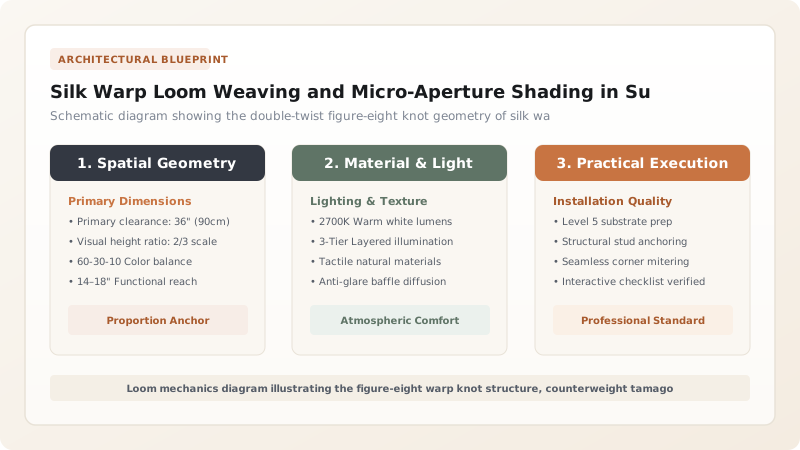
The Loom as an Instrument: Anatomy of the Sudare-Bata
While textiles are typically woven on horizontal floor looms with foot treadles and shuttles, a Japanese blind is woven on a specialized vertical loom known as the sudare-bata. Constructed from stout, vibration-damping timber such as Japanese zelkova (Keyaki) or Hinoki cypress, the loom stands upright like a towering harp. It consists of two vertical posts supporting an overhead roller beam, an adjustable lower breast beam, and a weighted warp array that hangs freely in space.
Unlike fabric weaving, where the weft yarn is wound onto a bobbin and shot through the shed, the weft of a Sudare is rigid: it consists of individual, non-flexible bamboo higo splints over a meter in length. Consequently, the loom does not utilize heddles or harnesses. The shed is formed and manipulated entirely by the weaver's hands, who physically crosses paired counterweighted bobbins to create an interlocking figure-eight twist knot around each rigid bamboo slat.
The Tamago Bobbin System and Gravitational Tensioning
The technical brilliance of the sudare-bata lies in its tensioning system. In conventional looms, warp tension is maintained by ratchets and beam friction, which cannot accommodate the microscopic thickness variations of natural split bamboo. In the sudare-bata, tension is completely gravitational and dynamic, provided by hundreds of suspended wooden bobbins known as tamago (literally 'eggs').
Turned from dense, close-grained hardwoods such as wild cherry (Yamazakura) or Japanese evergreen oak (Shirakashi), each tamago is an ovoid spindle weighing exactly 100 to 140 grams. Each pair of warp threads terminates in two opposing tamago bobbins that hang down the front and back faces of the breast beam. As the weaver crosses the bobbins, gravity pulls downward with unyielding, self-equalizing tension. If a particular bamboo splint is 0.05 mm thicker on its right side, the corresponding tamago bobbins simply drop infinitesimally lower, maintaining dead-uniform tension across the entire width of the blind and eliminating ripples, bows, or puckers.
The Double-Twist Knot: Engineering Flexibility and Stability
The mechanical bond holding the bamboo slats together is the double-twist knot (ni-jū-yori). When the weaver feeds a higo splint into position, the front and back warp threads are twisted around each other by 360 degrees before crossing over the next slat. This creates a true three-dimensional figure-eight wrap that completely locks each bamboo splint in its own dedicated silk cradle.
This knotting geometry delivers extraordinary structural advantages. Because each bamboo splint is isolated from its neighbors by the thickness of the silk twist, the slats never grind against one another with destructive wood-on-wood friction. When the blind is rolled upward for storage, the silk knots act as miniature organic hinges, allowing the rigid bamboo web to roll into an impossibly compact, silent cylinder. Furthermore, the thickness of the silk knot functions as an automatic mechanical spacer, guaranteeing that the air-gap between adjacent bamboo slats remains consistent across the entire square footage of the screen.
Thermodynamics of the Micro-Aperture Screen
The resulting micro-aperture screen is an unpowered thermodynamic engine. In traditional Japanese post-and-lintel architecture, entire exterior walls consist of sliding wooden lattices that are removed completely during summer, exposing the living rooms directly to the garden. Hanging a Sudare blind in this open structural bay creates an environmental boundary layer that manages solar radiation, air movement, and light quality simultaneously.
Direct solar radiation consists of high-energy shortwave infrared rays. When these rays strike the rounded upper surface of the cylindrical bamboo higo, the opaque wood absorbs and re-radiates the heat back into the exterior environment. Meanwhile, diffuse visible light reflects downward through the 0.4 mm horizontal micro-slits, illuminating the interior tatami mats with a gentle, glare-free golden twilight. Simultaneously, the micro-slits permit the passage of cooling breezes (suzumi-kaze). As hot air rises along the sun-warmed exterior of the blind, it generates a low-pressure draft that draws ambient cool air from shaded interior courtyards (tsubo-niwa) through the blind, demonstrating the pinnacle of passive bioclimatic design.
Sudare Weaving Architecture: Double-Twist Silk Warp vs Single-Twist Wire vs Glued Ribbon Backing
Use this reference table to calculate exact physical dimensions, ratios, and specifications before purchasing:
| Weaving Construction | Traditional Double-Twist Silk (Sudare-Bata) | Commercial Wire-Stitched Blind | Glued Fabric Ribbon Tape Backing |
|---|---|---|---|
| Warp Binding Mechanism | Paired silk yarns cross over and under, forming a complete interlocking figure-eight twist knot around each slat | Continuous thin brass or steel wire crimped in a simple single loop | Adhesive resin bonding bamboo slats to wide cotton or polyester ribbons |
| Flexibility & Rollability | Flawless; rolls smoothly and silently into tight cylinders without binding or slat displacement | Stiff; wire work-hardens and kinks, resisting smooth rolling over time | Poor; glue lines stiffen in cold weather and peel apart under summer heat |
| Aperture Precision & Uniformity | Absolute; knot thickness acts as a natural mechanical spacer maintaining 0.4 mm micro-slits | Irregular; wire slips easily along smooth bamboo culms | Obstructed; wide cloth ribbons block 25% of ventilation and light area |
| Tensile Fatigue Resistance | Extreme (40+ years); multi-strand silk absorbs cyclic wind flexing without fatigue fracture | Poor (3–6 years); metal fatigue snaps wire loops under frequent wind flutter | Moderate (5–8 years); adhesive degrades and delaminates under UV exposure |
| Aesthetic & Sensory Quality | Subtle, ethereal floating yarns; organic whispering rustle when caressed by wind | Industrial and utilitarian; visible wire stitches with metallic glare | Bulky and modern; disrupts traditional architectural light filtering |
Practical Constraints
Every successful decoration project must account for physical and environmental constraints:
Accumulated Weight of Loom Bobbins on Wide Architectural Screens
A 2-meter-wide blind requires over 60 pairs of bobbins, generating more than 30 kg of dead hanging weight that can bow the loom beam. Mitigation: Construct the loom breast beam from stout quarter-sawn Japanese zelkova (keyaki) and reinforce with an arched steel stiffener bar.
Warp Yarn Shrinkage in Changing Ambient Humidity
Silk and linen yarns shorten when moving from dry winter workshops to humid summer verandas, altering blind length. Mitigation: Pre-shrink and wash all warp yarns in boiling water prior to spooling, and hang the completed blind under tension for 7 days before final trimming.
Execution Blueprint & Craftsmanship Sequence
Execute this professional sequence to achieve flawless results without backtracking:
Loom Erection and Leveling
Assemble the heavy timber sudare-bata loom frame in the workshop. Level the horizontal overhead roller beam and lower breast beam using precision spirit levels to ensure the blind hangs perfectly square throughout the weaving process.
Bobbin Spooling and Counterweight Balancing
Wind 10 meters of 3-ply twisted raw silk warp yarn onto pairs of turned hardwood bobbins (tamago). Weigh every bobbin pair on an analytical scale to confirm uniform 120-gram mass, ensuring equal downward gravitational tension across the entire blind width.
Warp Thread Spacing and Reed Alignment
Hang the paired bobbins over the loom's top beam, dropping the two thread legs down the front and back of the breast beam. Space the pairs across the width at exact 30 mm intervals, guiding them through a hand-notched bamboo spacer comb (kushi).
Initial Slat Insertion and Baseline Calibration
Insert a heavier 3 mm thick square-profile bamboo baseline slat (katsura-take) into the open warp shed. Check its horizontal plane with a level, and lock it in place by crossing the paired bobbins in an initial double figure-eight locking knot.
Rhythmic Higo Insertion and Twist-Knotting
Slide an individual 1.1 mm cylindrical higo splint into the shed resting atop the baseline slat. Reaching from right to left, cross the front bobbin to the back and the back bobbin to the front, executing a complete 360-degree twist knot around the bamboo shaft.
Batten Beating and Micro-Gap Regulation
Insert a polished cherry-wood sword batten (hera) into the shed above the newly tied higo. Pull the batten downward with light, uniform pressure, seating the slat snugly against the twist knot to establish the calibrated 0.4 mm micro-aperture gap.
Continuous Warp Advancing and Tension Rolling
As the woven web grows downward, roll the completed section onto the lower storage drum, keeping constant tension on the bobbins. Repeat the insertion cycle for 1,200 to 1,500 slats until reaching specified architectural height.
Terminal Locking Knotting and Warp Trimming
Insert a heavy bottom rail slat (shita-hiki). Execute quadruple locking half-hitch knots with each warp pair, saturate the knots with a drop of natural rice-starch glue (shofu-nori), trim excess thread to a 50 mm fringe, and unroll the finished blind.
Common Mistakes & Countermeasures
Avoid these costly errors that compromise aesthetics, ergonomics, and budget:
Using synthetic nylon or polyester monofilament for the warp threads
Unequal counterweighting of the hanging wooden tamago bobbins
Beating the bamboo higo splints together with excessive force during weaving
Project Execution Checklist
Track your physical progress. Checkboxes persist automatically on this device:
Frequently Asked Questions
Why are the loom counterweights called 'tamago' (eggs)?
The turned hardwood or lead-weighted bobbins are carved into an elegant, smooth ovoid shape resembling an egg (tamago). This smooth, rounded contour ensures that as dozens of bobbin pairs are crossed and swung rapidly back and forth during weaving, they glide silently past each other without snagging, tangling, or bruising adjacent silk threads.
How does the micro-aperture gap control indoor temperature?
The 0.3 mm to 0.5 mm horizontal gaps block direct sunlight while allowing the convective boundary layer of air on the exterior of the blind to flow upward and escape. As solar heat is absorbed by the outer surface of the bamboo, it heats the air immediately adjacent to the blind, causing it to rise rapidly. This convective updraft pulls cooler air from shaded ground or courtyard gardens through the micro-apertures, providing continuous passive cooling.
Can the silk warp threads rot if the Sudare is exposed to rain?
Traditional Kyo-Sudare intended for exterior verandas (soto-sudare) are woven with unbleached raw silk that retains its natural protective sericin protein coating, or with unbleached native ramie (choma/asa). Once woven, the entire blind is typically immersed in fermented persimmon tannin (kakishibu), which binds with the protein fibers of the silk, rendering them completely hydrophobic, rot-proof, and immune to mildew.
How fast does a master artisan weave a Sudare blind?
Because every single bamboo slat must be manually fed into the shed, aligned, and hand-knotted across 40 to 60 individual warp pairs, the process is intensely deliberate. An experienced master weaver typically weaves between 200 and 300 slats per hour, meaning a single large architectural blind represents several full days of continuous, highly concentrated manual labor.