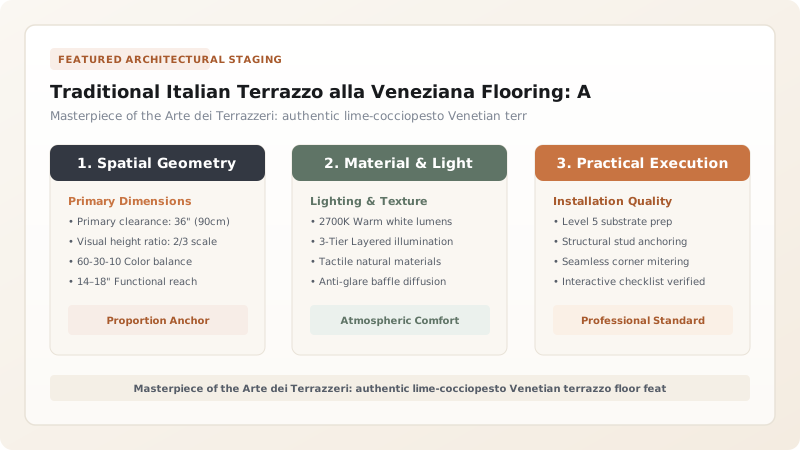
Traditional Italian Terrazzo alla Veneziana is the historic seamless flooring craft of Venice, engineered between the 15th and 18th centuries by the guild of Terrazzeri. Designed to accommodate the flexible timber floor joists and tidal settling of Venetian lagoon palazzi, authentic terrazzo utilizes a flexible hydraulic lime and cocciopesto binder matrix embedded with high-density graded marble aggregates (Carrara, Verona, and Istrian stone), compacted with heavy iron rollers (macinello) and polished with boiled linseed oil and beeswax.
At a Glance: Key Takeaways
- Geographic Origin: Venice and the Venetian Lagoon Palazzi (Veneto, Italy)
- Historical Guild: Arte dei Terrazzeri (Chartered in Venice in 1582)
- Binder System: Aged slaked lime putty (grassello) + volcanic pozzolana + cocciopesto
- Aggregate Suite: Graded fragments of Bianco Carrara, Rosso Verona, and Giallo Mori marble
- Compaction Tool: Hand-drawn grooved cast-iron cylinder roller (Macinello)
In-Depth Guides in this Directory
Explore specialized subtopic blueprints, technical dimensions, and execution checklists:
Slaked Lime, Pozzolana & Cocciopesto Binder Matrix in Venetian Terrazzo
Master the mortar chemistry of authentic Venetian terrazzo: aged slaked lime putty (grassello), crushed terracotta cocciopesto, and volcanic pozzolana.
Carrara & Verona Marble Aggregate Density Grading in Terrazzo Veneziano
Explore the stone aggregate science of Venetian terrazzo: Carrara and Verona marble grading, hand-seeding density (semina), and chromatic harmony.
Hand-Roller Macinello Tamping & Linseed Oil Burnishing in Venetian Terrazzo
Master the finishing craft of Venetian terrazzo: heavy macinello iron roller compaction, natural waterstone levigatura grinding, and linseed oil beeswax burnishing.
Venetian Lagoon Dynamics and the Genesis of Flexible Pavements
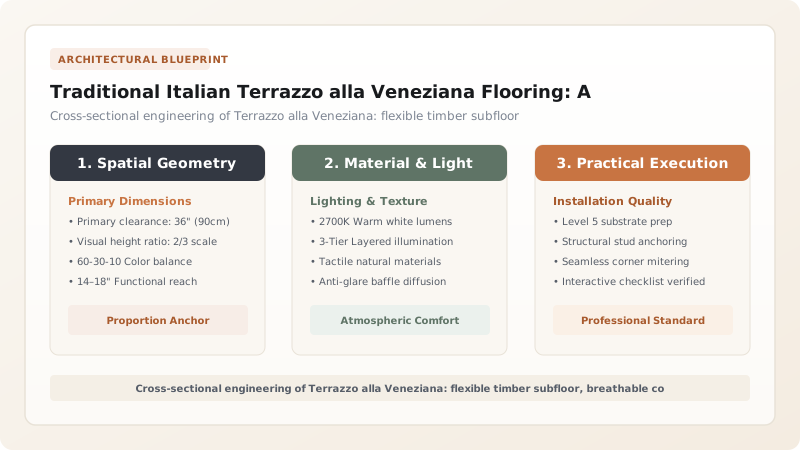
In the architectural history of the Renaissance, the city of Venice presented builders with an unprecedented engineering challenge. Founded amidst the tidal mudflats, salt marshes, and shifting silt of the Venetian lagoon, the Queen of the Adriatic was constructed entirely upon millions of submerged wooden pilings driven deep into the subsoil. Upon these trembling foundations rose monumental palazzi three to five stories tall. Because the underlying soil constantly shifted with tidal flows and structural loads settled unpredictably, the interior floors were supported not on rigid stone vaults, but on flexible, long-span timber joists cut from larch and spruce.
In such an environment, conventional monumental stone paving—such as thick granite slabs or rigid marble tiles—was unusable. When the long wooden joists deflected under human foot traffic or the palazzo tilted slightly upon its wooden pilings, rigid stone slabs cracked, sheared their mortar beds, and collapsed. To solve this structural crisis, Venetian craftsmen developed Terrazzo alla Veneziana (Venetian Terrazzo). Chartered formally as an autonomous trade guild in 1582 under the name I Terrazzeri, these master artisans engineered a seamless, monolithic composite floor that balanced the breathtaking visual splendor of classical marble with the dynamic, micro-flexible elasticity required to survive centuries of lagoon settlement.
The Chemistry of the Flexible Matrix: Slaked Lime and Cocciopesto
The core technological secret of authentic Venetian terrazzo lies in its mineral matrix. While modern commercial terrazzo relies on brittle Portland cement or synthetic petrochemical epoxy resins, authentic historical terrazzo is bound strictly with aged slaked lime putty (grassello di calce). Harvested from high-purity limestone burned in wood kilns and aged in subterranean water vats for a minimum of two to five years, this non-hydraulic lime exhibits extraordinary microscopic colloidal plasticity.
To grant the lime the ability to set in thick layers without shrinking or cracking, the Terrazzeri incorporated cocciopesto (crushed terracotta brick and roof tile fragments) and volcanic pozzolana ash. The active amorphous aluminosilicates in the fired terracotta react chemically with the calcium hydroxide in the lime, triggering a pozzolanic reaction that forms insoluble calcium silicate hydrates. This gives the binder a slow, hydraulic initial set while preserving a high degree of long-term mechanical elasticity. Crucially, if microscopic micro-cracks form as the wooden floor deflects, ambient humidity dissolves free uncarbonated calcium ions within the matrix, which migrate into the crack and re-crystallize as calcite upon exposure to atmospheric carbon dioxide—a miraculous phenomenon known to materials scientists as autogenous self-healing.
The Art of La Semina: Seeding the Marble Aggregate Palette
The incomparable visual richness of Terrazzo alla Veneziana is achieved through the disciplined choreography of la semina (the seeding). Onto the freshly troweled, wet lime-cocciopesto setting bed, the craftsman does not dump mixed concrete; rather, the master scatterer casts dry, washed marble fragments across the floor by hand with rhythmic, sweeping gestures developed through decades of practice.
The stones are sourced from the noble quarries of Northern Italy and the Adriatic littoral. The primary palette consists of pure white Bianco Carrara from the Apuan Alps, deep coral-red Rosso Verona from the hills of Sant'Ambrogio, warm honey-gold Giallo Mori, forest-green Verde Alpi, and dense, oyster-grey Pietra d'Istria shipped across the Adriatic on Venetian galleys. The craftsman grades these stones through a series of calibrated copper sieves into distinct dimensional fractions (grain sizes 1 to 5). By casting smaller chips into the interstices between larger marble chunks, the artisan achieves an aggregate packing density exceeding 75 to 80 percent stone coverage, creating the visual impression of an unbroken, undulating river of natural colored gems.
Mechanical Consolidation: The Macinello Roller and Oil Burnishing
The final physical and aesthetic transformation of the terrazzo floor relies on two historic finishing operations: compaction with the macinello and saturation with boiled linseed oil. Once the marble chips have been seeded across the wet bed, the crew rolls the entire expanse with the macinello—a massive, grooved cast-iron cylinder weighing between 60 and 90 kilograms, mounted on long wooden pushing shafts.
As the iron roller passes back and forth across the floor in overlapping transverse passes, its crushing weight drives the angular marble chips deep into the lime matrix, forcing out trapped air bubbles and bringing a thin slurry of lime and marble flour to the surface. After months of slow atmospheric carbonation, the floor is ground flat using progressive natural waterstones (pietra levigante). Once smoothed to a silky 800-grit hone, the porous lime matrix is saturated with hot boiled linseed oil (olio di lino cotto) blended with spirits of turpentine and finished with raw mountain beeswax (cera d'api). The oil polymerizes deep within the microscopic pores of the lime, repelling moisture and bestowing that deep, warm, translucent amber glow that has illuminated the ballrooms of the Doge's Palace and the grand palazzi of the Grand Canal for over four hundred years.
Venetian Terrazzo Styles, Aggregate Density & Architectural Contexts
Use this reference table to calculate exact physical dimensions, ratios, and specifications before purchasing:
| Terrazzo Typology | Italian Name | Aggregate Grain Size | Stone Density Ratio | Palatial / Architectural Context |
|---|---|---|---|---|
| Fine Scattered Terrazzo | Semenzato | Fine marble chips (Grain 1–2: 2–5 mm) | 70% – 75% surface stone coverage | Residential reception rooms, private salons, and library suites |
| Coarse Compacted Floor | Battuto alla Veneziana | Coarse marble chunks (Grain 3–5: 8–20 mm) | 80% – 85% surface stone coverage | Grand piano nobile ballrooms, public halls, and galleries |
| Pastellone Earthenware | Pastellone di Cocciopesto | Micro-pulverized terracotta & brick dust | Smooth continuous tinted lime plane | Historic Venetian kitchens, service halls, and ground-floor galleries |
| Mosaic Marble Terrazzo | Terrazzo con Mosaico | Sawn marble tesserae borders and medallions | 90% dense geometric mosaic inlay | Formal ceremonial entrance portals and central palazzo heraldic axes |
| Istrian Stone Slab Inlay | Terrazzo a Spacco | Large irregular cleaved marble flagstones | Interspersed random marble slab islands | Loggias, courtyard perimeter arcades, and grand porticos |
Practical Constraints
Every successful decoration project must account for physical and environmental constraints:
Slow Curing Rate of Pure Lime Matrices
A traditional lime-cocciopesto terrazzo floor requires 60 to 90 days of slow carbonation before wet grinding and mechanical polishing can safely begin. Mitigation: Incorporate volcanic pozzolana or fine brick dust (cocciopesto) to create an initial hydraulic set while maintaining strict climate control on site.
Weight Load on Historical Wooden Joists
A traditional 35 mm thick terrazzo floor weighs approximately 80 to 95 kg per square meter, threatening to overstress historic timber floor joists. Mitigation: Engineer a lightweight cocciopesto sub-base incorporating expanded natural volcanic clay granules to reduce structural deadload by 30%.
Execution Blueprint & Craftsmanship Sequence
Execute this professional sequence to achieve flawless results without backtracking:
Substrate Preparation and Timber Decoupling
Inspect underlying wooden floor joists for deflection. Fasten clean tongue-and-groove pine subfloor boards, covering them with a breathable oil-soaked paper decoupling membrane and galvanized wire mesh.
Mixing and Laying the Cocciopesto Base (Il Sottofondo)
Blend aged slaked lime putty with coarse crushed terracotta roof tiles (cocciopesto, 2–5 mm) and river sand. Trowel a 20 mm leveling bed (sottofondo) and level with screed rails.
Application of the Fine Setting Bed (La Coperta)
Apply a 10 mm bed composed of pure slaked lime putty, fine pozzolanic volcanic ash, and fine marble dust. Smooth with a wooden float (frattazzo) while maintaining a wet, receptive plane.
Hand-Seeding the Marble Aggregates (La Semina)
Cast washed, dry marble fragments (Bianco Carrara, Rosso Verona, and Giallo Mori) by hand across the wet lime bed, packing the stones densely to achieve over 80% surface coverage.
Mechanical Compaction with the Macinello Roller
Draw a heavy grooved cast-iron roller (macinello) across the floor in overlapping crosswise passes. The immense pressure forces the marble chips deep into the lime mortar, expelling trapped air.
Tamping and Surface Leveling (La Battitura)
Beat high-standing marble pieces level with flat wooden beaters (battelli) and steel trowels. Dust with a light veil of dry lime-marble flour to absorb excess surface moisture.
Curing and Wet-Grinding (La Levigatura)
Allow the floor to carbonate for 60 days. Wet the floor with water and grind sequentially using natural abrasive stones (sandstone, carborundum, and hone stones) from 60-grit to 800-grit.
Linseed Oil Saturation and Beeswax Burnishing
Wash clean and allow to dry. Saturate the porous lime matrix with hot boiled linseed oil diluted with spirits of turpentine. Once cured, apply raw beeswax emulsion and buff with woolen cloths to a mirror sheen.
Common Mistakes & Countermeasures
Avoid these costly errors that compromise aesthetics, ergonomics, and budget:
Using modern Portland cement instead of aged slaked lime in historic timber buildings
Rolling the wet aggregate bed with a lightweight lawn roller
Sealing authentic lime terrazzo with modern topical polyurethane or epoxy coatings
Project Execution Checklist
Track your physical progress. Checkboxes persist automatically on this device:
Frequently Asked Questions
Why did Venice develop terrazzo rather than laying solid marble slabs?
Venice is built entirely upon soft mud and silt islands supported by millions of submerged wooden pilings. The palazzi constantly shift and settle with tidal movements. Solid marble slabs are rigid, heavy, and brittle; when floor joists deflect, large slabs crack and break. Terrazzo alla Veneziana, utilizing flexible slaked lime and crushed terracotta (cocciopesto), created a continuous, monolithic floor that could flex and absorb the structural movement of the building without cracking.
What is the difference between authentic Venetian terrazzo and modern cement terrazzo?
Modern terrazzo uses grey or white Portland cement or synthetic epoxy resin as the binder. It hardens rapidly in 24 hours but is completely rigid, vapor-impermeable, and cold. Authentic Venetian terrazzo utilizes aged slaked lime putty (calcium hydroxide) mixed with cocciopesto. It cures slowly through atmospheric carbonation over months, retains micro-flexibility, breathes vapor naturally, and exhibits a warm, translucent, organic depth that cement cannot replicate.
What is 'cocciopesto' and why is it added to the lime binder?
Cocciopesto is finely crushed and powdered ancient terracotta roof tiles, bricks, and ceramic pottery. When mixed with non-hydraulic slaked lime, the amorphous silica and alumina in the fired clay react chemically with calcium hydroxide to form calcium silicate hydrates—a pozzolanic reaction. This grants the lime mortar hydraulic setting properties, allowing it to cure through moisture without air exposure while bestowing a warm pinkish-buff undertone.
How do you clean and maintain an authentic lime-based Venetian terrazzo floor?
Authentic lime terrazzo should be cleaned exclusively with warm water and neutral, vegetable-oil-based soaps (such as pure Marseille soap or linseed soap). Acidic cleaners (vinegar, bleach, ammonia, or commercial tile descalers) must never be used, as acid dissolves the calcium carbonate of both the marble chips and the lime binder. An annual buffing with pure beeswax restores its protective luster and water repellency.