Traditional Irish Liscannor flagstone hearth and flooring represents the quintessential vernacular stone surface of County Clare and the western Atlantic seaboard of Ireland. Quarried along the dramatic coastal cliffs between Liscannor, Doolin, and the Cliffs of Moher, this fine-grained, fissile Carboniferous sandstone is globally renowned for its distinctive trace-fossil surface texture—meandering, raised sinuous feeding trails created over 320 million years ago by prehistoric marine worms (*Psammichnites* / *Planolites*). Prized for its exceptional density, low porosity, natural slip resistance, and immense thermal mass, Liscannor stone has anchored traditional Irish cottage hearths, grand open inglenooks, kitchen floors, and church pavements for centuries, bedded in breathable lime mortars and enriched with beeswax and linseed oil finishes.
At a Glance: Key Takeaways
- Geographic Origin: Liscannor, Doolin & Cliffs of Moher, County Clare, West of Ireland
- Geological Era: Upper Carboniferous (Namurian epoch, ~320 million years old)
- Defining Characteristic: Fossilized marine worm track textures (ichnofossil feeding trails)
- Thermal Performance: High thermal mass, ideal for radiant hearths and underfloor heating
- Installation Standard: Breathable natural hydraulic lime (NHL) bedding without impermeable plastic DPMs
In-Depth Guides in this Directory
Explore specialized subtopic blueprints, technical dimensions, and execution checklists:
Fossilized Worm-Track-Textured Sandstone Bedding: Geology & Splitting
Geological guide to Liscannor fossilized worm-track sandstone. Discover Carboniferous ichnofossils, hand-cleavage splitting techniques, and quarrying craft.
Broad Hearth Inglenook Fireback and Lintel Setting in Irish Cottages
Comprehensive engineering guide to setting Liscannor flagstone in traditional Irish cottage inglenooks, open hearths, upright firebacks, and massive lintels.
Breathable Lime Mortar Bedding and Beeswax Maintenance for Liscannor Flagstone
Master guide to breathable lime mortar bedding and traditional beeswax and linseed oil maintenance for Irish Liscannor flagstone floors.
Geological Heritage: The Namurian Delta & Clare Flagstones
Along the storm-battered Atlantic coastline of western Ireland, the dramatic cliffs stretching from the fishing village of Liscannor past the Cliffs of Moher and onward to Doolin are formed from one of the most remarkable sedimentary rock sequences in Europe. Geologically classified as the Clare Shale and Central Clare Group of the Upper Carboniferous period (Namurian stage, approximately 318 to 324 million years old), these strata were laid down in an expansive tropical marine delta basin that once covered much of western Ireland. Giant river systems carried millions of tons of fine quartz sand, silt, and organic mud from a southern landmass, depositing them in rhythmic submarine delta fans and coastal mudflats.
As these sedimentary layers accumulated under immense overburden pressure, they underwent diagenetic lithification, transforming into a dense, fine-grained, highly fissile sandstone and siltstone. The stone splits naturally along parallel bedding planes into broad, perfectly flat slabs ranging from 25 to over 80 millimeters in thickness. Known locally as Liscannor slate or Liscannor flagstone (cloch Leacht Uí Chonchubhair), this mineral treasure exhibits extraordinary physical properties: an exceptionally high compressive strength, near-zero porosity (less than 1.5% water absorption), high chemical resistance, and an iconic natural palette that shifts from charcoal blue-grey to warm peat-olive when oiled.
The Living Surface: The Prehistoric Marine Worm Track Texture
What elevates Liscannor flagstone from ordinary sedimentary rock to a globally renowned architectural artifact is its extraordinary surface texture. While walking across a polished marble or slate floor presents a sterile, mechanical flatness, walking across an authentic Liscannor floor is an encounter with deep geological time. The upper surfaces of the flags are covered with raised, sinuous, meandering ribbons and looping relief tracks known scientifically as trace fossils or ichnofossils.
These patterns were not carved by human tools; they represent the horizontal feeding trails and locomotion burrows of soft-bodied marine organisms—primarily prehistoric annelid worms, polychaetes, or primitive gastropods belonging to the ichnogenera Psammichnites, Planolites, or Dictyodora. Over 320 million years ago, as these creatures crawled through the oxygen-rich surface mud of the ancient sea floor, their bodies left gentle furrows. Subsequent storm surges deposited fine quartz silt into these furrows, cementing them with iron and silica before the mud could collapse. When quarrymen split the stone today along its natural cleavage planes, these fossilized feeding trails emerge as proud, tactile ridges. In an architectural setting, this natural texture provides an incomparable benefit: an organic, lifetime slip-resistant surface that offers surefooted grip even when wet from coastal rains.
The Hearth of the Home: Inglenooks & The Vernacular Cottage
In the traditional Irish vernacular cottage (teach ceann tuí), the hearth was not merely an architectural fixture; it was the sacred physical, spiritual, and social epicenter of the household. Rooted in ancient Gaelic customs of hospitality, the turf fire burned continuously day and night, rarely allowed to go out (a ritual known as smooring the fire with peat ashes each evening). To construct a hearth capable of withstanding centuries of intense heat, falling peat embers, and heavy cast-iron cooking cauldrons, Irish builders turned to Liscannor stone.
The centerpiece of the hearth was the massive, single-slab Liscannor hearthstone (cloch na teallaigh), which projected into the center of the kitchen floor. At the back of the open fire, a massive upright Liscannor flag was bedded against the stone chimney breast, functioning as a heat-resistant fireback that absorbed heat from the blazing turf and radiated it into the room. Above, spanning the broad inglenook opening, masons hoisted monumental Liscannor flagstone lintels or supported them on heavy oak timber bressummers. The dark, peat-smoke-seasoned stone reflected the golden flicker of the turf fire, while the thermal mass of the floor absorbed heat during the day, gently releasing it back into the cottage throughout the damp Atlantic night.
Breathable Floor Engineering & Traditional Maintenance
Successfully installing or restoring an authentic Liscannor flagstone floor requires a deep understanding of traditional building physics. Historic Irish stone cottages were constructed without modern damp-proof courses or foundations. The thick rubble walls and natural earth floors operated on a principle of continuous vapor permeability: moisture from the water table beneath the house was permitted to evaporate harmlessly through the porous lime mortar joints and floor surface, carried away by the powerful natural convective draft of the open chimney flue.
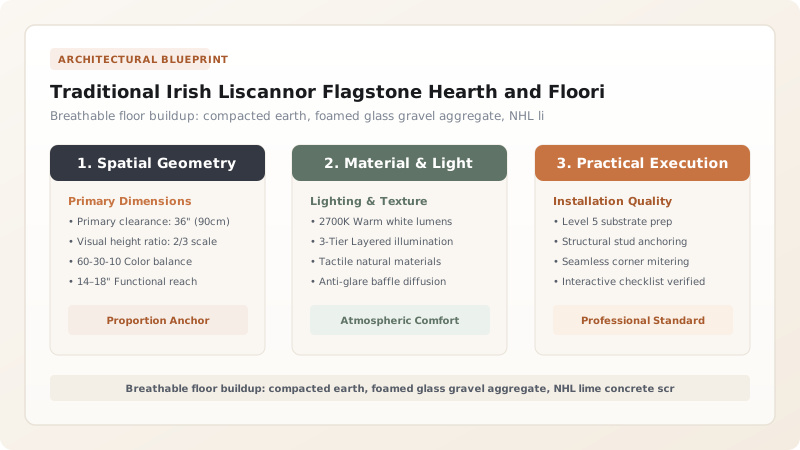
The catastrophic error of many modern renovations is laying Liscannor flags over rigid concrete slabs and impermeable polythene plastic sheets. By blocking vapor evaporation, the plastic forces ground moisture into the adjacent rubble walls, causing severe rising damp. Contemporary conservation architects design breathable floor systems using recycled foamed-glass gravel aggregate (providing thermal insulation and capillary break) topped with a breathable lime concrete screed and Natural Hydraulic Lime (NHL 3.5) bedding. Once laid and grouted with breathable lime, the stone is seasoned using traditional finishes: multiple coats of pure boiled linseed oil cut with gum turpentine, followed by hand-buffed beeswax. This treatment deepens the stone to a rich, lustrous ebony-charcoal patina that repels spills while allowing the floor to breathe freely for centuries.
Natural Stone Flooring Typologies in Traditional Irish Architecture
Use this reference table to calculate exact physical dimensions, ratios, and specifications before purchasing:
| Stone Variety | Geological Type | Quarry Provenance | Surface Texture | Primary Vernacular Usage |
|---|---|---|---|---|
| Liscannor Flagstone | Carboniferous sandstone/siltstone | County Clare (Moher basin) | Sinuous fossil worm tracks (raised relief) | Open cottage hearths, kitchen floors, inglenooks, farm pathways |
| Kilkenny Blue Limestone | Crinoidal calcitic limestone | County Kilkenny / Carlow | Honed smooth, flamed, or bush-hammered | Formal Georgian townhouses, civic entrance halls, church sanctuaries |
| Connemara Marble | Precambrian serpentine marble | County Galway (Connemara) | Swirling jade greens, white calcite veins | Ornamental fireplace surrounds, altar steps, luxury decorative inserts |
| Valentia Slate | Devonian purple-grey slate | Valentia Island, County Kerry | Smooth, fissile riven cleavage | Heavy hearth slabs, snooker tables, window cills, roofing slabs |
| Donegal Quartzite | Precambrian metamorphic quartzite | County Donegal / Mayo | Rough micaceous sparkle, golden ochre | Rustic exterior paving, rugged cottage garden steps, drystone walls |
Practical Constraints
Every successful decoration project must account for physical and environmental constraints:
Variable flagstone thickness (from 25 mm to over 70 mm) in hand-split natural cleft stone
Requires skilled masons to continually adjust bedding mortar depth to maintain a true, level floor surface. Mitigation: Pre-sort flagstones into calibrated thickness categories and lay thicker flags first to set benchmark floor levels.
High moisture levels and maritime driving rains along the western Atlantic seaboard
Cottage floors can become damp if subterranean moisture vapor cannot escape freely into the indoor air. Mitigation: Ensure continuous, unblocked natural draft ventilation through the inglenook chimney flue to draw moisture out.
Execution Blueprint & Craftsmanship Sequence
Execute this professional sequence to achieve flawless results without backtracking:
Subfloor Excavation & Breathable Base Preparation
Excavate the cottage subfloor to 300 mm depth, lay a geotextile membrane, and compact a 150 mm layer of breathable foamed glass gravel aggregate.
Breathable Lime Concrete Screed Pouring
Pour an 80 mm breathable lime concrete screed formulated with Natural Hydraulic Lime (NHL 5) and graded limestone aggregate, allowing it to cure for 21 days.
Flagstone Sorting & Dry-Laying Layout
Dry-lay Liscannor flags across the room, arranging the distinctive fossil worm track patterns into a harmonious, staggered random-width coursed pattern.
Full Mortar Bed Preparation
Mix an NHL 3.5 bedding mortar (1 part lime to 2.5 parts washed sharp river sand) to a stiff, workable consistency, spreading a 30–50 mm bed for each flag.
Flagstone Setting & Mallet Compaction
Dampen the underside of the flagstone, lower it onto the mortar bed, and beat it level with a heavy rubber mallet, checking flush alignment with spirit levels.
Inglenook Hearth & Fireback Installation
Set massive, monolithic Liscannor hearthstones and upright fireback flags against the chimney breast, ensuring heat-resistant lime mortar bedding.
Breathable Lime Joint Pointing
Pack joints tightly with a semi-dry lime mortar mix (NHL 2 with fine sand), tooling joints flush with the natural cleft edges of the stone.
Linseed Oil & Beeswax Nourishment
After 28 days of lime curing, apply two coats of pure boiled linseed oil diluted with genuine gum turpentine, finishing with buffed beeswax polish.
Common Mistakes & Countermeasures
Avoid these costly errors that compromise aesthetics, ergonomics, and budget:
Laying historic Liscannor flagstones over a modern plastic damp-proof membrane (polythene DPM)
Pointing flagstone joints with rigid Portland cement mortar
Applying synthetic acrylic or polyurethane clear topical sealers over Liscannor stone
Project Execution Checklist
Track your physical progress. Checkboxes persist automatically on this device:
Frequently Asked Questions
What created the distinctive worm-track patterns on Liscannor flagstones?
The undulating, raised tracks on Liscannor flagstone are trace fossils (ichnofossils) from the Upper Carboniferous period, approximately 320 million years ago. Known scientifically as *Psammichnites* or *Planolites*, they were formed by soft-bodied marine organisms—prehistoric marine worms or mollusks—burrowing through shallow coastal delta mudflats in search of food. Over millions of years, these trails were filled with fine sand and preserved as permanent stone relief.
Why shouldn't you install a modern plastic damp-proof membrane (DPM) under a Liscannor stone floor in an old cottage?
Old Irish stone cottages were built with thick, un-mortared or lime-mortared rubble walls that sit directly on earth without modern damp-proof courses. If you install an impermeable plastic membrane under the floor, rising ground moisture cannot evaporate through the floor joints; instead, it is trapped beneath the plastic and pushed sideways directly into the base of the cottage walls, causing severe rising damp, peeling lime wash, and structural wall rot.
How do Liscannor flagstones perform with modern underfloor heating systems?
Liscannor flagstone is one of the world's best natural stones for underfloor heating. Because it is a dense, high-mass sedimentary stone, it absorbs radiant heat from hydronic underfloor heating pipes and slowly radiates it into the living space for hours after the heating is turned off, providing exceptional thermal comfort and energy efficiency.
How do you clean and maintain authentic Liscannor flagstone floors?
Traditional maintenance is simple and avoids chemical detergents. Sweep regularly to remove grit. Mop periodically with warm water and a splash of mild natural soap (such as linseed oil soap). To maintain the deep, rich peat-smoked luster, buff the floor annually with a thin layer of natural beeswax and boiled linseed oil paste, which enriches the dark blue-grey color and highlights the fossil tracks.