
Sun-dried adobe mudbricks (khesht) and fermented mud-straw plaster (kahgel) constitute the thermal envelope of Persian desert architecture. With walls exceeding 80 cm in thickness, this monolithic earthen assembly creates a 12-hour thermal phase lag that dampens 50°C daytime solar extremes into gentle indoor warmth by midnight, while breathable kahgel reflects summer radiation.
At a Glance: Key Takeaways
- Masonry Unit: Khesht (sun-baked earthen adobe bricks, typically 25 x 25 x 5 cm)
- Exterior Plaster: Kahgel (fermented clay, chopped wheat straw, and river sand)
- Thermal Lag: 10 to 14 hour phase shift damping desert diurnal temperature swings
- Environmental Impact: 100% biodegradable, zero embodied carbon, completely recyclable earth
The Physics of Sun-Dried Khesht Adobe
In the arid plateau of central Iran, kiln-fired bricks were traditionally expensive due to timber fuel scarcity. The primary structural material was khesht—sun-dried mudbricks made from local alluvial clay soil, fine sand, water, and chopped straw, cast in wooden gang molds and baked under the blazing desert sun for 14 days.
While modern concrete has high thermal conductivity (rapidly conducting scorching heat directly into buildings), adobe mudbrick has low thermal conductivity (approx. 0.5 W/mK) paired with colossal volumetric heat capacity. When built into massive walls 80 to 120 cm thick, the earth absorbs daytime solar radiation without letting it reach the interior living spaces.
The 12-Hour Thermal Phase Lag Cycle
The brilliance of adobe thermal engineering lies in the phenomenon of thermal phase lag. In the Iranian desert, diurnal temperature swings are extreme: mid-day temperatures reach 48°C, while desert nights plummet to 18°C.
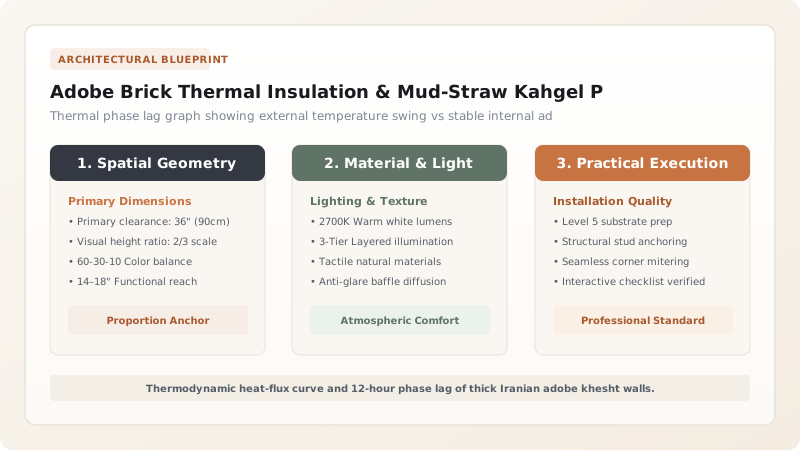
It takes roughly 12 hours for the heat of the midday sun to conduct through a 1-meter-thick khesht wall. Consequently, the solar heat absorbed at 1:00 PM reaches the interior surface of the wall at 1:00 AM, radiating soothing warmth into the bedrooms exactly when the desert night is coldest. By morning, the wall has discharged its heat, ready to absorb the next day's solar load.
The Formulation and Fermentation of Kahgel
To protect raw mudbricks from occasional torrential winter rains and blistering summer winds, Persian builders developed kahgel (from kah, meaning straw, and gel, meaning clay mud). Genuine kahgel is not merely wet mud slapped onto a wall; it is an aged, fermented biochemical composite.
Clay soil is mixed with fine sand, clean water, and shredded wheat or barley straw. The mixture is placed in large pits and left to ferment anaerobically for two to three weeks. Microbial fermentation breaks down straw pectins into organic acids and natural mucilage, while releasing natural resins that cross-link with the clay platelets, creating a durable, water-resistant, crack-free plaster.
Optics, Aroma, and Scented Sim-Gel
Optically, the exposed golden flecks of straw in kahgel scatter harsh sunlight, eliminating blinding specular glare. In grand palaces and aristocratic reception halls, decorators utilized an ultra-refined finish known as sim-gel, made by screening clay through silk sieves and blending it with powdered mica, chamomile flowers, or rosewater.
When rare desert rain showers strike a sim-gel wall, the moist earth releases an enchanting, sweet, earthy scent known across Iran as atr-e kahgel (the perfume of wet earth), celebrated by Persian poets as the very essence of home and life.
Thermal Envelope: Traditional Adobe & Kahgel vs Modern Hollow Concrete Blocks
Use this reference table to calculate exact physical dimensions, ratios, and specifications before purchasing:
| Property | Traditional Persian Adobe Khesht & Kahgel | Modern Concrete Block with Cement Render |
|---|---|---|
| Thermal Phase Lag | 12 to 14 hours (optimal desert diurnal shift) | 2 to 3 hours (transfers midday heat directly inside) |
| Embodied Carbon | Near zero (sun-dried local clay, straw, and water) | Extremely high (energy-intensive cement kilns) |
| Vapour Breathability | 100% Class I vapour open; regulates indoor humidity | Non-breathable; traps condensation, promoting mold |
| Solar Albedo & Glare | Diffuse golden matte surface; zero harsh optical glare | High glare or rapid heat absorption; industrial appearance |
| Recyclability | Completely compostable; returns to native agricultural soil | Non-biodegradable construction rubble filling landfills |
Practical Constraints
Every successful decoration project must account for physical and environmental constraints:
Cyclical maintenance and re-plastering requirements.
Kahgel requires sacrificial touch-ups or a fresh skim coat every 5 to 8 years following heavy desert rainstorms. Mitigation: Add 5% natural lime putty or boiled walnut oil to the exterior mix to dramatically enhance water wash-off resistance.
Vulnerability of raw adobe to seismic shear forces.
Unreinforced adobe walls can suffer catastrophic diagonal shear fractures during earthquakes. Mitigation: Embed continuous wooden tension rings (choob-keshi) and seismic tie-bands every 1.5 meters of wall height.
Execution Blueprint & Craftsmanship Sequence
Execute this professional sequence to achieve flawless results without backtracking:
Alluvial Clay Soil Testing
Select local clay loam soil with roughly 20–30% clay content, screening through wire mesh to eliminate stones and organic roots.
Khesht Adobe Dough Treading
Blend soil with washed river sand, clean water, and chopped straw, treading the wet mass with bare feet or oxen to ensure uniformity.
Gang Mold Casting and Sun Baking
Press wet mud into 25 x 25 x 5 cm wooden molds on a sand bed, lifting molds and baking bricks under full sun for 14 days.
Massive Wall Masonry Coursing
Lay khesht bricks in multi-wythe running bond using clay-loam mortar, building walls 80 to 100 cm thick for structural mass.
Kahgel Pit Fermentation
Mix clay, water, and wheat straw in fermentation pits, allowing the slurry to ferment undisturbed for 15 to 21 days.
Base Scratch Coat Application
Dampen the khesht wall and trowel an initial 25 mm coarse kahgel base coat, pressing the straw fibers deep into brick joints.
Fine Finish Coat Troweling
Apply a secondary 10 mm finish coat of fine-straw kahgel, smoothing with flexible wooden trowels to draw fine clay milk to the surface.
Gentle Shaded Curing
Protect the fresh plaster from sudden dry winds, misting lightly to ensure slow, uniform drying without hairline shrinkage fissures.
Common Mistakes & Countermeasures
Avoid these costly errors that compromise aesthetics, ergonomics, and budget:
Using unfermented fresh mud-straw mixtures for wall plastering.
Applying cement-based stuccos over historic adobe walls.
Project Execution Checklist
Track your physical progress. Checkboxes persist automatically on this device:
Frequently Asked Questions
Does rain dissolve adobe mud houses?
Surprisingly, no. When formulated with fermented straw and high-density clay, kahgel develops a water-shedding mineral crust. Because desert rainfall occurs in brief bursts rather than continuous months of soaking, the plaster sheds surface runoff and dries rapidly before moisture can penetrate.
Why is wheat straw added to the mud?
Straw performs multiple functions: its fibrous tensile strength prevents drying shrinkage cracks, its hollow tubes reduce material weight, and during anaerobic fermentation, the straw breaks down into natural lignins that chemically bind the clay.
How long can a khesht adobe house survive?
With proper roof drainage and periodic plaster maintenance, authentic adobe buildings easily last hundreds of years. The historic citadel of Bam (Arg-e Bam) and the ancient city of Yazd contain adobe structures that have stood for over a millennium.
Can you hang pictures or shelves on a kahgel wall?
Yes. While traditional rooms used recessed wall niches (taqcheh) carved directly into the brickwork, wooden plugs or masonry anchors can easily be set into khesht bricks to support modern shelving and artwork.


