Traditional Indian Thikri glass inlay—also known as Thikri kaam or Aina-kari—is the royal Rajasthani and Mughal architectural art of setting hand-cut convex mirror glass tesserae into sculptural relief gesso plaster. Celebrated in palace Sheesh Mahals (Mirror Palaces) such as Amer Fort, Udaipur City Palace, and Samode Haveli, the technique embeds thousands of diamond-cut, mercury-backed or silvered convex glass facets into an embossed matrix of slaked lime, Shivalik gypsum, and Makrana marble dust. When illuminated by oil lamps or candles, the curved mirror facets refract and scatter light infinitely, transforming interior chambers into celestial star-filled atmospheres.
At a Glance: Key Takeaways
- Artisan Craft: Thikri Kaam / Rajasthani Mirror Glass Inlay
- Iconic Monuments: Amer Fort Sheesh Mahal (Jaipur), Udaipur City Palace, Samode Haveli
- Primary Glass: Hand-blown convex Belgian or Syrian mirror glass (1 mm to 1.5 mm thick)
- Gesso Substrate: Slaked fat lime, Shivalik gypsum plaster, and pulverized marble dust
- Optical Effect: Infinite candlelight multiplication and twinkling specular refraction
In-Depth Guides in this Directory
Explore specialized subtopic blueprints, technical dimensions, and execution checklists:
Hand-Blown Convex Belgian Mirror Glass Diamond Cutting: The Thikri Glass Craft
Technical guide to cutting hand-blown convex Belgian mirror glass for Indian Thikri inlay: diamond scribes, plier trimming, and curved glass manipulation.
Shivalik Gypsum and Marble Dust Embossed Relief Gesso: Substrate Chemistry
Materials science of Indian Thikri relief gesso: Shivalik gypsum, Makrana marble dust, slaked lime binders, organic gums, and 3D stucco modeling.
Convex Faceting, Refraction and Candlelight Multiplication: Sheesh Mahal Optics
Optical physics of traditional Indian Sheesh Mahals: convex mirror faceting, divergent specular refraction, and candlelight multiplication dynamics.
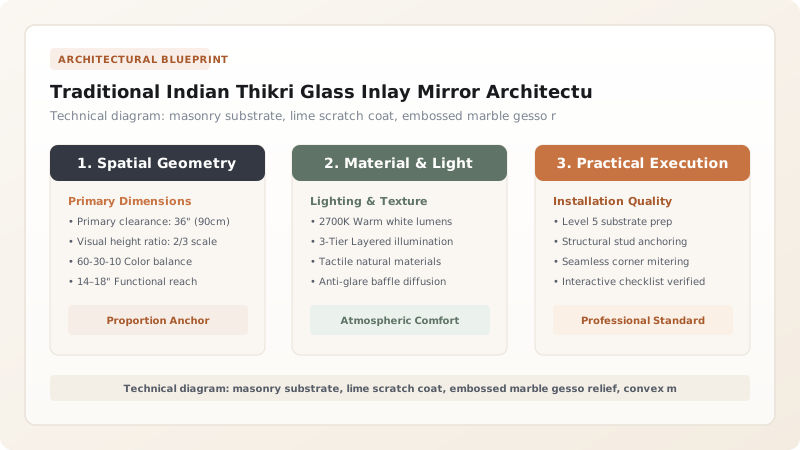
The Luminescent Splendor of the Royal Sheesh Mahal
In the royal forts and desert palaces of Rajasthan—from the Amber Palace in Jaipur to the lake-crowned pavilions of Udaipur and the desert citadel of Mehrangarh—the Sheesh Mahal (Mirror Palace) represents the absolute zenith of South Asian interior architecture. Constructed during the 17th and 18th centuries under the patronage of Rajput Maharajas, these subterranean and vaulted pleasure pavilions were engineered for nocturnal ceremony, royal audiences, and sensory delight.
The hallmark of the Sheesh Mahal is Thikri (or Thikri kaam), the intricate art of embedding hand-cut, faceted mirror glass shards into three-dimensional stucco plaster reliefs. Far from being a mere decorative wall covering, Thikri was an integrated architectural lighting system. In an era before electricity, when palatial state rooms were illuminated exclusively by flickering mustard-oil lamps (diyas) and beeswax candles, the encrusted mirror surfaces transformed dark stone interiors into shimmering, ethereal wonderlands of refracted light.
Cross-Cultural Synthesis: Persian Aina-Kari and Rajput Stucco
The technical genesis of Thikri reflects a brilliant cross-cultural synthesis along the Silk Roads. Following the Mughal emperor Shah Jahan's campaigns and trade diplomatic missions, Persian master craftsmen skilled in Aina-kari (the Iranian discipline of geometrical mirror mosaics) arrived at the imperial courts of Delhi and Agra. Rajput princes, serving as high-ranking imperial generals, invited these artisans to their ancestral capitals in Amber, Bundi, and Bikaner.
In Rajasthan, Persian geometric rigor merged with ancient Indian sthapathya (stone and stucco sculpting traditions). Where Persian Aina-kari typically employed flat, crystalline triangular mirror shards fitted tightly edge-to-edge in planar geometric webs, Rajasthani craftsmen introduced curvilinear, figurative, and naturalistic motifs: blooming lotus rosettes, sprawling Kalpavriksha (trees of life), dancing peacocks, and flowering opium poppies. Crucially, Indian artisans embedded the mirrors within high-relief, sculpted gesso plaster ribs, framing each individual mirror fragment within a raised, rounded stucco jewel casing.
Material Alchemy: Convex Belgian Glass and Organic Gesso Ground
The breathtaking visual warmth of historic Thikri arises from two fundamental material components. The first is the glass itself. Rather than modern flat window glass, historic palaces utilized ultra-thin, hand-blown convex glass globes imported from Belgium, Venice, and Bohemia. Blown into hollow glass spheres and silvered internally with a tin-mercury amalgam or liquid silver solution, these globes were carefully broken into curving convex shards. The spherical curvature gives each shard an optical radius of curvature that captures incident light from any vantage point and scatters it omnidirectionally.
The second essential material is the gesso ground, known natively as gaj-ka-kaam or choona gesso. The plaster was formulated by mixing fat lime (slaked for over a year in water pits) with finely pulverized Makrana marble powder and gypsum extracted from the Shivalik foothills. To give the mortar plasticity and adhesive bond strength, master craftsmen kneaded in natural organic admixtures: gum arabic (babul tree resin), curdled milk, pulses (urad dal), and aged jaggery (molasses) water. This organic-mineral matrix cured slowly into a stone-hard, marble-like relief that anchored the delicate glass pieces without shrinking or cracking.
Preservation Challenges and Modern Revival
Historic Sheesh Mahals face severe conservation vulnerabilities in the 21st century. The mercury-tin or silver reflective films behind antique mirrors are extraordinarily delicate. Exposure to high ambient humidity, sulfurous atmospheric pollution, and bats' guano causes irreversible black oxidation (silver tarnish) and localized delamination of the glass from its reflective backing. Catastrophically, past amateur restorations often applied modern Portland cement or silicone sealants, whose chemical outgassing destroys antique silvering within months.
Contemporary heritage conservation projects—such as the restoration of the Chandra Mahal at Jaipur City Palace—strictly forbid synthetic adhesives. Conservators employ traditional master craftsmen (ustas) who continue to prepare lime-marble gesso using centuries-old recipes. Degraded mirror shards are either stabilized in situ using reversible acrylic resins (Paraloid B-72) or replaced with custom hand-blown, silvered convex glass produced using traditional wood-fired glass furnaces in Firozabad, ensuring that the nocturnal magic of the Sheesh Mahal remains alive for posterity.
Thikri Craft Materials, Substrates & Optical Attributes
Use this reference table to calculate exact physical dimensions, ratios, and specifications before purchasing:
| Craft Component | Material Composition | Thickness / Gauge | Preparation Technique | Optical / Aesthetic Role |
|---|---|---|---|---|
| Convex Mirror Tesserae | Hand-blown glass with silver backing | 1.0–1.5 mm gauge | Scored with diamond and snipped with pliers | Curved surface disperses light at 180° angles |
| Gesso Ground (Choona) | Slaked lime, gypsum, marble dust | 5–15 mm relief layer | Aged and slaked with fenugreek & jaggery | Structural anchor and sculpted 3D border |
| Relief Embossing (Mural) | Shivalik plaster with zinc white | 3–8 mm raised ridge | Freehand modeling with wooden spatulas | Frames glass pieces in three-dimensional frames |
| Colored Glass Accents | Cobalt blue, emerald green, ruby glass | 1.2–2.0 mm flat/convex | Hand-blown pot metal glass sheets | Provides vibrant chromatic jewel accents in foliage |
| Gilding / Silver Foil | Pure 24k gold leaf or silver varq | Sub-micron beaten foil | Oil gilding over amber varnish sizing | Outlines relief ribs and heightens royal luster |
Practical Constraints
Every successful decoration project must account for physical and environmental constraints:
Atmospheric oxidation and black tarnish of mirror silver backing from environmental humidity
High ambient moisture tarnishes the reflective silver or tin-mercury amalgam behind the glass. Mitigation: Seal rear and perimeter edges with natural shellac or beeswax-dammar resin before final setting.
Extremely brittle nature of thin convex hand-blown glass under cutting pressure
High breakage rate (up to 40% material loss) during intricate diamond-point scoring. Mitigation: Cut glass submerged in shallow water trays or over soft leather pads to cushion shockwaves.
Execution Blueprint & Craftsmanship Sequence
Execute this professional sequence to achieve flawless results without backtracking:
Wall Substrate Preparation & Scratch Coat
Prepare the masonry wall with an aged slaked lime and river sand render, roughing the surface with cross-hatched keys to ensure mechanical gesso adhesion.
Marble Dust and Gypsum Gesso Formulation
Blend fine Shivalik gypsum plaster with pulverized Makrana marble flour and aged fat lime putty, kneading with gum arabic and jaggery water to achieve a butter-smooth paste.
Cartoon Pouncing and Architectural Layout
Transfer intricate Mughal-Rajput floral arabesques, cypress trees, and peacocks onto the dry lime ground using perforated paper stencils and crushed charcoal dust.
3D Relief Plaster Modeling (Embossing)
Model the raised relief outlines of flower petals, arched niches (jharokhas), and vines using wooden modeling tools and fine steel palette knives.
Diamond-Point Glass Scoring
Score thin hand-blown convex mirror glass sheets with a diamond-tipped iron stylus (kalam), tracing precise curves matching the plaster recesses.
Precision Snipping and Edge Smoothing
Snip scored glass with flat-jaw iron pliers into individual tesserae (leaves, petals, buds), grinding micro-burrs smooth against fine carborundum stones.
Setting Mirror Tesserae into Wet Gesso
Press each glass piece into the still-pliable gesso relief beds, tilting adjacent facets at subtle alternating angles to maximize omnidirectional light reflection.
Agate Burnishing, Polishing & Foil Accents
Gently clean glass faces with soft muslin, burnish exposed lime borders with smooth agate burnishers, and apply pure 24k gold leaf along raised plaster ribs.
Common Mistakes & Countermeasures
Avoid these costly errors that compromise aesthetics, ergonomics, and budget:
Using modern thick (3 mm to 5 mm) commercial float mirror glass instead of thin blown glass
Setting mirror tesserae into synthetic epoxy adhesives or modern mastic
Wiping historic Thikri mirror walls with modern acidic or ammonia-based glass cleaners
Project Execution Checklist
Track your physical progress. Checkboxes persist automatically on this device:
Frequently Asked Questions
What is the historical origin of Thikri mirror work in India?
Thikri mirror work evolved during the 16th and 17th centuries through cultural synthesis between Persian mirror craft (Aina-kari) and indigenous Rajasthani lime stucco carving. Rajput rulers, including Man Singh I of Jaipur, commissioned master craftsmen from Persia and Aleppo to decorate fort interiors, which local artisans adapted using convex blown Belgian glass and Makrana marble gesso.
Why is convex mirror glass preferred over flat mirror glass in Sheesh Mahals?
Flat glass acts as a planar mirror, reflecting light in a single direct angle like a spotlight. In contrast, convex (curved) mirror glass acts as a miniature divergent lens; it captures incident light from any direction and disperses it outward across a 180-degree spherical field. This creates the magical effect of converting a single candle into thousands of twinkling pinpricks of light.
What is 'Thikri' literally named after?
The word 'Thikri' in Rajasthani and Hindi dialects literally refers to a broken fragment, shard, or scrap—originally referring to shards of pottery or glass. In royal architectural craft, it refers specifically to the meticulously hand-cut shards of convex mirror glass that are reassembled into luminous mosaic compositions.
How are modern Thikri restorations executed without damaging original mirrors?
Restorers avoid chemical solvents and cementitious materials. Loose original glass tesserae are cataloged and gently detached, cleaned with deionized water and ethanol swabs, consolidated with Paraloid B-72, and re-bedded into fresh slaked lime and marble dust gesso prepared to exact historic recipes.