Wood dust and glue filling followed by mustard oil buffing forms the concluding artisanal phase of traditional Indian Tarkashi. After brass ribbon wires are hammered into sheesham wood, craftsmen pack the surface with a dark slurry of fine sheesham sanding dust and natural animal or acacia gum glue to seal all microscopic channel margins. Once cured, protruding metal ribbons are filed dead-flush with curved riffler files (reti), wet-sanded through fine grits, and hand-burnished with pure cold-pressed mustard oil and agate stone, creating an impeccably smooth, lustrous surface that resists moisture and highlights metallic filigree.
At a Glance: Key Takeaways
- Filling Medium: Micro-fine Sheesham wood dust + hot animal hide glue / babool gum
- Flushing Tool: Hand-cut curved riffler files (reti) and fine cabinet scrapers
- Abrasive Regimen: Wet-and-dry silicon carbide paper (220 to 600 grit) with water
- Polishing Medium: Cold-pressed raw mustard oil (sarson ka tel) & beeswax
- Burnishing Stone: Natural polished banded agate stone or jade cabochon
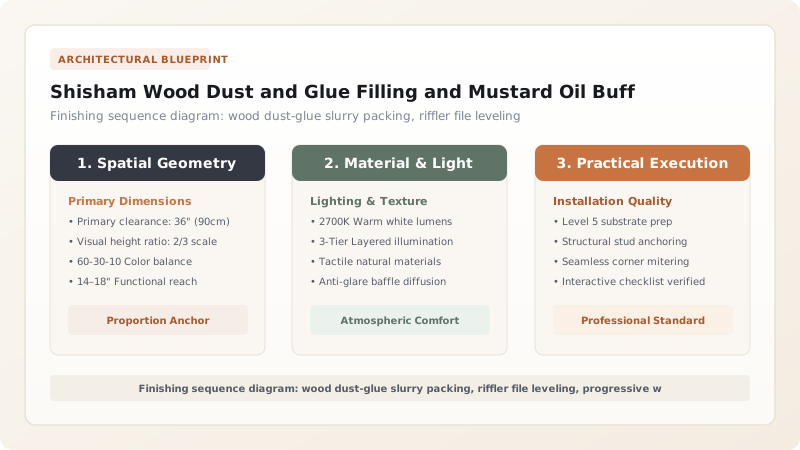
Surface Imperfections: The Necessity of Slurry Filling
Even when executed by the most accomplished master tarkash, the mechanical embedding of hundreds of meters of brass ribbon wire leaves unavoidable micro-discontinuities. Where the chisel penetrated slightly wider than the 0.5 mm wire, or where complex curves forced the wood grain to yield, microscopic voids and hairline fissures flank the embedded metal. If left unaddressed, these crevices would collect dirt, harbor moisture, and create visual shadows that detract from the crisp definition of the metallic filigree.
To achieve seamless integration between timber and metal, traditional workshops employ a time-honored technique: slurry filling. Crucially, artisans never use commercial plastic wood fillers, modern spackle, or epoxy putty, which shrink, turn chalky, and develop unsightly halos. Instead, they produce a customized filler using ultra-fine sanding dust harvested from the exact same sheesham plank during initial thicknessing. This dust retains the natural pigments, resins, and cellular structure of the timber, ensuring an imperceptible, organic color and texture match.
Natural Binders: Animal Hide Glue and Babool Gum
The binding vehicle for the wood dust must possess high adhesive strength, dimensional stability upon curing, and complete historical reversibility. Craftsmen turn to two traditional natural adhesives: animal hide glue (prepared by simmering purified cattle collagen) or natural babool gum (harvested from the sap of Acacia arabica trees).
The binder is dissolved in hot water to a light syrup consistency and blended with the sheesham dust on a marble slab using a flexible palette knife until it forms a smooth, rich, dark chocolate paste. The craftsman rubs this warm slurry vigorously across the entire surface using a pad of stiff vegetable-tanned leather, forcing the paste deep into every microscopic channel margin. As the water evaporates, the protein or polysaccharide chains contract, drawing the fine wood particles tightly against the vertical brass ribbon flanks and permanently bonding with the surrounding heartwood.
Leveling Mechanics: Hand Rifflers (Reti) and Cabinet Scrapers
Once the filler has cured for twenty-four hours into a stone-like density, the surface presents a rough, irregular topography with wire ribbons projecting slightly above the glue-caked wood. Leveling this composite surface of hard brass and dense hardwood requires exceptional tactile sensitivity. Power belt sanders are strictly forbidden; the violent heat generated by high-speed sanding belts would melt the glue, smear hot brass across wood pores, and dish out the softer wood between metal lines.
The artisan levels the surface manually using specialized reti—hand-cut curved riffler files forged with fine bastard teeth. Working at an oblique 45-degree angle across the wire lines, the file cleanly shears away protruding brass ribbons without catching or lifting wire ends. Once the metal is brought nearly flush, the craftsman transitions to a burnished rectangular cabinet scraper. Flexed between thumbs and drawn toward the body, the scraper removes microscopic file scratches and shaves wood and brass simultaneously into a single, perfectly flat optical plane.
The Alchemy of Mustard Oil and Agate Stone Burnishing
The crowning glory of Tarkashi is its natural finish, which rejects modern synthetic lacquers and polyurethanes entirely. Modern plastic coatings form cold, impermeable films that yellow with age, peel off metallic ribbons, and prevent the wood from breathing. Instead, Indian masters rely on the synergy of cold-pressed mustard oil (sarson ka tel) and stone burnishing.
Mustard oil is massaged sparingly across the surface with soft wool flannel. Its natural lipids and antioxidants penetrate deep into the sheesham heartwood, enriching its dark purple and golden-brown tones while establishing a natural barrier against moisture and wood-boring insects. The craftsman then takes an oval, mirror-polished cabochon of natural banded agate stone or jade. With heavy, deliberate hand pressure, he burnishes the oiled surface in tight overlapping circles. The intense friction generates localized warmth that drives the oil deep into cellular lumens and plastically compresses the surface wood fibers and ductile brass wire. The result is a breathtaking, mirror-smooth satin finish that celebrates the timeless harmony of Indian metal and wood.
Tarkashi Finishing Regimen: Traditional vs. Modern Methods
Use this reference table to calculate exact physical dimensions, ratios, and specifications before purchasing:
| Process Step | Traditional Guild Method | Modern Commercial Shortcut | Visual & Tactile Result | Long-Term Durability |
|---|---|---|---|---|
| Crevice Filling | Sheesham dust + animal hide glue | Commercial epoxy / polyester paste | Invisible dark color match vs. cloudy grey halos | Decades of stability vs. brittle filler crumbling |
| Wire Leveling | Hand riffler file (reti) + scrapers | High-speed belt sander | Preserves crisp metal edges vs. rounded wire heads | Zero grain gouging vs. severe wood dish-out |
| Surface Sanding | Water-lubricated wet-sanding (to 600g) | Dry orbital power sanding (180g) | Glass-smooth tactile feel vs. visible swirl scratches | Zero dust clogging vs. clogged wood pores |
| Final Finishing | Raw mustard oil + agate burnishing | Sprayed polyurethane / melamine coat | Deep organic warmth, silky touch vs. cold plastic sheen | Never peels, easily renewed vs. micro-cracking and flaking |
Practical Constraints
Every successful decoration project must account for physical and environmental constraints:
Cross-contamination of dark wood dust slurry onto polished yellow brass ribbons
Glue-bound wood dust can bake onto the metallic face, dulling its specular golden brightness. Mitigation: Scrape and file thoroughly during the rough leveling stage to expose virgin metallic brass before oil burnishing.
Strong distinctive aroma and slow drying time of cold-pressed raw mustard oil
Excessive oil application leaves a sticky surface that attracts environmental dust and takes days to cure. Mitigation: Apply oil in micro-thin layers, buffing aggressively with flannel cloth until the surface feels completely dry to touch.
Execution Blueprint & Craftsmanship Sequence
Execute this professional sequence to achieve flawless results without backtracking:
Dust Collection and Glue Preparation
Collect fine sanding dust generated during the initial leveling of the sheesham heartwood plank. Dissolve granules of high-clarity animal hide glue or natural babool tree gum in warm water to form a strong adhesive liquid.
Formulating and Applying the Slurry
Blend the sheesham dust and warm glue into a thick, uniform paste. Using a stiff leather pad or palette knife, work the slurry vigorously across the inlaid surface, packing it into all microscopic voids along wire channels.
Curing and Matrix Hardening
Allow the filled panel to dry undisturbed in a shaded, warm room for 24 hours. As the moisture evaporates, the protein glue contracts, pulling the wood dust tightly against the brass ribbon flanks.
Flush Filing with Hand Rifflers (Reti)
Select curved, hand-cut riffler files (reti). Holding the file with both hands, draw it across the inlaid surface at a 45-degree angle to the wire orientation, shaving away projecting metal ribbons until flush with the timber.
Cabinet Scraping for Planar Harmony
Draw a freshly burnished rectangular cabinet scraper across the surface. The scraper removes residual file marks, eliminates surface glue films, and planes wood and metal into an unbroken, level optical field.
Progressive Wet Sanding
Dip fine silicon carbide abrasive paper (320, 400, and 600 grit) into water. Sand the surface in gentle circular motions, washing away swarf with a sponge. The water lubricates the cut and prevents brass particles from embedding in wood pores.
Mustard Oil Application and Conditioning
Allow the washed timber to dry thoroughly. Pour a few drops of pure cold-pressed mustard oil (sarson ka tel) onto a clean wool flannel rag. Rub the oil into the wood in overlapping circular motions, allowing the lipids to penetrate the grain.
Agate Stone Friction Burnishing
Take a smooth, rounded cabochon of natural agate or jade. With firm, heavy pressure, stroke the stone back and forth across the oiled surface. The friction heat compresses surface fibers, drives oil deep into cells, and polishes the brass to a gleaming mirror.
Common Mistakes & Countermeasures
Avoid these costly errors that compromise aesthetics, ergonomics, and budget:
Using commercial synthetic plastic wood filler or pale sawdust from pine or mango wood
Applying modern high-gloss polyurethane varnish or nitrocellulose lacquer over Tarkashi
Project Execution Checklist
Track your physical progress. Checkboxes persist automatically on this device:
Frequently Asked Questions
Why is cold-pressed mustard oil specifically preferred over linseed or walnut oil?
In the craft traditions of Rajasthan and Uttar Pradesh, mustard oil (sarson ka tel) is ubiquitous, inexpensive, and possessed of unique chemical attributes. It contains natural sulfur compounds and erucic acid that act as mild natural fungicides and insect repellents, protecting the wood against termites and wood-boring beetles. Furthermore, its warm golden-yellow color accentuates the rich purplish-brown tones of sheesham and prevents brass from oxidizing.
How does stone burnishing with agate improve the finished surface?
Unlike sandpaper—which works by scratching and removing material—agate stone burnishing is a compressive process. The smooth, non-porous agate exerts intense localized pressure that collapses open wood tracheids, flattens microscopic wood fibers, and polishes the ductile brass ribbon through plastic friction deformation, yielding a silky, glass-smooth sheen that no chemical finish can mimic.
How should an owner care for and clean an antique Tarkashi wooden artifact?
Antique Tarkashi should never be cleaned with water, alcohol, or commercial aerosol furniture sprays. Dust the piece regularly with a dry, soft microfiber cloth or camel-hair brush. Once a year, apply a tiny pea-sized drop of pure mustard oil or high-grade beeswax paste to a flannel cloth, buff gently along the grain, and immediately dry-buff with a clean cloth.