
Hand-painting Jaipur Blue Pottery is an exacting fine-art tradition combining high-temperature mineral oxide chemistry with classical Mughal and Rajput artistic motifs. Working with handmade squirrel-tail brushes on raw, absorbent quartz-biscuit grounds, master painters execute freehand Persian arabesques (Islimi), lotuses, and geometric borders. The colors are synthesized from pure mineral oxides: copper oxide creates luminous translucent turquoise (Firozi) in an alkaline glaze matrix, while cobalt oxide produces deep, royal indigo blues.
At a Glance: Key Takeaways
- Brushwork Tooling: Handmade fine-point brushes crafted from squirrel tail hair (Gilhari)
- Motif Vocabulary: Persian Islimi vines, Mughal rosettes, cypress trees, dancing peacocks
- Royal Blue Pigment: Pulverized Cobalt Oxide (CoO) / cobalt aluminate spinel
- Turquoise Pigment: Pulverized Copper Oxide (CuO / CuCO3) in alkaline borax flux
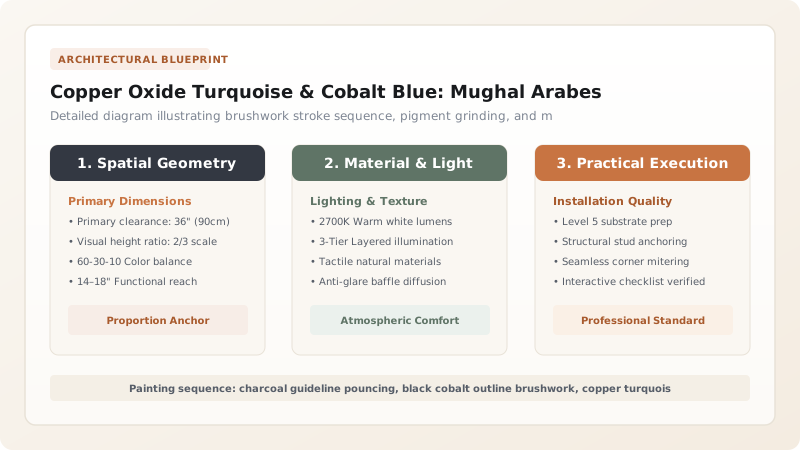
Inorganic Pigment Chemistry: Copper Turquoise and Cobalt Blues
In conventional painting, artists use organic dyes that would instantly vaporize and burn away at kiln temperatures. Jaipur Blue Pottery relies on transition metal oxides that survive 850°C heat, fusing directly into the glass glaze structure.
The signature color—Turquoise Blue (Firozi)—is derived from Copper Oxide (CuO) or copper carbonate. Crucially, copper produces turquoise only in an alkaline, silica-rich glaze matrix; in a lead or acidic glaze, copper fires to a leaf green. The deep Royal Blue (Surmai or Neel) is created using Cobalt Oxide (CoO). Cobalt is an exceptionally powerful colorant: even a 0.5% concentration yields an intense, luminous indigo that never fades or discolors under solar ultraviolet exposure.
Artisanal Tooling: Squirrel-Tail Brushes and Ink Formulation
Executing hairline geometric borders and delicate floral petals on unglazed, porous quartz biscuits requires specialized brushes. Commercial synthetic brushes are too stiff and hold insufficient liquid. Master painters make their own brushes using hairs harvested from the tails of local palm squirrels (Funambulus palmarum, Tamil/Hindi: Gilhari).
Squirrel hairs possess an ultra-fine natural tip and high capillary fluid retention. The hairs are bound with silk thread and inserted into pigeon or duck feather quills. The pigment powders are ground with water and a few drops of gum arabic on a granite slab until perfectly colloidal. The painter holds the brush vertically between thumb and index finger, resting the wrist on a wooden bridge stick (Mahldand) to float the brush tip smoothly across the absorbent tile surface without smudging.
Iconographic Vocabulary: Islimi Arabesques, Palmettes, and Peacocks
The decorative grammar of Jaipur Blue Pottery represents a sophisticated synthesis of Islamic geometric order and Hindu devotional nature. The layout of an architectural tile begins with a central focal medallion (Toranj) framed by four corner quadrants (Lachak).
Connecting these elements are continuous, undulating Islimi vine scrolls—spiraling vegetal tendrils that symbolize the infinite, continuous flow of divine life. Within the vines, painters detail Mughal palmettes, blooming Kaveri lotuses, marigolds, and stylized cypress trees (symbolizing eternity). For secular architectural panels, painters incorporate royal Rajasthani fauna: regal elephants with floral saddle cloths and majestic dancing peacocks whose plumage mirrors the cobalt and turquoise palette of the ceramic glaze.
Painting Sequence: The Magic of Post-Firing Color Transformation
Painting a Blue Pottery tile is a counter-intuitive exercise in visualization. The raw mineral oxides on the unfired tile look completely different from the finished work: cobalt oxide appears as a dull, matte greyish-black powder, while copper oxide appears as a dark brownish-green wash.
The artisan first paints the fine outlines (Tahrir) using dark cobalt ink. Once the outlines dry, the inner petals and background fields are filled with dilute copper washes (Rang-bhari). The painter must gauge pigment saturation purely by eye and brush resistance. When the tile is glazed and fired to 850°C, the dull grey and brown powders undergo a miraculous chemical transformation: melting into the glass, the cobalt blooms into vibrant royal blue, and the copper flashes into radiant, glowing Mediterranean turquoise.
Jaipur Blue Pottery Mineral Pigments & Firing Transformation
Use this reference table to calculate exact physical dimensions, ratios, and specifications before purchasing:
| Pigment Name | Chemical Composition | Unfired Color on Biscuit | Fired Color in Alkaline Glaze | Artisanal Application |
|---|---|---|---|---|
| Cobalt Blue (Neel) | Cobalt Oxide (CoO) | Dull charcoal greyish-black | Deep royal indigo / navy blue | Primary outline contours (Tahrir) and dark floral shading |
| Turquoise (Firozi) | Copper Oxide (CuO) | Dirty greenish-brown wash | Luminous transparent aqua / turquoise | Background field washes and main petal fills |
| Saffron Yellow (Pila) | Lead Chromate / Antimony oxide | Pale chalky mustard yellow | Vibrant sunshine / golden yellow | Flower stamens, border borders, fruit highlights |
| Forest Green (Hara) | Copper oxide + Chromic oxide | Muted olive-grey wash | Rich emerald / forest green | Foliage leaves, vine stems, bird feathers |
| Manganese Black | Manganese Dioxide (MnO2) | Matte purplish-brown | Crisp velvety jet black | Fine geometric boundaries and eye pupils |
Practical Constraints
Every successful decoration project must account for physical and environmental constraints:
Extreme Absorbency of Raw Quartz Greenware Substrates
The dry quartz biscuit acts like dry chalk; once a brushstroke touches the surface, moisture is sucked in instantly, preventing corrections. Mitigation: Mist the tile surface lightly with pure water before painting to slow absorption and train painters to execute fluid, confident one-pass strokes.
Scarcity of Certified Natural Squirrel-Hair Brush Artisans
Wildlife protection laws in India strictly protect palm squirrels, making commercial trade in squirrel-hair brushes legally restricted. Mitigation: Utilize certified heritage master collections or switch to modern engineered ultra-fine synthetic micro-filaments (Kolinsky mimics).
High Cost of Pure Cobalt and Antimony Mineral Oxides
Refined cobalt oxide is expensive and subject to global market volatility, tempting commercial workshops to use cheap synthetic dyes. Mitigation: Maintain dedicated cooperative bulk purchasing of certified ceramic-grade metal oxides for regional artisan clusters.
Execution Blueprint & Craftsmanship Sequence
Execute this professional sequence to achieve flawless results without backtracking:
Mulling Mineral Oxides on a Granite Slab
Grind pure cobalt and copper oxide powders with distilled water and Arabic gum solution using a heavy glass muller until particles achieve sub-micron suspension.
Transferring Master Motifs via Charcoal Pouncing
Prick pinholes along the outlines of a master paper cartoon. Lay over the dry white tile and tap with charcoal dust (Khadiya) to transfer reference dots.
Painting Fine Structural Outlines (Tahrir)
Dip a fine squirrel-tail brush into concentrated cobalt ink. Draw continuous, confident outline contours of vines, petals, and cartouches with uniform line width.
Color Washing Infill Fields (Rang-Bhari)
Dilute copper oxide wash with water. Fill the background fields and petal bodies using broader squirrel-hair wash brushes, maintaining smooth, puddle-free coverage.
Adding Accent Details and Saffron Yellow Highlights
Paint flower stamens and border beads using antimony yellow and chromium green mineral inks, ensuring colors do not bleed into wet adjacent washes.
Inspecting Painted Greenware Under Magnification
Inspect the painted tile for smudge marks or hairline brush slips, cleaning unwanted pigment specks with a damp pointed bamboo stylus before glazing.
Common Mistakes & Countermeasures
Avoid these costly errors that compromise aesthetics, ergonomics, and budget:
Applying Copper Oxide Wash Too Thickly on Petals
Using Commercial Synthetic Bristle Brushes for Outlining
Touching the Raw Painted Biscuit with Sweaty Fingers
Project Execution Checklist
Track your physical progress. Checkboxes persist automatically on this device:
Frequently Asked Questions
Why do the colors look dull grey and brown before firing?
Mineral oxides like cobalt and copper are unreacted metal powders in their raw state. Cobalt looks like charcoal dust, and copper looks like olive-green mud. It is only during the 850°C firing, when the glass glaze melts around them, that they oxidize and chemically bond with silica, blooming into brilliant blue and turquoise.
Why are squirrel-hair brushes preferred for Blue Pottery?
Squirrel tail hairs are extraordinarily soft, have a natural microscopic wave that holds a large reservoir of liquid mineral ink, and come to an ultra-sharp point that allows the painter to draw hair-thin lines across porous quartz without skipping or dragging.
Will the hand-painted colors fade over time in the sun?
Never. Unlike modern organic paints or screen-printed inks that break down under UV sunlight, Jaipur Blue Pottery colors are pure mineral oxides fused permanently inside a vitrified glass matrix. They will retain their original brilliance for hundreds of years.
What is an 'Islimi' motif?
Islimi is a classical Persian decorative arabesque motif featuring continuous, spiraling vegetal vines decorated with leaves, buds, and stylized flowers, symbolizing eternal life and divine cosmic rhythm.


